British literature:
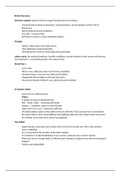
Victorian england: Queen Victoria; longest female monarch in history.
- Characterised by times of expansion, industrialisation, social problems and the rise of
democracy.
- Bad working and social conditions
- Farm life -> industrial life.
- Rich factory owners vs poor industrial workers.
Changes:
- politics; labour party and trade unions.
- Class distinction stayed important.
- Developments in science, technology and psychology.
Labour party: the industrial workers; horrible conditions, protest united in trade unions and became
more powerful -> new political party; The Labour Party.
World War I:
- 1915-1918.
- Men to men, alliances, power and money, patriotism.
- Greatest impact a war has had, affected all nations
- changed the life of millions and took many lives.
- Many were injured of killed in war. (physically and mentally)
In Flanders fields:
- John McCrea, military doctor.
- Poppy:
A poppy can grow in disturbed land
Red – blood , black – mourning and death
Papaver – morphine, opium to ease the pain.
Heart, form of a cross – symbol for suffering.
- The dead soldiers speak to the soldiers who are still alive. They say they have to remember
the dead soldiers and to keep fighting. Keep fighting otherwise their death would have been
for nothing. Some parts were used as propaganda.
The soldier:
- Rupert Brooke, educated man, written when the first ww broke out (1914, still a positive
view on fighting)
- It’s a memorial for the sacrifice of the fallen soldiers.
- It’s intention is to glorify fighting for your country. Dying for your country is good.
- When you die in a foreign field, it’s like that part belongs to England since the man belongs to
England.
- Positive and nationalistic.
, Dulce and Decorum
- Wilfred Owen, sent to war, had intense personal experiences as a soldier.
- It describes a mustard gas attack followed by a retreat from the battlefield. The gruesome
effects are shown.
- It criticizes the praising of war.
- Title is ironic. ‘it is sweet and fitting’ how sweet and fitting it is to die for your country.
- Horrific imagery
- To make the reader feel the weariness, the pain and the burden.
A Lady Chatterley’s Lover:
David Herbert Lawrence:
- father was a miner, he is a pacifist (fought for peace), travelled constantly, more of a
prophet than an artist.
- His novels reflects the English society (middle/upper class)
and his thoughts on sexuality n(suppressed sexuality, clearly described sexual scenes)
- His writing is vivid/alive, uneven, incredible plots and a search of spontaneity/instinct.
The book:
- Book was banned for obscenity, not his best book; characters are stereotypes / incoherent
- Clifford Chattery (upper) is paralyzed (war), his wife has an affair with Oliver Mellors
(working) and gets pregnant. (Clifford emotionally neglects Connie)
- Set in the industrial midlands after world war 1, industrialization threatening nature
- Mechanisation of the world + corrosion of relationships?
- Honest descriptions of sexual relations (because it is the strongest natural umpulse)
Themes:
- Head vs heart: upper class vs lower class, Clifford vs Oliver, mechanisation vs natural.
Between Connie vs Clifford and Oliver vs Bertha.
- Social classes: the contrasts that result in unfair dominance of the upper class.
- Setting: Wragby hall; mining town, landscape
- away from Clifford (empty and impotent) towards Oliver (alive)
- away from greed and class systems towards a life where mind and body are equal.
Characters:
- Connie Reid (lady Chatterley): Cultured upper-class, development as a women, introduced to
love affairs as teenager
- Clifford Chatterley: paralyzed and impotent because of war, successful writer and
businessman, not truly interested in love
- Oliver Mellors: game keeper, sarcastic and intelligent, noble, working class
Victorian england: Queen Victoria; longest female monarch in history.
- Characterised by times of expansion, industrialisation, social problems and the rise of
democracy.
- Bad working and social conditions
- Farm life -> industrial life.
- Rich factory owners vs poor industrial workers.
Changes:
- politics; labour party and trade unions.
- Class distinction stayed important.
- Developments in science, technology and psychology.
Labour party: the industrial workers; horrible conditions, protest united in trade unions and became
more powerful -> new political party; The Labour Party.
World War I:
- 1915-1918.
- Men to men, alliances, power and money, patriotism.
- Greatest impact a war has had, affected all nations
- changed the life of millions and took many lives.
- Many were injured of killed in war. (physically and mentally)
In Flanders fields:
- John McCrea, military doctor.
- Poppy:
A poppy can grow in disturbed land
Red – blood , black – mourning and death
Papaver – morphine, opium to ease the pain.
Heart, form of a cross – symbol for suffering.
- The dead soldiers speak to the soldiers who are still alive. They say they have to remember
the dead soldiers and to keep fighting. Keep fighting otherwise their death would have been
for nothing. Some parts were used as propaganda.
The soldier:
- Rupert Brooke, educated man, written when the first ww broke out (1914, still a positive
view on fighting)
- It’s a memorial for the sacrifice of the fallen soldiers.
- It’s intention is to glorify fighting for your country. Dying for your country is good.
- When you die in a foreign field, it’s like that part belongs to England since the man belongs to
England.
- Positive and nationalistic.
, Dulce and Decorum
- Wilfred Owen, sent to war, had intense personal experiences as a soldier.
- It describes a mustard gas attack followed by a retreat from the battlefield. The gruesome
effects are shown.
- It criticizes the praising of war.
- Title is ironic. ‘it is sweet and fitting’ how sweet and fitting it is to die for your country.
- Horrific imagery
- To make the reader feel the weariness, the pain and the burden.
A Lady Chatterley’s Lover:
David Herbert Lawrence:
- father was a miner, he is a pacifist (fought for peace), travelled constantly, more of a
prophet than an artist.
- His novels reflects the English society (middle/upper class)
and his thoughts on sexuality n(suppressed sexuality, clearly described sexual scenes)
- His writing is vivid/alive, uneven, incredible plots and a search of spontaneity/instinct.
The book:
- Book was banned for obscenity, not his best book; characters are stereotypes / incoherent
- Clifford Chattery (upper) is paralyzed (war), his wife has an affair with Oliver Mellors
(working) and gets pregnant. (Clifford emotionally neglects Connie)
- Set in the industrial midlands after world war 1, industrialization threatening nature
- Mechanisation of the world + corrosion of relationships?
- Honest descriptions of sexual relations (because it is the strongest natural umpulse)
Themes:
- Head vs heart: upper class vs lower class, Clifford vs Oliver, mechanisation vs natural.
Between Connie vs Clifford and Oliver vs Bertha.
- Social classes: the contrasts that result in unfair dominance of the upper class.
- Setting: Wragby hall; mining town, landscape
- away from Clifford (empty and impotent) towards Oliver (alive)
- away from greed and class systems towards a life where mind and body are equal.
Characters:
- Connie Reid (lady Chatterley): Cultured upper-class, development as a women, introduced to
love affairs as teenager
- Clifford Chatterley: paralyzed and impotent because of war, successful writer and
businessman, not truly interested in love
- Oliver Mellors: game keeper, sarcastic and intelligent, noble, working class