

100% satisfaction guarantee Immediately available after payment Both online and in PDF No strings attached 4.2 TrustPilot
logo-home
Exam (elaborations)

Campbell biology chapter 40 Exam Questions With All Correct Answers A+ Pass

Rating
-
Sold
-
Pages
3
Grade
A+
Uploaded on
02-11-2025
Written in
2025/2026

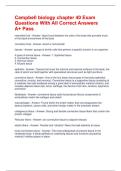
Campbell biology chapter 40 Exam Questions With All Correct Answers A+ Pass interstitial fluid - Answer- liquid found between the cells of the body that provides much of the liquid environment of the body circulatory fluid - Answer- blood or hemolymph tissues - Answer- groups of similar cells that perform a specific function in an organism 4 types of animal tissue - Answer- 1. Epithelial tissue 2. Connective tissue 3. Nervous tissue 4. Muscle tissue epithelia - Answer- Tissues that cover the internal and external surfaces of the body, the cells of which are held together with specialized structures such as tight junctions. connective tissue - Answer- One of the four basic tissue types in the body (epithelial, connective, muscle, and nervous). Connective tissue is a supportive tissue consisting of a relatively few cells scattered among a great deal of extracellular material (matrix), and includes adipose tissue (fat), bone, cartilage, the dermis of teh skin, tendons, ligaments, and blood. fibroblasts - Answer- connective tissue cells that produce fibrous components of extracellular matrix like collagen and elastin macrophages - Answer- Found within the lymph nodes, they are phagocytes that destroy bacteria, cancer cells, and other foreign matter in the lymphatic stream. collagenous fibers - Answer- Strong and flexible connective tissue fibers that contain the protein collagen Reticular fibers - Answer- join connective tissue to adjacent tissues elastic fibers - Answer- Flexible and "stretchy" fibers that add elasticity to tissue loose connective tissue - Answer- The most widespread connective tissue in the vertebrate body. It binds epithelia to underlying tissues and functions as packing material, holding organs in place. Fibrous connective tissue - Answer- A dense tissue with large numbers of collagenous fibers organized into parallel bundles. This is the dominant tissue in tendons and ligaments. bone - Answer- rigid connective tissue that makes up the skeleton of vertebrates adipose tissue - Answer- a kind of body tissue containing stored fat that serves as a source of energy cartilage - Answer- strong connective tissue that supports the body and is softer and more flexible than bone Muscle tissue - Answer- Tissue consisting of long muscle cells that are capable of contracting when stimulated by nerve impulses. Three types skeletal, cardiac, and smooth. nervous tissue - Answer- A body tissue that carries electrical messages back and forth between the brain and every other part of the body. neurons - Answer- Individual cells in the nervous system that receive, integrate, and transmit information. Glia - Answer- cells that support, nurture, and insulate neurons, remove debris when neurons die, enhance the formation and maintenance of neural connections, and modify neuronal functioning Hormones - Answer- chemical messengers, mostly those manufactured by the endocrine glands, that are produced in one tissue and affect another regulator - Answer- an animal for which mechanisms of homeostasis moderate internal changes in the face of external fluctuations conformer - Answer- organisms that do not regulate their internal conditions; they change as their external environment changes homeostasis - Answer- metabolic equilibrium actively maintained by several complex biological mechanisms that operate via the autonomic nervous system to offset disrupting changes set point - Answer- tells what a particular value should be negative feedback - Answer- a mechanism of response in which a stimulus initiates reactions that reduce the stimulus positive feedback - Answer- A physiological control mechanism in which a change in some variable triggers mechanisms that amplify the change.

Show more Read less
Institution
Campbell Biology Chapter 40
Course
Campbell biology chapter 40


Whoops! We can’t load your doc right now. Try again or contact support.

Written for

Institution
Campbell biology chapter 40
Course
Campbell biology chapter 40

Document information

Uploaded on
November 2, 2025
Number of pages
3
Written in
2025/2026
Type
Exam (elaborations)
Contains
Questions & answers

Subjects

  • a pass

Content preview

Campbell biology chapter 40 Exam
Questions With All Correct Answers
A+ Pass
interstitial fluid - Answer- liquid found between the cells of the body that provides much
of the liquid environment of the body

circulatory fluid - Answer- blood or hemolymph

tissues - Answer- groups of similar cells that perform a specific function in an organism

4 types of animal tissue - Answer- 1. Epithelial tissue
2. Connective tissue
3. Nervous tissue
4. Muscle tissue

epithelia - Answer- Tissues that cover the internal and external surfaces of the body, the
cells of which are held together with specialized structures such as tight junctions.

connective tissue - Answer- One of the four basic tissue types in the body (epithelial,
connective, muscle, and nervous). Connective tissue is a supportive tissue consisting of
a relatively few cells scattered among a great deal of extracellular material (matrix), and
includes adipose tissue (fat), bone, cartilage, the dermis of teh skin, tendons, ligaments,
and blood.

fibroblasts - Answer- connective tissue cells that produce fibrous components of
extracellular matrix like collagen and elastin

macrophages - Answer- Found within the lymph nodes, they are phagocytes that
destroy bacteria, cancer cells, and other foreign matter in the lymphatic stream.

collagenous fibers - Answer- Strong and flexible connective tissue fibers that contain the
protein collagen

Reticular fibers - Answer- join connective tissue to adjacent tissues

elastic fibers - Answer- Flexible and "stretchy" fibers that add elasticity to tissue

loose connective tissue - Answer- The most widespread connective tissue in the
vertebrate body. It binds epithelia to underlying tissues and functions as packing
material, holding organs in place.


Get to know the seller

Seller avatar
Reputation scores are based on the amount of documents a seller has sold for a fee and the reviews they have received for those documents. There are three levels: Bronze, Silver and Gold. The better the reputation, the more your can rely on the quality of the sellers work.
Stuviaascorers University of Washington
View profile
Follow You need to be logged in order to follow users or courses
Sold
338
Member since
2 year
Number of followers
185
Documents
9991
Last sold
4 days ago
StuviaAscorers | Top Study Notes & Exam Solutions

Stuviaascorers – Your #1 Source for Top-Quality Study Materials! Struggling with exams? Stuviaascorers has got you covered! I provide expertly crafted study notes, summaries, past papers, and exam-ready answers to help you pass with flying colors. My materials are designed for clarity, accuracy, and success—so you can study smarter, not harder! Why Choose My Study Materials? Well-structured & easy to understand – No fluff, just what you need! Exam-focused & high-scoring content – Get straight to the point! Accurate answers & clear explanations – Learn with confidence! Save time & boost your grades – Study efficiently! Don’t leave your success to chance! Browse my documents and start acing your exams today!

Read more Read less
3.8

61 reviews

5
29
4
11
3
10
2
1
1
10

Recently viewed by you

Why students choose Stuvia

Created by fellow students, verified by reviews

Quality you can trust: written by students who passed their tests and reviewed by others who've used these notes.

Didn't get what you expected? Choose another document

No worries! You can instantly pick a different document that better fits what you're looking for.

Pay as you like, start learning right away

No subscription, no commitments. Pay the way you're used to via credit card and download your PDF document instantly.

Student with book image

“Bought, downloaded, and aced it. It really can be that simple.”

Alisha Student

Frequently asked questions
