

100% satisfaction guarantee Immediately available after payment Both online and in PDF No strings attached 4.2 TrustPilot
logo-home
Exam (elaborations)

CAMPBELL BIOLOGY CHAPTER 14 EXAM QUESTIONS AND ANSWERS

Rating
-
Sold
-
Pages
3
Grade
A+
Uploaded on
02-11-2025
Written in
2025/2026

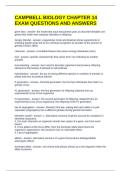
CAMPBELL BIOLOGY CHAPTER 14 EXAM QUESTIONS AND ANSWERS gene idea - answer- the model that says that parents pass on discrete heritable unit-genes-that retain their separate identities in offspring Gregor Mendel - answer- Augustinian monk and botanist whose experiments in breeding garden peas led to his eventual recognition as founder of the science of genetics () character - answer- a heritable feature that varies among individuals (color) trait - answer- specific characteristic that varies from one individual to another (purple) true-breeding - answer- term used to describe organisms that produce offspring identical to themselves if allowed to self-pollinate hybridization - answer- the act of mixing different species or varieties of animals or plants and thus to produce hybrids P generation - answer- Parental generation, the first two individuals that mate in a genetic cross. F1 generation - answer- the first generation of offspring obtained from an experimental cross of two organisms F2 generation - answer- the second generation of offspring, obtained from an experimental cross of two organisms; the offspring of the F1 generation law of segregation - answer- Mendel's first law, stating that each allele in a pair separates (segregates) into a different gamete during gamete formation. Mendel's model - answer- 1. Alternative versions of genes account for variations in inherited characters. 2. For each character an organism inherits two copies of a gene, one from each parent. 3. If two alleles at the locus differ, then the dominant allele determines the organism's appearance, the recessive has no noticeable effect. 4. Law of segregation alleles - answer- alternative versions of a gene that produce distinguishable phenotypic effects dominant allele - answer- one whose trait always shows up in the organism when the allele is present recessive allele - answer- an allele that has no noticeable effect on the phenotype of a gene when the individual is heterozygous for that gene. Punnett square - answer- a chart that shows all the possible combinations of alleles that can result from a genetic cross homozygous - answer- term used to refer to an organism that has two identical alleles for a particular trait heterozygous - answer- an organism that has two different alleles for a trait phenotype - answer- The physical traits that appear in an individual as a result of its gentic make up. genotype - answer- the genetic makeup, or set of alleles, of an organism testcross - answer- the crossing of an individual of unknown genotype with a homozygous recessive individual to determine the unknown genotype monohybrid - answer- genetic cross that involves one trait monohybrid cross - answer- mating of two organisms that differ in only one character dihybrid - answer- Crosses between individuals that differ in two traits dihybrid cross - answer- A cross in which two characteristics are tracked. law of independent assortment - answer- each pair of alleles segregates independently of each other pair of alleles during gamete formation multiplication rule - answer- to determine the probability, we multiply the probability of one event by the probability of another addition rule - answer- A rule of probability stating that the probability of any one of two or more mutually exclusive events occurring can be determined by adding their individual probabilities. complete dominance - answer- A type of inheritance in which the phenotypes of the heterozygote and dominant homozygote are indistinguishable. incomplete dominance - answer- production of a phenotype that is intermediate between the two homozygous parents codominance - answer- A phenotypic situation in which the two alleles affect the phenotype in separate, distinguishable ways Tay-Sacks disease - answer- A human genetic disease caused by a recessive allele for a dysfunctional enzyme, leading to accumulation of certain lipids in the brain. Seizures, blindness, and degeneration of motor and mental performance usually become manifest a few months after birth, followed by death within a few years.

Show more Read less
Institution
CAMPBELL BIOLOGY CHAPTER 14
Course
CAMPBELL BIOLOGY CHAPTER 14


Whoops! We can’t load your doc right now. Try again or contact support.

Written for

Institution
CAMPBELL BIOLOGY CHAPTER 14
Course
CAMPBELL BIOLOGY CHAPTER 14

Document information

Uploaded on
November 2, 2025
Number of pages
3
Written in
2025/2026
Type
Exam (elaborations)
Contains
Questions & answers

Subjects

Content preview

CAMPBELL BIOLOGY CHAPTER 14
EXAM QUESTIONS AND ANSWERS
gene idea - answer- the model that says that parents pass on discrete heritable unit-
genes-that retain their separate identities in offspring

Gregor Mendel - answer- Augustinian monk and botanist whose experiments in
breeding garden peas led to his eventual recognition as founder of the science of
genetics (1822-1884)

character - answer- a heritable feature that varies among individuals (color)

trait - answer- specific characteristic that varies from one individual to another
(purple)

true-breeding - answer- term used to describe organisms that produce offspring
identical to themselves if allowed to self-pollinate

hybridization - answer- the act of mixing different species or varieties of animals or
plants and thus to produce hybrids

P generation - answer- Parental generation, the first two individuals that mate in a
genetic cross.

F1 generation - answer- the first generation of offspring obtained from an
experimental cross of two organisms

F2 generation - answer- the second generation of offspring, obtained from an
experimental cross of two organisms; the offspring of the F1 generation

law of segregation - answer- Mendel's first law, stating that each allele in a pair
separates (segregates) into a different gamete during gamete formation.

Mendel's model - answer- 1. Alternative versions of genes account for variations in
inherited characters.
2. For each character an organism inherits two copies of a gene, one from each
parent.
3. If two alleles at the locus differ, then the dominant allele determines the
organism's appearance, the recessive has no noticeable effect.
4. Law of segregation

alleles - answer- alternative versions of a gene that produce distinguishable
phenotypic effects

dominant allele - answer- one whose trait always shows up in the organism when the
allele is present


Get to know the seller

Seller avatar
Reputation scores are based on the amount of documents a seller has sold for a fee and the reviews they have received for those documents. There are three levels: Bronze, Silver and Gold. The better the reputation, the more your can rely on the quality of the sellers work.
Freshy Oxford University
View profile
Follow You need to be logged in order to follow users or courses
Sold
49
Member since
1 year
Number of followers
4
Documents
6784
Last sold
2 days ago

3.6

9 reviews

5
3
4
3
3
1
2
0
1
2

Why students choose Stuvia

Created by fellow students, verified by reviews

Quality you can trust: written by students who passed their tests and reviewed by others who've used these notes.

Didn't get what you expected? Choose another document

No worries! You can instantly pick a different document that better fits what you're looking for.

Pay as you like, start learning right away

No subscription, no commitments. Pay the way you're used to via credit card and download your PDF document instantly.

Student with book image

“Bought, downloaded, and aced it. It really can be that simple.”

Alisha Student

Frequently asked questions
