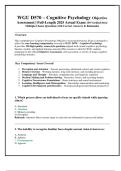
WGU D570 – Cognitive Psychology Objective
Assessment | Full-Length 2025 Actual Exam 150 Verified-Style
Multiple-Choice Questions with Correct Answers & Rationales
Overview
This comprehensive Cognitive Psychology Objective Assessment Practice Exam is designed to
reflect the core learning competencies assessed in WGU D570 – Cognitive Psychology.
It provides 150 high-quality, exam-style questions aligned with current cognitive psychology
theories, models, and applied learning outcomesThis resource is ideal for WGU students
preparing for the official Objective Assessment, self-assessment, or review of major cognitive
psychology domains.
Key Competency Areas Covered
1. Perception and Attention – Sensory processing, attentional control, and visual cognition
2. Memory Systems – Working memory, long-term memory, and encoding processes
3. Language and Thought – Structure, comprehension, and linguistic cognition
4. Decision Making and Problem Solving – Heuristics, biases, and reasoning models
5. Cognitive Neuroscience Foundations – Brain structures and neural mechanisms
6. Learning, Intelligence, and Metacognition – Knowledge representation and monitoring
7. Cognitive Development and Disorders – Neuropsychological and lifespan perspectives
1. Which process allows an individual to focus on specific stimuli while ignoring
others?
A. Sensation
B. Attention
C. Memory encoding
D. Perception
Rationale: Attention filters sensory input so only relevant information is processed further.
2. The inability to recognize familiar faces despite normal vision is known as:
A. Amnesia
B. Aphasia
C. Prosopagnosia
D. Agnosia
,Rationale: Prosopagnosia is a face recognition disorder often linked to damage in the fusiform
face area.
3. In the Atkinson–Shiffrin model, the first stage of memory processing is:
A. Working memory
B. Sensory memory
C. Long-term memory
D. Episodic memory
Rationale: Sensory memory briefly stores incoming information before it’s attended to and
encoded.
4. Which brain structure is most involved in forming new long-term memories?
A. Amygdala
B. Hippocampus
C. Cerebellum
D. Thalamus
Rationale: The hippocampus consolidates new declarative memories before transferring them to
long-term storage.
5. The Stroop task is primarily used to measure:
A. Memory recall
B. Cognitive control and selective attention
C. Visual acuity
D. Emotional regulation
Rationale: It assesses interference and the ability to suppress automatic responses.
6. Which of the following best illustrates top-down processing?
A. Seeing an image for the first time
B. Using prior knowledge to interpret ambiguous stimuli
C. Reacting to a loud noise automatically
D. Touching a hot stove
Rationale: Top-down processing relies on existing schemas and expectations.
,7. Short-term memory typically holds information for about:
A. 1 second
B. 15–30 seconds
C. 2 minutes
D. 5 minutes
Rationale: Without rehearsal, STM duration is about 20 seconds on average.
8. Which type of memory involves facts and general knowledge?
A. Procedural
B. Episodic
C. Semantic
D. Implicit
Rationale: Semantic memory stores factual and conceptual knowledge independent of context.
9. A student remembering the day she graduated college is an example of:
A. Semantic memory
B. Episodic memory
C. Procedural memory
D. Working memory
Rationale: Episodic memory stores autobiographical events tied to time and place.
10. The “phonological loop” is part of:
A. Long-term memory
B. Working memory
C. Sensory memory
D. Implicit memory
Rationale: The phonological loop temporarily holds verbal and auditory information for
rehearsal.
11. Which phenomenon explains better recall of the first and last items in a list?
A. Recency illusion
B. Serial position effect
C. Priming
, D. Encoding specificity
Rationale: The serial position effect combines primacy (first) and recency (last) recall
advantages.
12. Chunking improves short-term memory by:
A. Increasing item capacity
B. Grouping information into meaningful units
C. Repeating information faster
D. Linking to emotional cues
Rationale: Chunking increases efficiency by organizing data into familiar patterns.
13. Which type of attention is guided by external stimuli rather than goals?
A. Sustained attention
B. Bottom-up attention
C. Top-down attention
D. Divided attention
Rationale: Bottom-up attention is stimulus-driven, triggered by environmental changes.
14. The cognitive process of adjusting existing schemas when faced with new
information is:
A. Assimilation
B. Accommodation
C. Encoding
D. Retrieval
Rationale: Accommodation modifies mental frameworks to incorporate novel data.
15. The method of loci improves memory through:
A. Spatial visualization and imagery
B. Rote rehearsal
C. Semantic association only
D. Abstract reasoning
Rationale: It pairs items to remember with familiar spatial locations.
Assessment | Full-Length 2025 Actual Exam 150 Verified-Style
Multiple-Choice Questions with Correct Answers & Rationales
Overview
This comprehensive Cognitive Psychology Objective Assessment Practice Exam is designed to
reflect the core learning competencies assessed in WGU D570 – Cognitive Psychology.
It provides 150 high-quality, exam-style questions aligned with current cognitive psychology
theories, models, and applied learning outcomesThis resource is ideal for WGU students
preparing for the official Objective Assessment, self-assessment, or review of major cognitive
psychology domains.
Key Competency Areas Covered
1. Perception and Attention – Sensory processing, attentional control, and visual cognition
2. Memory Systems – Working memory, long-term memory, and encoding processes
3. Language and Thought – Structure, comprehension, and linguistic cognition
4. Decision Making and Problem Solving – Heuristics, biases, and reasoning models
5. Cognitive Neuroscience Foundations – Brain structures and neural mechanisms
6. Learning, Intelligence, and Metacognition – Knowledge representation and monitoring
7. Cognitive Development and Disorders – Neuropsychological and lifespan perspectives
1. Which process allows an individual to focus on specific stimuli while ignoring
others?
A. Sensation
B. Attention
C. Memory encoding
D. Perception
Rationale: Attention filters sensory input so only relevant information is processed further.
2. The inability to recognize familiar faces despite normal vision is known as:
A. Amnesia
B. Aphasia
C. Prosopagnosia
D. Agnosia
,Rationale: Prosopagnosia is a face recognition disorder often linked to damage in the fusiform
face area.
3. In the Atkinson–Shiffrin model, the first stage of memory processing is:
A. Working memory
B. Sensory memory
C. Long-term memory
D. Episodic memory
Rationale: Sensory memory briefly stores incoming information before it’s attended to and
encoded.
4. Which brain structure is most involved in forming new long-term memories?
A. Amygdala
B. Hippocampus
C. Cerebellum
D. Thalamus
Rationale: The hippocampus consolidates new declarative memories before transferring them to
long-term storage.
5. The Stroop task is primarily used to measure:
A. Memory recall
B. Cognitive control and selective attention
C. Visual acuity
D. Emotional regulation
Rationale: It assesses interference and the ability to suppress automatic responses.
6. Which of the following best illustrates top-down processing?
A. Seeing an image for the first time
B. Using prior knowledge to interpret ambiguous stimuli
C. Reacting to a loud noise automatically
D. Touching a hot stove
Rationale: Top-down processing relies on existing schemas and expectations.
,7. Short-term memory typically holds information for about:
A. 1 second
B. 15–30 seconds
C. 2 minutes
D. 5 minutes
Rationale: Without rehearsal, STM duration is about 20 seconds on average.
8. Which type of memory involves facts and general knowledge?
A. Procedural
B. Episodic
C. Semantic
D. Implicit
Rationale: Semantic memory stores factual and conceptual knowledge independent of context.
9. A student remembering the day she graduated college is an example of:
A. Semantic memory
B. Episodic memory
C. Procedural memory
D. Working memory
Rationale: Episodic memory stores autobiographical events tied to time and place.
10. The “phonological loop” is part of:
A. Long-term memory
B. Working memory
C. Sensory memory
D. Implicit memory
Rationale: The phonological loop temporarily holds verbal and auditory information for
rehearsal.
11. Which phenomenon explains better recall of the first and last items in a list?
A. Recency illusion
B. Serial position effect
C. Priming
, D. Encoding specificity
Rationale: The serial position effect combines primacy (first) and recency (last) recall
advantages.
12. Chunking improves short-term memory by:
A. Increasing item capacity
B. Grouping information into meaningful units
C. Repeating information faster
D. Linking to emotional cues
Rationale: Chunking increases efficiency by organizing data into familiar patterns.
13. Which type of attention is guided by external stimuli rather than goals?
A. Sustained attention
B. Bottom-up attention
C. Top-down attention
D. Divided attention
Rationale: Bottom-up attention is stimulus-driven, triggered by environmental changes.
14. The cognitive process of adjusting existing schemas when faced with new
information is:
A. Assimilation
B. Accommodation
C. Encoding
D. Retrieval
Rationale: Accommodation modifies mental frameworks to incorporate novel data.
15. The method of loci improves memory through:
A. Spatial visualization and imagery
B. Rote rehearsal
C. Semantic association only
D. Abstract reasoning
Rationale: It pairs items to remember with familiar spatial locations.