hemisphere level 3
Study online at https://quizlet.com/_ffq5fd
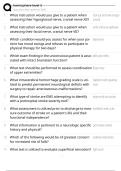
1. What instruction would you give to a patient when stick out and move tongue
assessing their hypoglossal nerve, cranial nerve XII? around
2. What instruction would you give to a patient when smile and raise eyebrows
assessing their facial nerve, cranial nerve VII?
3. Which condition would you assess for when your pa- depression
tient has mood swings and refuses to participate in
physical therapy for two days?
4. Which exam finding in the unconscious patient is asso- dolls eyes reflex
ciated with intact brainstem function?
5. What test should be performed to assess coordination finger nose
of upper extremities?
6. What intracerebral hemorrhage grading scale is uti- Spetzler-martin grading
lized to predict permanent neurological deficits with scale
surgery to repair arteriovenous malformations?
7. What type of stroke are EMS attempting to identify large vessle occulusion
with a prehospital stroke severity tool?
8. What assessment is utilized prior to discharge to mea- modified rankin scale
sure outcome of stroke on a patient's life and their
functional independence?
9. What information is pertinent to a neurologic specific Last known normal
history and physical?
10. Which of the following would be of greatest concern sedative medications
for increased risk of falls?
11. What test is utilized to evaluate superficial sensation? light touch
1/3
Study online at https://quizlet.com/_ffq5fd
1. What instruction would you give to a patient when stick out and move tongue
assessing their hypoglossal nerve, cranial nerve XII? around
2. What instruction would you give to a patient when smile and raise eyebrows
assessing their facial nerve, cranial nerve VII?
3. Which condition would you assess for when your pa- depression
tient has mood swings and refuses to participate in
physical therapy for two days?
4. Which exam finding in the unconscious patient is asso- dolls eyes reflex
ciated with intact brainstem function?
5. What test should be performed to assess coordination finger nose
of upper extremities?
6. What intracerebral hemorrhage grading scale is uti- Spetzler-martin grading
lized to predict permanent neurological deficits with scale
surgery to repair arteriovenous malformations?
7. What type of stroke are EMS attempting to identify large vessle occulusion
with a prehospital stroke severity tool?
8. What assessment is utilized prior to discharge to mea- modified rankin scale
sure outcome of stroke on a patient's life and their
functional independence?
9. What information is pertinent to a neurologic specific Last known normal
history and physical?
10. Which of the following would be of greatest concern sedative medications
for increased risk of falls?
11. What test is utilized to evaluate superficial sensation? light touch
1/3