Pancreatic Exocrine Secretions and Its Control
The microscopic anatomy of the exocrine pancreas and the relative
contributions of the acinus and ducts to pancreatic exocrine secretion
The major constituents of pancreatic juice and their function
The control of pancreatic exocrine secretion in terms of cephalic gastric
and intestinal phases and the relative roles of the vagus nerve and the
hormones secretin and pancreozymin-cholecystokinin (PZ-CCK also
known as CCK-cholecystokinin)
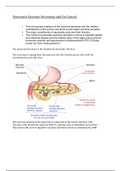
The pancreas lies close to the duodenum and under the liver.
The secretions coming from the pancreas into the duodenum are also with the
secretions from the bile duct.
The exocrine portion of the pancreas is composed of the acinar and duct cells.
The duct cells release the aqueous NaHCO3 solution, this is stimulated by secretin!
The acinar cells secrete digestive enzymes and their release is stimulated by CCK!
, This is what a cross section of the pancreas would look like. The exocrine cells (acinar)
cells will secrete pancreatic enzymes into the pancreatic duct that we can see in the
middle.
The acinar cells are pyramidal in shape and arranged as acini (clusters of cells
resembling a many-lobed berry) if we look at them closely we see microvilli that
extend into the ducts, these are the smallest ducts called the intercalated ducts which
are lined by squamous epithelial cells.
These ducts lead onto intralobular ducts, lined by cuboidal epithelial cells and these
then lead onto interlobular ducts lined with columnar epithelium and goblet cells.
These lead on to the pancreatic duct.
Acini -> Microvilli -> Intercalated duct -> Intralobular duct -> interlobular duct ->
Pancreatic duct
As the pancreatic juices flow through the ducts their composition may be changed.
Pancreatic Exocrine Functions
The pancreas secretes 1.5L of fluid a day, this fluid consists of sodium and HCO 3—rich
juice, albumin, globulin and digestive enzymes.
The acinar cells secrete digestive enzymes which are to breakdown carbohydrates,
fats, proteins and nucleic acids.
Enzymes are secreted in an inactive form, to prevent autodigestion, this is because
some of them do digest proteins so if they were active they would start digesting the
pancreas and damaging other cells.
The activation of these enzymes occurs in the duodenum.
Alkaline Secretions of Pancreas
The microscopic anatomy of the exocrine pancreas and the relative
contributions of the acinus and ducts to pancreatic exocrine secretion
The major constituents of pancreatic juice and their function
The control of pancreatic exocrine secretion in terms of cephalic gastric
and intestinal phases and the relative roles of the vagus nerve and the
hormones secretin and pancreozymin-cholecystokinin (PZ-CCK also
known as CCK-cholecystokinin)
The pancreas lies close to the duodenum and under the liver.
The secretions coming from the pancreas into the duodenum are also with the
secretions from the bile duct.
The exocrine portion of the pancreas is composed of the acinar and duct cells.
The duct cells release the aqueous NaHCO3 solution, this is stimulated by secretin!
The acinar cells secrete digestive enzymes and their release is stimulated by CCK!
, This is what a cross section of the pancreas would look like. The exocrine cells (acinar)
cells will secrete pancreatic enzymes into the pancreatic duct that we can see in the
middle.
The acinar cells are pyramidal in shape and arranged as acini (clusters of cells
resembling a many-lobed berry) if we look at them closely we see microvilli that
extend into the ducts, these are the smallest ducts called the intercalated ducts which
are lined by squamous epithelial cells.
These ducts lead onto intralobular ducts, lined by cuboidal epithelial cells and these
then lead onto interlobular ducts lined with columnar epithelium and goblet cells.
These lead on to the pancreatic duct.
Acini -> Microvilli -> Intercalated duct -> Intralobular duct -> interlobular duct ->
Pancreatic duct
As the pancreatic juices flow through the ducts their composition may be changed.
Pancreatic Exocrine Functions
The pancreas secretes 1.5L of fluid a day, this fluid consists of sodium and HCO 3—rich
juice, albumin, globulin and digestive enzymes.
The acinar cells secrete digestive enzymes which are to breakdown carbohydrates,
fats, proteins and nucleic acids.
Enzymes are secreted in an inactive form, to prevent autodigestion, this is because
some of them do digest proteins so if they were active they would start digesting the
pancreas and damaging other cells.
The activation of these enzymes occurs in the duodenum.
Alkaline Secretions of Pancreas