✅
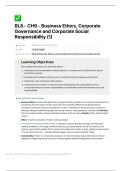
BL8 - CH9 - Business Ethics, Corporate
Governance and Corporate Social
Responsibility (1)
Created @October 30, 2025 12:14 PM
Class Stuvia Copies
Files & media Block 8 Notes.pdf Block 8 Lecture slides pt1.pdf Block 8 Lecture slides pt2.pdf
💡 Learning Objectives
After reading this chapter, you should be able to:
1. Understand why the standards of ethical behavior in business are no different from ethical
standards in general.
2. Recognize the conditions that give rise to unethical business strategies and behavior.
3. Identify the costs of business ethics failures.
4. Understand the concepts of corporate social responsibility and sustainability and how
companies balance economic responsibilities to shareholders with environmental and social
responsibilities.
Key Definitions and Concepts
Business Ethics: Involves the application of general ethical principles to the actions and decisions of
businesses and the conduct of their personnel. Not materially different from general ethical
principles, as business actions are judged by society's standards of right and wrong. Focuses on
decision-making for determining right and wrong; extrinsic rules guiding all. (Contrast with Morality:
Internal compass based on personal/religious tenets; what one does. Integrity: When actions match
words.)
Ethics: Concerns principles of right or wrong conduct.
Corporate Social Responsibility (CSR): A company's duty to operate honorably, provide good
working conditions, encourage workforce diversity, be a good steward of the environment, and
actively work to better quality of life in local communities and society at large. Implied social contract:
"It's the right thing to do" – operate ethically, legally, and as a good corporate citizen.
Sustainability: Refers to conducting business in an environmentally responsible manner without
depleting or degrading natural resources. Guards against ultimate endangerment of the planet.
BL8 - CH9 - Business Ethics, Corporate Governance and Corporate Social Responsibility (1) 1
, Sustainable Business Practices: Practices meeting present needs without compromising future
generations' ability to meet theirs. Includes protecting the environment, ensuring longevity of
resources, maintaining ecological systems.
Environmental Sustainability Strategy: Deliberate actions to protect the environment, ensure
resource longevity, maintain ecological support for future generations, and prevent planetary
endangerment. Key aspects: Replenish resources, reduce greenhouse gases/air pollution, use
sustainable energy (e.g., solar), recyclable materials, sustainable food growth, habitat protection,
eco-friendly waste management.
Triple Bottom Line (TBL): Three performance metrics – economic (profit), social (people),
environmental (planet). Goal: Succeed in all three simultaneously. Relationship to CSR: CSR strategies
aim for TBL excellence by balancing shareholder returns with societal and environmental benefits.
Corporate Governance: System by which organizations (especially corporations) are directed and
controlled by owners. Ensures alignment of owner and manager goals for sustainable success. Role
in strategy: Reflects vision/mission, formulates balanced objectives, monitors execution,
rewards/penalizes performance.
Agency Theory: Principal (shareholder) appoints agent (management) for tasks. Problem: Conflict if
agent prioritizes self-interest. Solution: Align interests to benefit shareholders/stakeholders.
King IV Code: South African governance framework (2016) for ethical culture, good performance,
effective control, legitimacy. Underpinnings: Integrated thinking (organization as societal part,
stakeholder-inclusive, sustainable development); Integrated reporting (communicates value creation
via strategy, governance, performance in context); Integrated report (short/medium/long-term value
creation).
Environment, Social, and Governance (ESG): Framework assessing risks/opportunities in
environmental impact/stewardship, social relationships/value creation (e.g., employees, suppliers),
governance (leadership, policies, controls, shareholder rights).
Sustainable Development Goals (SDGs): 17 UN global goals for sustainable future, interconnecting
social, economic, environmental sustainability.
Creating Shared Value: Differs from CSR/philanthropy by integrating societal benefits into core
business strategy for mutual value (business + society). CSR: Broader duty to stakeholders.
Philanthropy: Charitable giving without direct business tie.
Self-Dealing: Managers advancing personal interests over firm's.
Short-Termism: Excessive focus on short-term objectives at expense of long-term strategy,
increasing ethical lapses.
Strategic Management Model: Involves formulation (vision, mission, SWOT, strategy choice) and
implementation (actions, how/what). Ethics integrates across both.
Differences: Ethics vs. Morality in Business
Ethics: Decision-making process for right/wrong; extrinsic rules (what I believe/say).
Morality: Internal behavior code (what I do).
Integrity: Actions matching words/beliefs.
Examples
BL8 - CH9 - Business Ethics, Corporate Governance and Corporate Social Responsibility (1) 2
BL8 - CH9 - Business Ethics, Corporate
Governance and Corporate Social
Responsibility (1)
Created @October 30, 2025 12:14 PM
Class Stuvia Copies
Files & media Block 8 Notes.pdf Block 8 Lecture slides pt1.pdf Block 8 Lecture slides pt2.pdf
💡 Learning Objectives
After reading this chapter, you should be able to:
1. Understand why the standards of ethical behavior in business are no different from ethical
standards in general.
2. Recognize the conditions that give rise to unethical business strategies and behavior.
3. Identify the costs of business ethics failures.
4. Understand the concepts of corporate social responsibility and sustainability and how
companies balance economic responsibilities to shareholders with environmental and social
responsibilities.
Key Definitions and Concepts
Business Ethics: Involves the application of general ethical principles to the actions and decisions of
businesses and the conduct of their personnel. Not materially different from general ethical
principles, as business actions are judged by society's standards of right and wrong. Focuses on
decision-making for determining right and wrong; extrinsic rules guiding all. (Contrast with Morality:
Internal compass based on personal/religious tenets; what one does. Integrity: When actions match
words.)
Ethics: Concerns principles of right or wrong conduct.
Corporate Social Responsibility (CSR): A company's duty to operate honorably, provide good
working conditions, encourage workforce diversity, be a good steward of the environment, and
actively work to better quality of life in local communities and society at large. Implied social contract:
"It's the right thing to do" – operate ethically, legally, and as a good corporate citizen.
Sustainability: Refers to conducting business in an environmentally responsible manner without
depleting or degrading natural resources. Guards against ultimate endangerment of the planet.
BL8 - CH9 - Business Ethics, Corporate Governance and Corporate Social Responsibility (1) 1
, Sustainable Business Practices: Practices meeting present needs without compromising future
generations' ability to meet theirs. Includes protecting the environment, ensuring longevity of
resources, maintaining ecological systems.
Environmental Sustainability Strategy: Deliberate actions to protect the environment, ensure
resource longevity, maintain ecological support for future generations, and prevent planetary
endangerment. Key aspects: Replenish resources, reduce greenhouse gases/air pollution, use
sustainable energy (e.g., solar), recyclable materials, sustainable food growth, habitat protection,
eco-friendly waste management.
Triple Bottom Line (TBL): Three performance metrics – economic (profit), social (people),
environmental (planet). Goal: Succeed in all three simultaneously. Relationship to CSR: CSR strategies
aim for TBL excellence by balancing shareholder returns with societal and environmental benefits.
Corporate Governance: System by which organizations (especially corporations) are directed and
controlled by owners. Ensures alignment of owner and manager goals for sustainable success. Role
in strategy: Reflects vision/mission, formulates balanced objectives, monitors execution,
rewards/penalizes performance.
Agency Theory: Principal (shareholder) appoints agent (management) for tasks. Problem: Conflict if
agent prioritizes self-interest. Solution: Align interests to benefit shareholders/stakeholders.
King IV Code: South African governance framework (2016) for ethical culture, good performance,
effective control, legitimacy. Underpinnings: Integrated thinking (organization as societal part,
stakeholder-inclusive, sustainable development); Integrated reporting (communicates value creation
via strategy, governance, performance in context); Integrated report (short/medium/long-term value
creation).
Environment, Social, and Governance (ESG): Framework assessing risks/opportunities in
environmental impact/stewardship, social relationships/value creation (e.g., employees, suppliers),
governance (leadership, policies, controls, shareholder rights).
Sustainable Development Goals (SDGs): 17 UN global goals for sustainable future, interconnecting
social, economic, environmental sustainability.
Creating Shared Value: Differs from CSR/philanthropy by integrating societal benefits into core
business strategy for mutual value (business + society). CSR: Broader duty to stakeholders.
Philanthropy: Charitable giving without direct business tie.
Self-Dealing: Managers advancing personal interests over firm's.
Short-Termism: Excessive focus on short-term objectives at expense of long-term strategy,
increasing ethical lapses.
Strategic Management Model: Involves formulation (vision, mission, SWOT, strategy choice) and
implementation (actions, how/what). Ethics integrates across both.
Differences: Ethics vs. Morality in Business
Ethics: Decision-making process for right/wrong; extrinsic rules (what I believe/say).
Morality: Internal behavior code (what I do).
Integrity: Actions matching words/beliefs.
Examples
BL8 - CH9 - Business Ethics, Corporate Governance and Corporate Social Responsibility (1) 2