BIO 253 Final Exam – Questions With Solved
Solutions
Save
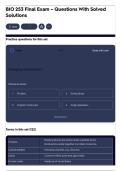
Practice questions for this set
Learn 1 /7 Study with Learn
Packaging and transport
Choose an answer
1 Proteins 2 Extracellular
3 Organic molecules 4 Golgi apparatus
Don't know?
Terms in this set (122)
Building blocks are amino acids; peptide bond
Proteins
binds amino acids together in protein molecule.
Carbohydrates Monosaccharides, e.g., Glucose.
Lipids Consist of fatty acids and glycerides.
Nucleic acids Made up of nucleotides.
, Organic molecules Always contain Carbon and Hydrogen.
Inorganic molecules May contain Carbon and Hydrogen but never both.
Occurs when Na+ channels open and Na+ rushes
Depolarization
into the cells.
Repolarization Occurs when K+ channels open.
Part of the brain associated with sensory
Parietal lobe
information.
Diencephalon Made up of the Thalamus and Hypothalamus.
Path of the brain stem Includes Pons, mid Brain, and Medulla Oblongata.
Intracellular Na+ is always on the outside.
Extracellular K+ is found inside.
Includes temperature regulation, protection, vitamin
Functions of the Skin
D production, and excretion of waste.
Increases when the skin is exposed to ultraviolet
Melanin production
light, leading to increased vitamin D absorption.
Stratum Cornum is the outermost layer containing
Epidermis
dead and keratinized cells.
The layer of the epidermis that is not defined in the
Stratum basal
notes.
Inter most layer Contains newer active dividing cells
Stratum Lucedo Not present in thin skin
Anterior cavity Fluid found in the anterior cavity - aqueous humor
Fluid found in the Posterior Cavity - Vitreous
Posterior Cavity
Humour
Cochlea Contains the receptors for hearing (in the inner ear)
Damage to cochlea Could cause hearing loss
Osmosis Diffusion of water
Active transport Transport that requires energy
Passive transport Transport that does not require energy
Solutions
Save
Practice questions for this set
Learn 1 /7 Study with Learn
Packaging and transport
Choose an answer
1 Proteins 2 Extracellular
3 Organic molecules 4 Golgi apparatus
Don't know?
Terms in this set (122)
Building blocks are amino acids; peptide bond
Proteins
binds amino acids together in protein molecule.
Carbohydrates Monosaccharides, e.g., Glucose.
Lipids Consist of fatty acids and glycerides.
Nucleic acids Made up of nucleotides.
, Organic molecules Always contain Carbon and Hydrogen.
Inorganic molecules May contain Carbon and Hydrogen but never both.
Occurs when Na+ channels open and Na+ rushes
Depolarization
into the cells.
Repolarization Occurs when K+ channels open.
Part of the brain associated with sensory
Parietal lobe
information.
Diencephalon Made up of the Thalamus and Hypothalamus.
Path of the brain stem Includes Pons, mid Brain, and Medulla Oblongata.
Intracellular Na+ is always on the outside.
Extracellular K+ is found inside.
Includes temperature regulation, protection, vitamin
Functions of the Skin
D production, and excretion of waste.
Increases when the skin is exposed to ultraviolet
Melanin production
light, leading to increased vitamin D absorption.
Stratum Cornum is the outermost layer containing
Epidermis
dead and keratinized cells.
The layer of the epidermis that is not defined in the
Stratum basal
notes.
Inter most layer Contains newer active dividing cells
Stratum Lucedo Not present in thin skin
Anterior cavity Fluid found in the anterior cavity - aqueous humor
Fluid found in the Posterior Cavity - Vitreous
Posterior Cavity
Humour
Cochlea Contains the receptors for hearing (in the inner ear)
Damage to cochlea Could cause hearing loss
Osmosis Diffusion of water
Active transport Transport that requires energy
Passive transport Transport that does not require energy