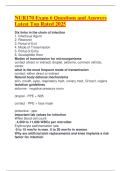
NUR170 Exam 6 Questions and Answers
Latest Top Rated 2025
Six links in the chain of infection
1. Infectious Agent
2. Reservoir
3. Portal of Exit
4. Mode of Transmission
5. Portal of Entry
6. Susceptible Host
Modes of transmission for microorganisms
contact (direct or indirect) droplet, airborne, common vehicle,
vector
what is the most frequent mode of transmission
contact, either direct or indirect
Natural body defense mechanisms
skin, mouth, eyes, respiratory tract, urinary tract, GI tract, vagina
isolation guidelines
airborne - negative pressure room
droplet - PPE + N95
contact - PPE + face mask
protective - ppe
important lab values for infection
White blood cell count
- 4,500 to 11,000 WBCs per microliter
Erythrocyte sedimentation rate
-0 to 15 mm/hr in men. 0 to 20 mm/hr in women.
Why are artificial joint replacements and knee implants a risk
factor for infection
,your body recognizes that the artificial joints and emplacements
are not a part of the host causing a confusion in the body
vehicles
Spreading agents and ingredients that carry or deliver other
ingredients into the skin and make them more effective.
reservoir
the habitat of the infectious agent - where it lives, grows, and
replicates itself
can be other animals, contaminated soil, water, food, or medical
equipment
virulent
describes how efficient an infectious agent is at making people ill
factors that increase host susceptibility to infection
age, disease, transplants, medications, surgical procedures,
radiation therapy, indwelling devices
direct contact transmission
microorganisms move directly from an infected animal to another
infected animal
ex: transferred by touch
indirect contact transmission
refers to situations in which a susceptible person is infected by
contact with a contaminated surface
ex: dirty gloves, contaminated door knob, etc.
vehicle transmission
transmission by an inanimate reservoir (food, water)
ex: raw poultry products - salmonella
vector-borne transmission
transmission of infectious agents through animals and insects
ex: mosquitos-malaria, rats-black death
manifestations of inflammation
heat, redness, swelling, pain, loss of function
stages of infection
Incubation period
Prodromal stage
acute illness
,period of decline
Convalescent period
local infection
pathogens are limited to a small area of the body
ex: UTI, Ear infection, etc.
systemic infections
infections that affect the entire body
ex: Sepsis or blood poisoning
medical asepsis
clean technique
- clean gloves, hand hygiene
also known as standard precautions
surgical asepsis
techniques used to destroy all pathogenic organisms, also called
sterile technique
sterilization
The process that completely destroys all microbial life, including
spores.
airborne precautions
occurs through contact with contaminated respiratory droplets
spread by a cough or sneeze
ex: Tuberculosis, SARS, measles, chickenpox, herpes zoster,
TB, robiola,
droplet infections
infections spread over short distances in droplet form
ex: strep throat, Covid-19, influenza, common cold,
Pneumonia, Rhinovirus
normal WBC count
5,000-10,000 wbc/L
anything above that implies infection
anything below that means that the patient is susceptible
erythrocyte sedimentation rate (ESR)
speed at which erythrocytes settle out of plasma
0-15 mm/hr in men
0-20 mm/hr in women
, part of the brain that controls heat loss
anterior hypothalamus (a/c)
part of the brain that controls heat production
posterior hypothalamus (PC production for P)
evaporation
The change of a substance from a liquid to a gas
along with a transfer of heat energy to the air
thermoregulation
mechanisms that regulate the balance between heat lost and heat
produced
heat conduction object
the transfer of heat by the direct contact of particles of matter
radiation conduction
transfer of heat from the surface of one object to another without
direct contact
convection condction
transfer of heat away by air movement
Pyrexia
another term for fever
a temporary elevation in body temperature caused by the immune
system's release of endogenous pyrogens
pyrogens
Bacteria and viruses that elevate body temperature
hyperthermia
profuse diaphoresis with excess water and electrolyte loss
hypothermia
coldness that overwhelms the body's ability to produce heat
malignant hyperthermia
A hereditary condition of uncontrolled heat production that occurs
when susceptible people receive certain anesthetic drugs.
heat exhaustion
the body's inability to promote heat loss or reduce heat production
heatstroke
Latest Top Rated 2025
Six links in the chain of infection
1. Infectious Agent
2. Reservoir
3. Portal of Exit
4. Mode of Transmission
5. Portal of Entry
6. Susceptible Host
Modes of transmission for microorganisms
contact (direct or indirect) droplet, airborne, common vehicle,
vector
what is the most frequent mode of transmission
contact, either direct or indirect
Natural body defense mechanisms
skin, mouth, eyes, respiratory tract, urinary tract, GI tract, vagina
isolation guidelines
airborne - negative pressure room
droplet - PPE + N95
contact - PPE + face mask
protective - ppe
important lab values for infection
White blood cell count
- 4,500 to 11,000 WBCs per microliter
Erythrocyte sedimentation rate
-0 to 15 mm/hr in men. 0 to 20 mm/hr in women.
Why are artificial joint replacements and knee implants a risk
factor for infection
,your body recognizes that the artificial joints and emplacements
are not a part of the host causing a confusion in the body
vehicles
Spreading agents and ingredients that carry or deliver other
ingredients into the skin and make them more effective.
reservoir
the habitat of the infectious agent - where it lives, grows, and
replicates itself
can be other animals, contaminated soil, water, food, or medical
equipment
virulent
describes how efficient an infectious agent is at making people ill
factors that increase host susceptibility to infection
age, disease, transplants, medications, surgical procedures,
radiation therapy, indwelling devices
direct contact transmission
microorganisms move directly from an infected animal to another
infected animal
ex: transferred by touch
indirect contact transmission
refers to situations in which a susceptible person is infected by
contact with a contaminated surface
ex: dirty gloves, contaminated door knob, etc.
vehicle transmission
transmission by an inanimate reservoir (food, water)
ex: raw poultry products - salmonella
vector-borne transmission
transmission of infectious agents through animals and insects
ex: mosquitos-malaria, rats-black death
manifestations of inflammation
heat, redness, swelling, pain, loss of function
stages of infection
Incubation period
Prodromal stage
acute illness
,period of decline
Convalescent period
local infection
pathogens are limited to a small area of the body
ex: UTI, Ear infection, etc.
systemic infections
infections that affect the entire body
ex: Sepsis or blood poisoning
medical asepsis
clean technique
- clean gloves, hand hygiene
also known as standard precautions
surgical asepsis
techniques used to destroy all pathogenic organisms, also called
sterile technique
sterilization
The process that completely destroys all microbial life, including
spores.
airborne precautions
occurs through contact with contaminated respiratory droplets
spread by a cough or sneeze
ex: Tuberculosis, SARS, measles, chickenpox, herpes zoster,
TB, robiola,
droplet infections
infections spread over short distances in droplet form
ex: strep throat, Covid-19, influenza, common cold,
Pneumonia, Rhinovirus
normal WBC count
5,000-10,000 wbc/L
anything above that implies infection
anything below that means that the patient is susceptible
erythrocyte sedimentation rate (ESR)
speed at which erythrocytes settle out of plasma
0-15 mm/hr in men
0-20 mm/hr in women
, part of the brain that controls heat loss
anterior hypothalamus (a/c)
part of the brain that controls heat production
posterior hypothalamus (PC production for P)
evaporation
The change of a substance from a liquid to a gas
along with a transfer of heat energy to the air
thermoregulation
mechanisms that regulate the balance between heat lost and heat
produced
heat conduction object
the transfer of heat by the direct contact of particles of matter
radiation conduction
transfer of heat from the surface of one object to another without
direct contact
convection condction
transfer of heat away by air movement
Pyrexia
another term for fever
a temporary elevation in body temperature caused by the immune
system's release of endogenous pyrogens
pyrogens
Bacteria and viruses that elevate body temperature
hyperthermia
profuse diaphoresis with excess water and electrolyte loss
hypothermia
coldness that overwhelms the body's ability to produce heat
malignant hyperthermia
A hereditary condition of uncontrolled heat production that occurs
when susceptible people receive certain anesthetic drugs.
heat exhaustion
the body's inability to promote heat loss or reduce heat production
heatstroke