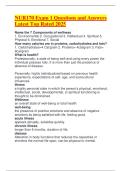
NUR170 Exam 1 Questions and Answers
Latest Top Rated 2025
Name the 7 Components of wellness
1. Environmental 2. Occupational 3. Intellectual 4. Spiritual 5.
Physical 6. Emotional 7. Social
How many calories are in proteins, carbohydrates and fats?
1. Carbohydrates=4 Cal/gram 2. Proteins= 4cal/gram 3. Fats=
9cal/gram
What is health?
Professionally: a state of being well and using every power the
individual possess fully. It is more than just the presence or
absence of disease.
Personally: highly individualized based on previous health
experience, expectations of self, age, and sociocultural
influences.
illness
a highly personal state in which the person's physical, emotional,
intellectual, social, developmental, or spiritual functioning is
thought to be diminished
Wellness
an overall state of well-being or total health
well-being
the presence of positive emotions and absence of negative
emotions its being satisfied with life, feeling good.
acute illness
appears abruptly, subsides quickly.
chronic illness
longer than 6 months, duration of life.
disease
Alteration in body functions that reduces the capacities or
shortens the normal life span. can be physical or mental.
,health continuum
A model that illustrates the full range of health between the
extremes of illness on one end and wellness on the other end
health and illness or disease can be viewed as opposite ends of a
health continuum.
The 7 components of wellness need to be balanced to attain
optimal health.
Nurse's Role in Health Promotion
Guide patients in right direction, educate patients on prevention
and lifestyle choices, collaborate with patients to identify specific
plans, and role model aka practice what you preach
Levels of Prevention: Primary
health promotion/illness prevention
ex. use of sunscreen, vaccination info
Levels of Prevention: Secondary
to identify illness and provide treatment at the earliest possible
stage.
ex. screenings
Levels of prevention: Tertiary
disease management
ex. trying to prevent pressure ulcers because you have a spinal
injury
internal variables of health choices
non modifiable
ex. genetic factors, age, etc.
External Variables
you can choose between healthy and unhealthy
ex. control over choices.
, Variables influencing the individuals health choices
psychological, cognitive, and nontraditional
Psychological
awareness of mind/body interactions. our mind has the ability to
directly affect our body functions. biggest cause = stress
Cognitive:
life style choices/health benefits/spiritual or religious beliefs.
risk factors= negative choices.
ex. family disease, smoking, not wearing a seatbelt.
Health beliefs (cognitive)
may or may not be based on fact
internal locus of control= we have control
external locus of control=it happens to us/no control
Spiritual/Religious beliefs
can affect health behaviors, also affect health choices and health
overall.
Nontraditional health choices
Complementary approaches, Integrative health, Alternative
medicine
Complementary health approaches
practices of non mainstream.
ex. accupuncture, yoga, meditation
integrative health
incorporating complementary approaches into mainstream health
care
alternative medicine
a group of medical treatments, practices, and products that are
used instead of conventional Western medicine
ex. diet to treat cancer/no meds/surgery/etc
Latest Top Rated 2025
Name the 7 Components of wellness
1. Environmental 2. Occupational 3. Intellectual 4. Spiritual 5.
Physical 6. Emotional 7. Social
How many calories are in proteins, carbohydrates and fats?
1. Carbohydrates=4 Cal/gram 2. Proteins= 4cal/gram 3. Fats=
9cal/gram
What is health?
Professionally: a state of being well and using every power the
individual possess fully. It is more than just the presence or
absence of disease.
Personally: highly individualized based on previous health
experience, expectations of self, age, and sociocultural
influences.
illness
a highly personal state in which the person's physical, emotional,
intellectual, social, developmental, or spiritual functioning is
thought to be diminished
Wellness
an overall state of well-being or total health
well-being
the presence of positive emotions and absence of negative
emotions its being satisfied with life, feeling good.
acute illness
appears abruptly, subsides quickly.
chronic illness
longer than 6 months, duration of life.
disease
Alteration in body functions that reduces the capacities or
shortens the normal life span. can be physical or mental.
,health continuum
A model that illustrates the full range of health between the
extremes of illness on one end and wellness on the other end
health and illness or disease can be viewed as opposite ends of a
health continuum.
The 7 components of wellness need to be balanced to attain
optimal health.
Nurse's Role in Health Promotion
Guide patients in right direction, educate patients on prevention
and lifestyle choices, collaborate with patients to identify specific
plans, and role model aka practice what you preach
Levels of Prevention: Primary
health promotion/illness prevention
ex. use of sunscreen, vaccination info
Levels of Prevention: Secondary
to identify illness and provide treatment at the earliest possible
stage.
ex. screenings
Levels of prevention: Tertiary
disease management
ex. trying to prevent pressure ulcers because you have a spinal
injury
internal variables of health choices
non modifiable
ex. genetic factors, age, etc.
External Variables
you can choose between healthy and unhealthy
ex. control over choices.
, Variables influencing the individuals health choices
psychological, cognitive, and nontraditional
Psychological
awareness of mind/body interactions. our mind has the ability to
directly affect our body functions. biggest cause = stress
Cognitive:
life style choices/health benefits/spiritual or religious beliefs.
risk factors= negative choices.
ex. family disease, smoking, not wearing a seatbelt.
Health beliefs (cognitive)
may or may not be based on fact
internal locus of control= we have control
external locus of control=it happens to us/no control
Spiritual/Religious beliefs
can affect health behaviors, also affect health choices and health
overall.
Nontraditional health choices
Complementary approaches, Integrative health, Alternative
medicine
Complementary health approaches
practices of non mainstream.
ex. accupuncture, yoga, meditation
integrative health
incorporating complementary approaches into mainstream health
care
alternative medicine
a group of medical treatments, practices, and products that are
used instead of conventional Western medicine
ex. diet to treat cancer/no meds/surgery/etc