WGU C168 Critical Thinking and Logic
Questions Answers 2025/2026
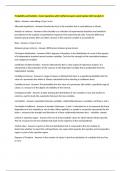
Egocentrism - Correct Answer-The tendency to view everything in relationship to
oneself and to regard one's own opinions, values, or interests as most important.
Fair-mindedness - Correct Answer-The commitment to consider all relevant opinions
equally without regard to one's own sentiments or selfish interests.
Fallacies - Correct Answer-Flaws or errors in reasoning which, when found in the
premise of an argument, invalidate its conclusion.
Intellectual cowardice - Correct Answer-Fear of ideas or viewpoints that do not conform
to one's own. Term used by Paul and Elder.
Intellectual empathy - Correct Answer-The act of routinely inhabiting the perspectives of
others in order to genuinely understand them. Term used by Paul and Elder.
Intellectual humility - Correct Answer-Openness to the possibility that one's beliefs are
mistaken and a willingness to reevaluate them in the face of new evidence or
persuasive counterarguments. Term used by Paul and Elder.
Intellectual perseverance - Correct Answer-The act of working one's way through
intellectual complexities despite frustrations inherent in doing so. Term used by Paul
and Elder.
Second-order thinking - Correct Answer-Another term for critical thinking. It is first-order
thinking (or ordinary thinking) that is consciously realized (i.e., analyzed, assessed, and
improved). Term used by Paul and Elder.
Sociocentrism - Correct Answer-The assumption that one's own social group is
inherently superior to all others.
Sophistry - Correct Answer-The ability to win an argument regardless of flaws in its
reasoning.
Stereotype - Correct Answer-A fixed or oversimplified conception of a person, group, or
idea.
Strong-sense critical thinking - Correct Answer-Thinking that uses critical thinking skills
to evaluate all beliefs, especially one's own, and that pursues what is intellectually fair
and just.
Questions Answers 2025/2026
Egocentrism - Correct Answer-The tendency to view everything in relationship to
oneself and to regard one's own opinions, values, or interests as most important.
Fair-mindedness - Correct Answer-The commitment to consider all relevant opinions
equally without regard to one's own sentiments or selfish interests.
Fallacies - Correct Answer-Flaws or errors in reasoning which, when found in the
premise of an argument, invalidate its conclusion.
Intellectual cowardice - Correct Answer-Fear of ideas or viewpoints that do not conform
to one's own. Term used by Paul and Elder.
Intellectual empathy - Correct Answer-The act of routinely inhabiting the perspectives of
others in order to genuinely understand them. Term used by Paul and Elder.
Intellectual humility - Correct Answer-Openness to the possibility that one's beliefs are
mistaken and a willingness to reevaluate them in the face of new evidence or
persuasive counterarguments. Term used by Paul and Elder.
Intellectual perseverance - Correct Answer-The act of working one's way through
intellectual complexities despite frustrations inherent in doing so. Term used by Paul
and Elder.
Second-order thinking - Correct Answer-Another term for critical thinking. It is first-order
thinking (or ordinary thinking) that is consciously realized (i.e., analyzed, assessed, and
improved). Term used by Paul and Elder.
Sociocentrism - Correct Answer-The assumption that one's own social group is
inherently superior to all others.
Sophistry - Correct Answer-The ability to win an argument regardless of flaws in its
reasoning.
Stereotype - Correct Answer-A fixed or oversimplified conception of a person, group, or
idea.
Strong-sense critical thinking - Correct Answer-Thinking that uses critical thinking skills
to evaluate all beliefs, especially one's own, and that pursues what is intellectually fair
and just.