

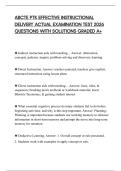
ABCTE PTK EFFECTIVE INSTRUCTIONAL
DELIVERY ACTUAL EXAMINATION TEST 2026
QUESTIONS WITH SOLUTIONS GRADED A+
◉ Indirect instruction aids with teaching.... Answer: abstraction,
concepts, patterns, inquiry, problem-solving and discovery learning
◉ Direct Instruction. Answer: teacher-centered; teachers give explicit,
structured instruction using lesson plans
◉ Direct instruction aids with teaching.... Answer: facts, rules, &
sequences; breaking down textbook or workbook material; lower
Bloom's Taxonomy; & gaining student interest
◉ What essential cognitive process do many students fail to do before
beginning activities, and why is this step important. Answer: Planning;
Planning is important because students use working memory to rehearse
information in short-term memory and prompt the move into long-term
memory for retention
◉ Deductive Learning. Answer: 1. Overall concept or rule presented.
2. Students work with examples to apply concept or rule.
,(rule --> examples)
◉ Inductive Learning. Answer: 1. Students study examples of content.
2. Students make generalizations, leading to an understanding of the rule
(examples --> rule)
◉ Deductive Reasoning. Answer: top-down, general-to-specific process;
beginning from a general theory --> narrowing down to a more specific
hypothesis --> testing --> drawing specific conclusions; moving from
generalizing (or rule) to specific examples or activities
◉ Inductive Reasoning. Answer: bottom-up, specific-to-general process;
beginning from accumulating specific info --> identifying principles -->
drawing conclusions or general principles; moving from specific
examples to generalizing (or a rule)
◉ How can teachers structure class logically. Answer: 1. Present
problems, then solutions.
2. Frame topics as stories.
3. Chronologically recount processes & events
3. Show interconnected ideas' relationships to overarching themes.
4. Share outlines.
5. Transition between topics using mini summaries, connections or
verbal signals
, ◉ What are some methods to aid in student comprehension & emphasize
importance. Answer: 1. Repeat key concepts & ideas.
2. Compare & Contrast
3. Summarize
4. Use analogies & metaphors.
◉ List some methods to stimulate student interest in new material..
Answer: 1. Anecdotes
2. Examples
3. Connect topics to prior knowledge, experiences, interests, values, &
utility
◉ How can listeners demonstrate active listening. Answer: 1. Use verbal
& nonverbal signals
2. Ask questions to clarify
3. Restate main points for speaker to confirm or correct.
◉ What are the 6 levels of Bloom's Taxonomy. Answer: 1. Knowledge
2. Comprehension
3. Application
4. Analysis
5. Synthesis
DELIVERY ACTUAL EXAMINATION TEST 2026
QUESTIONS WITH SOLUTIONS GRADED A+
◉ Indirect instruction aids with teaching.... Answer: abstraction,
concepts, patterns, inquiry, problem-solving and discovery learning
◉ Direct Instruction. Answer: teacher-centered; teachers give explicit,
structured instruction using lesson plans
◉ Direct instruction aids with teaching.... Answer: facts, rules, &
sequences; breaking down textbook or workbook material; lower
Bloom's Taxonomy; & gaining student interest
◉ What essential cognitive process do many students fail to do before
beginning activities, and why is this step important. Answer: Planning;
Planning is important because students use working memory to rehearse
information in short-term memory and prompt the move into long-term
memory for retention
◉ Deductive Learning. Answer: 1. Overall concept or rule presented.
2. Students work with examples to apply concept or rule.
,(rule --> examples)
◉ Inductive Learning. Answer: 1. Students study examples of content.
2. Students make generalizations, leading to an understanding of the rule
(examples --> rule)
◉ Deductive Reasoning. Answer: top-down, general-to-specific process;
beginning from a general theory --> narrowing down to a more specific
hypothesis --> testing --> drawing specific conclusions; moving from
generalizing (or rule) to specific examples or activities
◉ Inductive Reasoning. Answer: bottom-up, specific-to-general process;
beginning from accumulating specific info --> identifying principles -->
drawing conclusions or general principles; moving from specific
examples to generalizing (or a rule)
◉ How can teachers structure class logically. Answer: 1. Present
problems, then solutions.
2. Frame topics as stories.
3. Chronologically recount processes & events
3. Show interconnected ideas' relationships to overarching themes.
4. Share outlines.
5. Transition between topics using mini summaries, connections or
verbal signals
, ◉ What are some methods to aid in student comprehension & emphasize
importance. Answer: 1. Repeat key concepts & ideas.
2. Compare & Contrast
3. Summarize
4. Use analogies & metaphors.
◉ List some methods to stimulate student interest in new material..
Answer: 1. Anecdotes
2. Examples
3. Connect topics to prior knowledge, experiences, interests, values, &
utility
◉ How can listeners demonstrate active listening. Answer: 1. Use verbal
& nonverbal signals
2. Ask questions to clarify
3. Restate main points for speaker to confirm or correct.
◉ What are the 6 levels of Bloom's Taxonomy. Answer: 1. Knowledge
2. Comprehension
3. Application
4. Analysis
5. Synthesis


