This OpenStax ancillary resource is © Rice University under a CC BY 4.0 International license; it may be reproduced or modified but
must be attributed to OpenStax, Rice University and any changes must be noted.
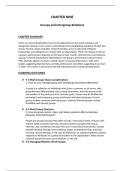
CHAPTER NINE
Groups and Intergroup Relations
CHAPTER SUMMARY
There are several implications that can be deduced from the study of groups and
intergroup relations. First, norms control behavior by establishing standards of right and
wrong. Second, status inequities create frustration and can adversely influence
productivity and willingness to remain with an organization. Third, the impact of size on
a group’s performance depends on the type of task. Fourth, cohesiveness may influence
a group’s level of productivity, depending on the group’s performance-related norms.
Fifth, diversity appears to have a mixed impact on group performance, with some
studies suggesting that diversity can help performance and others suggesting it can hurt
it. Sixth, role conflict is associated with job-induced tension and job dissatisfaction.
LEARNING OUTCOMES
9.1 Work Groups: Basic Considerations
1. How do you manage group and intergroup processes effectively?
A group is a collection of individuals who share a common set of norms, who
generally have differentiated roles among themselves, and who interact with
one another in the joint pursuit of common goals. Groups may be divided into
permanent and temporary groups and formal and informal groups. Formal
groups include command and task groups, whereas informal groups include
friendship and interest groups.
6.2 Work Group Structure
2. How do group norms, roles, and status systems affect employee
behavior and performance?
People join groups because they offer security, meet social needs, enhance self-
esteem, fulfill economic interests, introduce them to people with mutual
interests, and, sometimes, because they are in close physical proximity. Groups
typically develop through several distinct stages, including forming, storming,
norming, and performing. A role may be defined as an expected behavior pattern
assigned or attributed to a particular position in the organization. Roles may be
oriented toward the task, social relations, or the self.
6.3 Managing Effective Work Groups
, Organizational Behavior
3. How do managers develop group cohesiveness, which facilitates
organizational goal attainment?
Social loafing is a tendency for individual members of a group to reduce their
task effort in the belief that other members will cover for them. A norm is a
standard that is shared by group members and that regulates member behavior
within an organization. Norms facilitate group survival, simplify expected
behaviors, help members avoid embarrassing situations, and help identify group
members. Asch’s experiment in group pressure and individual judgment
demonstrated that individuals will discount their own perceptions of a situation
and follow the will of a group. Status systems serve to differentiate individuals
on the basis of some criterion or set of criteria. Status incongruence occurs when
one individual holds a position in the status hierarchy that is inconsistent with
the conventional criteria for that position. Group cohesiveness is the extent to
which individual members of a group are motivated to remain in the group.
Work group effectiveness is defined by three criteria: group productivity,
personal need satisfaction of the members, and the group’s capacity for future
cooperation.
6.4 Intergroup Behavior and Performance
4. What are barriers to intergroup cooperation, and how do you take action
to minimize such impediments and understand how to get the most out of
the collective actions of groups in organizations in order to enhance
industrial competitiveness?
Intergroup performance is influenced by three interaction requirements. These
include the requirements for interdependence, information, and integration. A
linking role is a position or unit within the organization that is charged with
overseeing and coordinating the activities of two or more groups. A task force
consists of members from several departments or units who are brought
together on a temporary basis to solve a specific and immediate problem.
Decoupling refers to the practice of physically or administratively separating
groups that are not able to work together effectively.
LECTURE OUTLINE
I. Work Groups: Basic Considerations > Learning Outcome 1
A. What is a Group?
A group is defined as two or more individuals, interacting and interdependent,
who have come together to achieve particular objectives. Groups can be either
formal or informal.
May 21, 2019 2
must be attributed to OpenStax, Rice University and any changes must be noted.
CHAPTER NINE
Groups and Intergroup Relations
CHAPTER SUMMARY
There are several implications that can be deduced from the study of groups and
intergroup relations. First, norms control behavior by establishing standards of right and
wrong. Second, status inequities create frustration and can adversely influence
productivity and willingness to remain with an organization. Third, the impact of size on
a group’s performance depends on the type of task. Fourth, cohesiveness may influence
a group’s level of productivity, depending on the group’s performance-related norms.
Fifth, diversity appears to have a mixed impact on group performance, with some
studies suggesting that diversity can help performance and others suggesting it can hurt
it. Sixth, role conflict is associated with job-induced tension and job dissatisfaction.
LEARNING OUTCOMES
9.1 Work Groups: Basic Considerations
1. How do you manage group and intergroup processes effectively?
A group is a collection of individuals who share a common set of norms, who
generally have differentiated roles among themselves, and who interact with
one another in the joint pursuit of common goals. Groups may be divided into
permanent and temporary groups and formal and informal groups. Formal
groups include command and task groups, whereas informal groups include
friendship and interest groups.
6.2 Work Group Structure
2. How do group norms, roles, and status systems affect employee
behavior and performance?
People join groups because they offer security, meet social needs, enhance self-
esteem, fulfill economic interests, introduce them to people with mutual
interests, and, sometimes, because they are in close physical proximity. Groups
typically develop through several distinct stages, including forming, storming,
norming, and performing. A role may be defined as an expected behavior pattern
assigned or attributed to a particular position in the organization. Roles may be
oriented toward the task, social relations, or the self.
6.3 Managing Effective Work Groups
, Organizational Behavior
3. How do managers develop group cohesiveness, which facilitates
organizational goal attainment?
Social loafing is a tendency for individual members of a group to reduce their
task effort in the belief that other members will cover for them. A norm is a
standard that is shared by group members and that regulates member behavior
within an organization. Norms facilitate group survival, simplify expected
behaviors, help members avoid embarrassing situations, and help identify group
members. Asch’s experiment in group pressure and individual judgment
demonstrated that individuals will discount their own perceptions of a situation
and follow the will of a group. Status systems serve to differentiate individuals
on the basis of some criterion or set of criteria. Status incongruence occurs when
one individual holds a position in the status hierarchy that is inconsistent with
the conventional criteria for that position. Group cohesiveness is the extent to
which individual members of a group are motivated to remain in the group.
Work group effectiveness is defined by three criteria: group productivity,
personal need satisfaction of the members, and the group’s capacity for future
cooperation.
6.4 Intergroup Behavior and Performance
4. What are barriers to intergroup cooperation, and how do you take action
to minimize such impediments and understand how to get the most out of
the collective actions of groups in organizations in order to enhance
industrial competitiveness?
Intergroup performance is influenced by three interaction requirements. These
include the requirements for interdependence, information, and integration. A
linking role is a position or unit within the organization that is charged with
overseeing and coordinating the activities of two or more groups. A task force
consists of members from several departments or units who are brought
together on a temporary basis to solve a specific and immediate problem.
Decoupling refers to the practice of physically or administratively separating
groups that are not able to work together effectively.
LECTURE OUTLINE
I. Work Groups: Basic Considerations > Learning Outcome 1
A. What is a Group?
A group is defined as two or more individuals, interacting and interdependent,
who have come together to achieve particular objectives. Groups can be either
formal or informal.
May 21, 2019 2