

Written by students who passed Immediately available after payment Read online or as PDF Wrong document? Swap it for free 4.6 TrustPilot
logo-home
Document preview thumbnail
Preview 1 out of 4 pages
Exam (elaborations)

NSG 3600 Exam 2 Questions and Answers

Document preview thumbnail
Preview 1 out of 4 pages

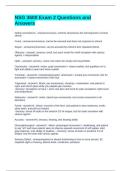
NSG 3600 Exam 2 Questions and Answers Stupor unconscious, can be aroused by extreme &/or repeated stimuli Olfactory I, sensory, smell, test each nostril for smell reception with various agents + interpretation Optic II, sensory, vision, test vision for acuity and visual fields Oculomotor III, motor, pupil constriction + raises eyelids, test pupillary rxn to light and ability to open and close eyelids Trochlear IV, motor/proprioceptor, downward + inward eye movement, test for downward + inward movement of the eye Trigeminal V, Motor: jaw movements, chewing + mastication, ask patient to open and clench jaws while you palpate jaw muscles -Sensory: sensations on face + neck, test face and neck for pain sensations, light touch, and temperature Abducens VI, motor, lateral eye movements, test ocular movement in all directions Facial VII, -Motor: muscles of the face, ask patient to raise eyebrows, smile, show teeth, and puff out cheeks -Sensory: sense of taste on the anterior 2/3 of tongue, test for taste sensation with various agents Acoustic VIII, sensory, hearing, test hearing ability Glossopharyngeal IX, -Motor: pharyngeal movement + swallowing, ask patient to say "ah" and have patient yawn to observe upward movement of soft palate, elicit gag response, note ability to swallow ---Sensory: sense of taste on posterior 1/3 of tongue, test for taste with various agents Sensory Deficit impaired or absent functioning of one or more senses. IE: impaired sight or hearing, altered taste, numbness, paralysis Sensory Overload condition resulting from excessive sensory input to which the brain is unable to meaningfully response. Person feels out of control. IE: constant presence of pain or discomfort from dressings, IV lines + unfamiliar environment Sensory Deprivation condition resulting from decreased sensory input or input that is monotonous, unpatterned, or meaningless. RAS is no longer able to project a normal level of activation to the brain. IE: bed rest, isolation, small living area, impaired vision or hearing due to bandage or case, Spinal cord injuries or brain damage, confused or disoriented What should a normal tympanic membrane looks like? pale, grey, ovoid, semi-transparent. separates the external ear from the middle ear - normally it is intact and closes the entrance to the middle ear completely. If it is ruptured or opened by surgical intervention, the middle ear and the inner ear have direct passage to the external ear. How do you test for convergence? *hold finger about 6-8" from the bridge of the patient's noise. Move finger towards patient's nose to assess convergence. Eyes should converge(cross eyed appearance). How do you test for visual accommodation? hold forefinger, pencil or straight object about 4-6" from the bridge of the patient's nose. Ask patient to look at the object, then a distant object, then back to the object being held. Pupil should normally constrict when looking at a near object and dilates when looking at a distant object. What is a normal pulse oximetry? noninvasive measurement of arterial oxyhemoglobin saturation. normal range: 95-100%. Values less than 90% are abnormal. Normal Lung Sounds Bronchial breath sounds, bronchovesicular breath sounds, vesicular breath sounds Adventitious Breath Sounds listen for loudness, pitch, duration, timing, location, variations with breathing and any change after a cough or deep breath Wheeze(Sibilant) Musical or squeaking, high-pitched, continuous sounds, osculated during inspiration and expiration, air passing through narroed airways Rhonchi(Sonorous Wheeze) course, snoring quality, low-pitched, continous, escalated during inspiration and expiration, coughing may clear, air passing through or around secretions Crackles Bubbling, crackling, popping, low to high pitched, discontinuous, during inspriation and expiration, opening of deflated small airways and alveoli, air passing through fluids Stridor harsh, loud, high-pitched, ascultated on inspriation, narrowing of upper airway(larynx or trachea), presence of foreign body in aiways Friction Rub rubbing or grating, loudest over lower lateral anterior surface, ascultated during inspiration and expiration, inflamed pleura rubbing against chest wall When do you use the bell of a steth? screens out high-frequency sounds and is more useful for hearing low frequency sounds commonly made by heart or blood within vessels What do you expect to find when you palpate over the pericardium? Normal signs - no pulsations palpable over aortic and pulmonic areas and palpable apical impulse. ORDER: aortic, pulmonic, Erb's points, tricuspid + mitral(palphate the apical impulse) S/S of DVT formation of thrombus in a deep vein, hypotension, bradycardia, tachycardia, weak and diminished peripheral pulses, hypoxia, cardiac dysthrymias, palpitations, decreased central venous pressure, decreased pulmonary after pressure, dyspnea, fatigue What is bruit? swooshing or blowing sounds outside of the heart. can be caused by abnormal dilation of vessel. Nodule Cicumscribed solid elevation 1cm in diameter that usually extends into deeper layer of skin Vesicle sharply circumscribed elevation of epidermis filled with clear fluid Wheal sharply cirumscribed raised lesion consisted of edema Macule alterations in skin color - flat + different color from surrounding skin. 1cm diameter Signs of CHF shortness of breath(dyspnea) on exertion or lying down, fatigue + weakness, edema in legs, ankles + feet, rapid or irregular heartbeat, reduced ability to exercise, persistent cough or wheezing with white or pink blood-tinged phlegm.

Content preview

NSG 3600 Exam 2 Questions and
Answers
Define somnolence - answerconscious, extreme drowsiness but will respond to normal
stimuli

Coma - answerunconscious, cannot be aroused and does not response to stimuli

Stupor - answerunconscious, can be aroused by extreme &/or repeated stimuli

Olfactory - answerI, sensory, smell, test each nostril for smell reception with various
agents + interpretation

Optic - answerII, sensory, vision, test vision for acuity and visual fields

Oculomotor - answerIII, motor, pupil constriction + raises eyelids, test pupillary rxn to
light and ability to open and close eyelids

Trochlear - answerIV, motor/proprioceptor, downward + inward eye movement, test for
downward + inward movement of the eye

Trigeminal - answerV, Motor: jaw movements, chewing + mastication, ask patient to
open and clench jaws while you palpate jaw muscles
-Sensory: sensations on face + neck, test face and neck for pain sensations, light touch,
and temperature

Abducens - answerVI, motor, lateral eye movements, test ocular movement in all
directions

Facial - answerVII, -Motor: muscles of the face, ask patient to raise eyebrows, smile,
show teeth, and puff out cheeks
-Sensory: sense of taste on the anterior 2/3 of tongue, test for taste sensation with
various agents

Acoustic - answerVIII, sensory, hearing, test hearing ability

Glossopharyngeal - answerIX, -Motor: pharyngeal movement + swallowing, ask patient
to say "ah" and have patient yawn to observe upward movement of soft palate, elicit
gag response, note ability to swallow ---Sensory: sense of taste on posterior 1/3 of
tongue, test for taste with various agents

Sensory Deficit - answerimpaired or absent functioning of one or more senses. IE:
impaired sight or hearing, altered taste, numbness, paralysis


Document information

Uploaded on
October 27, 2025
Number of pages
4
Written in
2025/2026
Type
Exam (elaborations)
Contains
Questions & answers
$16.99

Wrong document? Swap it for free Within 14 days of purchase and before downloading, you can choose a different document. You can simply spend the amount again.
Written by students who passed
Immediately available after payment
Read online or as PDF

Seller avatar
Reputation scores are based on the amount of documents a seller has sold for a fee and the reviews they have received for those documents. There are three levels: Bronze, Silver and Gold. The better the reputation, the more your can rely on the quality of the sellers work.
Pogba119
3.9
(14)
Sold
59
Followers
2
Items
5448
Last sold
1 month ago


Why students choose Stuvia

Created by fellow students, verified by reviews

Quality you can trust: written by students who passed their tests and reviewed by others who've used these notes.

Didn't get what you expected? Choose another document

No worries! You can instantly pick a different document that better fits what you're looking for.

Pay as you like, start learning right away

No subscription, no commitments. Pay the way you're used to via credit card and download your PDF document instantly.

Student with book image

“Bought, downloaded, and aced it. It really can be that simple.”

Alisha Student

Working on your references?

Create accurate citations in APA, MLA and Harvard with our free citation generator.

Working on your references?

Frequently asked questions
