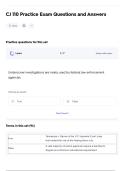
CJ 110 Practice Exam Questions and Answers
Save
Practice questions for this set
Learn 1 /7 Study with Learn
Undercover investigations are rarely used by federal law enforcement
agencies.
Choose an answer
1 True 2 False
Don't know?
Terms in this set (94)
Tennessee v. Garner is the U.S. Supreme Court case
true
that ended the use of the fleeing felon rule.
A vast majority of police agencies require a bachelor's
false
degree as a minimum educational requirement.
, Numerous academic studies have indicated that the
nature of policing and the experiences officers go
true
through on the job cause them to band together into
their own subculture.
Probable cause is a series of facts that would indicate
to a "reasonable person" that a crime is being
true
committed or was committed and that a certain
person is committing or did commit it.
The two primary goals and objectives of police
true departments, according to Sheehan and Cordner, are
maintaining order and protecting life and property.
false All states in the United States permit lateral transfers.
Generally, state police patrol small towns and state
true highways, regulate traffic, and have the primary
responsibility to enforce some state laws.
London's first large-scale, civil police department
true
consisted of approximately l,000 men.
Some experts say that stress alone probably does not
true cause illness, but it contributes to circumstances in
which diseases may take hold and flourish.
Most small cities in the United States have their own
false
police academies.
The Kansas City Study determined that decreasing or
increasing routine preventive patrol within the range
tested in the experiment had no effect on crime,
true
citizen fear of crime, community attitudes toward the
police on the delivery of police service, police
response time, or traffic accidents.
Probable cause is the standard of proof a police
true
officer needs to arrest an individual.
The concept of problem-oriented policing can be
true
attributed to Herman Goldstein.
Save
Practice questions for this set
Learn 1 /7 Study with Learn
Undercover investigations are rarely used by federal law enforcement
agencies.
Choose an answer
1 True 2 False
Don't know?
Terms in this set (94)
Tennessee v. Garner is the U.S. Supreme Court case
true
that ended the use of the fleeing felon rule.
A vast majority of police agencies require a bachelor's
false
degree as a minimum educational requirement.
, Numerous academic studies have indicated that the
nature of policing and the experiences officers go
true
through on the job cause them to band together into
their own subculture.
Probable cause is a series of facts that would indicate
to a "reasonable person" that a crime is being
true
committed or was committed and that a certain
person is committing or did commit it.
The two primary goals and objectives of police
true departments, according to Sheehan and Cordner, are
maintaining order and protecting life and property.
false All states in the United States permit lateral transfers.
Generally, state police patrol small towns and state
true highways, regulate traffic, and have the primary
responsibility to enforce some state laws.
London's first large-scale, civil police department
true
consisted of approximately l,000 men.
Some experts say that stress alone probably does not
true cause illness, but it contributes to circumstances in
which diseases may take hold and flourish.
Most small cities in the United States have their own
false
police academies.
The Kansas City Study determined that decreasing or
increasing routine preventive patrol within the range
tested in the experiment had no effect on crime,
true
citizen fear of crime, community attitudes toward the
police on the delivery of police service, police
response time, or traffic accidents.
Probable cause is the standard of proof a police
true
officer needs to arrest an individual.
The concept of problem-oriented policing can be
true
attributed to Herman Goldstein.