

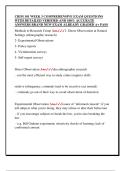
CRIM 101 WEEK 3 COMPREHENSIVE EXAM QUESTIONS
WITH DETAILED VERIFIED AND 100% ACCURATE
ANSWERS BRAND NEW EXAM ALREADY GRADED A+ PASS
Methods to Research Crime Ans✓✓✓1- Direct Observation in Natural
Settings (ethnographic research)
2- Experimental Observations
3- Police reports
4- Victimization surveys
5- Self-report surveys
Direct Observation Ans✓✓✓aka ethnographic research
- not the most efficient way to study crime (requires skill)
relative infrequency; criminals tend to be secretive (act normal)
- criminals go out of their way to avoid observation of detection
Experimental Observation Ans✓✓✓issues of "informed consent"; if you
tell subjects what you're doing, they may refuse or alter their behaviour
- if you encourage subjects to break the law, you're also breaking the
law
- e.g. Bill Graham experiment; electricity shocks of learning; lack of
conformed consent
, Uniform Crime Report (UCR) Ans✓✓✓implemented in 1962, and is the
most common data used by criminologists intended to standardize the
collection and assembly of police reported crime stats (less than perfect)
- made to get a "clearer/bigger picture"
- variations in reporting and interpreting data
- indicates that crime has been decreasing almost annually since the
early 1990s
The dark figure of crime Ans✓✓✓vast amount of crime that is not
reported to police (estimated to be 2/3 of all crime, GSS) - thus not
reflected on UCR (based solely on police reports)
The dark figure of reporting Ans✓✓✓once a crime is reported to police,
it goes through a process of assessment, classification and perhaps
recording
— police decisions making can be influenced by factors such as
relationship b/w the victim, eliciting style, etc...
Constructionist perspective Ans✓✓✓argues that identification, coding,
and counting of crime is an inherently social process; how we identify,
code and count crime says as much about our society and our justice
system as it does about the amount of crime
- police "produce" crime stats by choosing which ones they think are
important enough to warrant a police response, and also through exercise
of police discretion (e.g. dealing with situations formally [by charge] or
informally [resolving problem w/o charges])
WITH DETAILED VERIFIED AND 100% ACCURATE
ANSWERS BRAND NEW EXAM ALREADY GRADED A+ PASS
Methods to Research Crime Ans✓✓✓1- Direct Observation in Natural
Settings (ethnographic research)
2- Experimental Observations
3- Police reports
4- Victimization surveys
5- Self-report surveys
Direct Observation Ans✓✓✓aka ethnographic research
- not the most efficient way to study crime (requires skill)
relative infrequency; criminals tend to be secretive (act normal)
- criminals go out of their way to avoid observation of detection
Experimental Observation Ans✓✓✓issues of "informed consent"; if you
tell subjects what you're doing, they may refuse or alter their behaviour
- if you encourage subjects to break the law, you're also breaking the
law
- e.g. Bill Graham experiment; electricity shocks of learning; lack of
conformed consent
, Uniform Crime Report (UCR) Ans✓✓✓implemented in 1962, and is the
most common data used by criminologists intended to standardize the
collection and assembly of police reported crime stats (less than perfect)
- made to get a "clearer/bigger picture"
- variations in reporting and interpreting data
- indicates that crime has been decreasing almost annually since the
early 1990s
The dark figure of crime Ans✓✓✓vast amount of crime that is not
reported to police (estimated to be 2/3 of all crime, GSS) - thus not
reflected on UCR (based solely on police reports)
The dark figure of reporting Ans✓✓✓once a crime is reported to police,
it goes through a process of assessment, classification and perhaps
recording
— police decisions making can be influenced by factors such as
relationship b/w the victim, eliciting style, etc...
Constructionist perspective Ans✓✓✓argues that identification, coding,
and counting of crime is an inherently social process; how we identify,
code and count crime says as much about our society and our justice
system as it does about the amount of crime
- police "produce" crime stats by choosing which ones they think are
important enough to warrant a police response, and also through exercise
of police discretion (e.g. dealing with situations formally [by charge] or
informally [resolving problem w/o charges])


