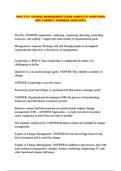
WGU C721 CHANGE MANAGEMENT EXAM COMPLETE QUESTIONS
AND CORRECT ANSWERS (2026-2027)
The five ANSWER components—planning, organizing, directing, controlling
resources, and staffing—support the achievement of organizational goals.
Management's response Working with and through people to accomplish
organizational objectives is the process of management.
Leadership: A REPLY Since leadership is complicated by nature, it is
challenging to define.
Qualities of a successful change agent: ANSWER They identify as leaders of
change.
ANSWER: Leadership is not risk averse.
Possessing expert knowledge is a personal trait that makes a manager good.
ANSWER: Organizational development (OD) the process of transforming
businesses and individuals to promote growth.
Business content and behavioral process professionals employ change
management (CM)—ANSWER Approaches—to help executives transition
entire companies or units from one state to another.
The strategies employed by ANSWER Business content are included in change
management.
Experts in Change Management: ANSWER Provide knowledge based on the
kind of program and its need for change.
Experts in Change Management: ANSWER In addition to the process, deal with
more technical management, strategy, finance, marketing, engineering, IT, and
other functional content skill areas.
, A Specialist in Change Management - ANSWER aids in working in teams and
bringing the company's goals and procedures into line with the new, intended
structure, processes, and strategy.
Experts in Organizational Development - ANSWER Pay attention to how
managers, executives, and staff interact, communicate, plan, sell, and resolve
issues.
The first planned change is ANSWER. gaining the ability to recognize, analyze,
and react to patterns set off by outside circumstances.
Technological, Economic, Environmental, Government & Political,
Sociocultural, Globalization, and Natural/Human are examples of external
forces.
Technological, economic, political-legal, and sociocultural forces are the
internal forces.
ANSWER Competitive advantage, control, impatient capital markets, cost
containment, and environmental factors are the driving forces behind change.
The following factors contribute to stability: transaction costs, institutionalism,
sustained advantage, organizational social capital, and answer predictability and
uncertainty reduction.
Error Type 1: ANSWER Although the environment is calm, managers and
leaders think it is tumultuous.
Error Type 2: ANSWER Although the environment is tumultuous, managers
and leaders believe it to be stable.
ANSWER: Developmental Change an enhancement of the current situation.
does not always need to be expansive in scope or scale.
Answer to Transitional Change consists of an implementation to change the
current state and reach a known intended state. can necessitate retraining and
AND CORRECT ANSWERS (2026-2027)
The five ANSWER components—planning, organizing, directing, controlling
resources, and staffing—support the achievement of organizational goals.
Management's response Working with and through people to accomplish
organizational objectives is the process of management.
Leadership: A REPLY Since leadership is complicated by nature, it is
challenging to define.
Qualities of a successful change agent: ANSWER They identify as leaders of
change.
ANSWER: Leadership is not risk averse.
Possessing expert knowledge is a personal trait that makes a manager good.
ANSWER: Organizational development (OD) the process of transforming
businesses and individuals to promote growth.
Business content and behavioral process professionals employ change
management (CM)—ANSWER Approaches—to help executives transition
entire companies or units from one state to another.
The strategies employed by ANSWER Business content are included in change
management.
Experts in Change Management: ANSWER Provide knowledge based on the
kind of program and its need for change.
Experts in Change Management: ANSWER In addition to the process, deal with
more technical management, strategy, finance, marketing, engineering, IT, and
other functional content skill areas.
, A Specialist in Change Management - ANSWER aids in working in teams and
bringing the company's goals and procedures into line with the new, intended
structure, processes, and strategy.
Experts in Organizational Development - ANSWER Pay attention to how
managers, executives, and staff interact, communicate, plan, sell, and resolve
issues.
The first planned change is ANSWER. gaining the ability to recognize, analyze,
and react to patterns set off by outside circumstances.
Technological, Economic, Environmental, Government & Political,
Sociocultural, Globalization, and Natural/Human are examples of external
forces.
Technological, economic, political-legal, and sociocultural forces are the
internal forces.
ANSWER Competitive advantage, control, impatient capital markets, cost
containment, and environmental factors are the driving forces behind change.
The following factors contribute to stability: transaction costs, institutionalism,
sustained advantage, organizational social capital, and answer predictability and
uncertainty reduction.
Error Type 1: ANSWER Although the environment is calm, managers and
leaders think it is tumultuous.
Error Type 2: ANSWER Although the environment is tumultuous, managers
and leaders believe it to be stable.
ANSWER: Developmental Change an enhancement of the current situation.
does not always need to be expansive in scope or scale.
Answer to Transitional Change consists of an implementation to change the
current state and reach a known intended state. can necessitate retraining and