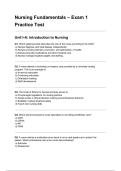
Nursing Fundamentals – Exam 1
Practice Test
Unit I-A: Introduction to Nursing
Q1. Which statement best describes the role of the nurse according to the ANA?
a) Nurses diagnose and treat disease independently.
b) Nurses provide protection, promotion, and optimization of health.
c) Nurses prescribe medications and direct medical care.
d) Nurses manage hospital budgets and staffing.
Q2. A nurse attends a workshop on hospice care provided by a university nursing
program. This is an example of:
a) In-service education
b) Continuing education
c) Orientation training
d) Staff development
Q3. The Code of Ethics for Nurses primarily serves to:
a) Provide legal regulations for nursing practice
b) Guide nurses in ethical decision-making and professional behavior
c) Establish medical treatment plans
d) Teach new nursing skills
Q4. Which advanced practice nurse specializes in providing anesthesia care?
a) CNS
b) CRNA
c) NP
d) CNM
Q5. A nurse notices a medication error about to occur and speaks up to protect the
patient. Which professional role is the nurse demonstrating?
a) Educator
b) Researcher
, c) Patient advocate
d) Administrator
Unit I-F: Health Care Delivery Systems
Q6. A patient recovering from hip replacement is transferred to a facility for
physical therapy and strengthening before returning home. This describes:
a) Primary care
b) Secondary care
c) Restorative care
d) Palliative care
Q7. Which law increased access to health care insurance for millions of Americans?
a) Medicare Act
b) Social Security Act
c) Affordable Care Act
d) Nurse Practice Act
Q8. Which of the following are examples of nursing-sensitive outcomes? (Select all
that apply)
a) Fall rates
b) Infection rates
c) Nurse job satisfaction
d) Cost savings for the hospital
e) Pressure injury prevalence
Q9. A patient who is terminally ill chooses care focused on comfort, dignity, and
symptom relief rather than cure. Which service is most appropriate?
a) Hospice care
b) Respite care
c) Acute care
d) Secondary care
Q10. Telehealth is especially beneficial because it:
a) Replaces all in-person visits
b) Expands access to care in rural and underserved areas
c) Reduces the need for nurses
d) Guarantees lower cost care
Practice Test
Unit I-A: Introduction to Nursing
Q1. Which statement best describes the role of the nurse according to the ANA?
a) Nurses diagnose and treat disease independently.
b) Nurses provide protection, promotion, and optimization of health.
c) Nurses prescribe medications and direct medical care.
d) Nurses manage hospital budgets and staffing.
Q2. A nurse attends a workshop on hospice care provided by a university nursing
program. This is an example of:
a) In-service education
b) Continuing education
c) Orientation training
d) Staff development
Q3. The Code of Ethics for Nurses primarily serves to:
a) Provide legal regulations for nursing practice
b) Guide nurses in ethical decision-making and professional behavior
c) Establish medical treatment plans
d) Teach new nursing skills
Q4. Which advanced practice nurse specializes in providing anesthesia care?
a) CNS
b) CRNA
c) NP
d) CNM
Q5. A nurse notices a medication error about to occur and speaks up to protect the
patient. Which professional role is the nurse demonstrating?
a) Educator
b) Researcher
, c) Patient advocate
d) Administrator
Unit I-F: Health Care Delivery Systems
Q6. A patient recovering from hip replacement is transferred to a facility for
physical therapy and strengthening before returning home. This describes:
a) Primary care
b) Secondary care
c) Restorative care
d) Palliative care
Q7. Which law increased access to health care insurance for millions of Americans?
a) Medicare Act
b) Social Security Act
c) Affordable Care Act
d) Nurse Practice Act
Q8. Which of the following are examples of nursing-sensitive outcomes? (Select all
that apply)
a) Fall rates
b) Infection rates
c) Nurse job satisfaction
d) Cost savings for the hospital
e) Pressure injury prevalence
Q9. A patient who is terminally ill chooses care focused on comfort, dignity, and
symptom relief rather than cure. Which service is most appropriate?
a) Hospice care
b) Respite care
c) Acute care
d) Secondary care
Q10. Telehealth is especially beneficial because it:
a) Replaces all in-person visits
b) Expands access to care in rural and underserved areas
c) Reduces the need for nurses
d) Guarantees lower cost care