

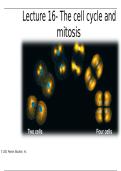
Lecture 16- The cell cycle and
mitosis
© 2021 Pearson Education, Inc.
, Today’s lesson: How do cells divide?
Dylan Brunette, Vanderbilt University.
Actin filaments in a cell are color-coded by depth.
https://www.hhmi.org/beautifulbiology/scroll-and-tell/cell-division
, Learning objectives
• Describe the function of asexual cell division and its genetic outcom
• Understand chromosome structure.
• Chromosome, chromatid, centromere.
• Understand and identify major phases of the eukaryotic cell cycle.
• What is happening to the chromosomes during each of these
• Be able to describe the major events occurring during the five
stages of mitosis.
• C hromosome dynamics at each stage.
• Cellular events that are taking place:
• Nuclear envelope
• Mitotic spindle
• Kinetochores
, “omnis cellula e cellula” (every cell comes from
cell)- Rudolph Virchow, 1855
• Cells reproduce by cell division, a
process where one cell divides to
make two daughter cells.
• The ability to reproduce distinguis
living things from non-living thing
• Genetic information from mother t
daughter cell must be correctly
transmitted for life to
continue.
https://embryology.med.unsw.edu.au/embryology/index.php?
title=Human_Embryo_Development_Movie
mitosis
© 2021 Pearson Education, Inc.
, Today’s lesson: How do cells divide?
Dylan Brunette, Vanderbilt University.
Actin filaments in a cell are color-coded by depth.
https://www.hhmi.org/beautifulbiology/scroll-and-tell/cell-division
, Learning objectives
• Describe the function of asexual cell division and its genetic outcom
• Understand chromosome structure.
• Chromosome, chromatid, centromere.
• Understand and identify major phases of the eukaryotic cell cycle.
• What is happening to the chromosomes during each of these
• Be able to describe the major events occurring during the five
stages of mitosis.
• C hromosome dynamics at each stage.
• Cellular events that are taking place:
• Nuclear envelope
• Mitotic spindle
• Kinetochores
, “omnis cellula e cellula” (every cell comes from
cell)- Rudolph Virchow, 1855
• Cells reproduce by cell division, a
process where one cell divides to
make two daughter cells.
• The ability to reproduce distinguis
living things from non-living thing
• Genetic information from mother t
daughter cell must be correctly
transmitted for life to
continue.
https://embryology.med.unsw.edu.au/embryology/index.php?
title=Human_Embryo_Development_Movie


