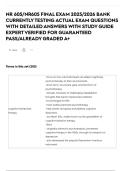
NR 605/NR605 FINAL EXAM 2025/2026 BANK
CURRENTLY TESTING ACTUAL EXAM QUESTIONS
WITH DETAILED ANSWERS WITH STUDY GUIDE
EXPERT VERIFIED FOR GUARANTEED
PASS/ALREADY GRADED A+
Save
Terms in this set (205)
-focus on how well individuals can adapt cognitively
and functionally to their environments
-short-term, structured, goal-oriented form of
psychotherapy
-stresses necessity of challenging maladaptive
thoughts that lead to behavioral problems
-first emerged in 1955
-most widely practiced psychotherapy
cognitive-behavioral -help clients recognize and address cognitive
therapy distortions
• by Albert Ellis, widely known as the grandfather of
cognitive behavior therapy
-Beck
• originally trained in psychoanalysis, pioneered
cognitive therapy in the 1960s, through his research on
depression
• also developed the popular Depression Inventory
instrument
, -Orem's self-care deficit nursing theory
• provides a framework to view CBT as a supportive
intervention
• fosters effective self-care behaviors
CBT Relationship to
Nursing Theory
-Roy's Adaptation Theory
• premise that individuals use coping mechanisms to
adapt to stimuli, both internal and external
• share underpinnings with CBT.
-treatment of a wide range of diagnoses
• depression
• anxiety disorders
Indications for CBT • substance use disorders
• eating disorders
• severe mental illness
• PTSD
-way an ind cognitively structures thoughts about self
& the world determines how the ind feels & behaves
-Dysfunctional thoughts are rooted in irrational
assumptions
-Dysfunctional thinking and learned patterns of
maladaptive behavior contribute to psychological
Principles of CBT include: problems
-Ind's can learn more adaptive behaviors which can
relieve symptoms & improve quality of life
-CBT is (+) & stresses collaboration & active
participation
-CBT includes action plans in the form of therapy
homework
, -using a structured, collaborative approach to help
clients recognize and reevaluate cognitive distortions
-help clients:
• better understand the behaviors of others
Role of the
• develop improved coping skills
Psychotherapist in CBT
-Psychoeducation
-Homework
• to help clients reinforce & build on what was learned
during the therapy session
-helps individuals prepare for change
-person-centered, evidence-based approach to
behavior change
-using a collaborative, goal-oriented communication
style
-empowers clients to draw on their meanings &
motivational interviewing
capacities to facilitate change
(MI)
• addressing issues with ambivalence and resistance
-grew out of William R. Miller's clinical practice
working with clients with substance use disorders in
the 1980s
• collaborated with Stephen Rollnick to write book:
Motivational interviewing
-reduction of substance use and health promotion
Indications for MI -improving medication adherence in clients with
schizophrenia
-acceptance
-empathy
-compassion
MI Guiding Principles -respect of client autonomy
-acknowledgment of the client's strengths & efforts
-Spirit of MI
• Partnership, compassion, acceptance, evocation
, represented by the mnemonic RULE:
MI Role of the Resist the righting reflex
Psychotherapist Understand the patient's motivation
Listen to the patient
Empower the patient
Communication skills for MI:
-Open questions
• cannot be answered with a yes or no, require
elaboration
-Affirming
• provide encouragement, are (+) comments on a
client's strengths or efforts
-Reflecting
• mirror the content or feelings explicitly or implicitly
OARS
stated by the client
• convey empathy, demonstrate listening, highlight
emotions & beliefs, • provide opportunities for the
client to elaborate on their concerns
• empower clients to take control of the conversation
• recommended to use at least two reflections for
every question
-Summarizing
• links together what has been stated to help the
client organize their experiences
CURRENTLY TESTING ACTUAL EXAM QUESTIONS
WITH DETAILED ANSWERS WITH STUDY GUIDE
EXPERT VERIFIED FOR GUARANTEED
PASS/ALREADY GRADED A+
Save
Terms in this set (205)
-focus on how well individuals can adapt cognitively
and functionally to their environments
-short-term, structured, goal-oriented form of
psychotherapy
-stresses necessity of challenging maladaptive
thoughts that lead to behavioral problems
-first emerged in 1955
-most widely practiced psychotherapy
cognitive-behavioral -help clients recognize and address cognitive
therapy distortions
• by Albert Ellis, widely known as the grandfather of
cognitive behavior therapy
-Beck
• originally trained in psychoanalysis, pioneered
cognitive therapy in the 1960s, through his research on
depression
• also developed the popular Depression Inventory
instrument
, -Orem's self-care deficit nursing theory
• provides a framework to view CBT as a supportive
intervention
• fosters effective self-care behaviors
CBT Relationship to
Nursing Theory
-Roy's Adaptation Theory
• premise that individuals use coping mechanisms to
adapt to stimuli, both internal and external
• share underpinnings with CBT.
-treatment of a wide range of diagnoses
• depression
• anxiety disorders
Indications for CBT • substance use disorders
• eating disorders
• severe mental illness
• PTSD
-way an ind cognitively structures thoughts about self
& the world determines how the ind feels & behaves
-Dysfunctional thoughts are rooted in irrational
assumptions
-Dysfunctional thinking and learned patterns of
maladaptive behavior contribute to psychological
Principles of CBT include: problems
-Ind's can learn more adaptive behaviors which can
relieve symptoms & improve quality of life
-CBT is (+) & stresses collaboration & active
participation
-CBT includes action plans in the form of therapy
homework
, -using a structured, collaborative approach to help
clients recognize and reevaluate cognitive distortions
-help clients:
• better understand the behaviors of others
Role of the
• develop improved coping skills
Psychotherapist in CBT
-Psychoeducation
-Homework
• to help clients reinforce & build on what was learned
during the therapy session
-helps individuals prepare for change
-person-centered, evidence-based approach to
behavior change
-using a collaborative, goal-oriented communication
style
-empowers clients to draw on their meanings &
motivational interviewing
capacities to facilitate change
(MI)
• addressing issues with ambivalence and resistance
-grew out of William R. Miller's clinical practice
working with clients with substance use disorders in
the 1980s
• collaborated with Stephen Rollnick to write book:
Motivational interviewing
-reduction of substance use and health promotion
Indications for MI -improving medication adherence in clients with
schizophrenia
-acceptance
-empathy
-compassion
MI Guiding Principles -respect of client autonomy
-acknowledgment of the client's strengths & efforts
-Spirit of MI
• Partnership, compassion, acceptance, evocation
, represented by the mnemonic RULE:
MI Role of the Resist the righting reflex
Psychotherapist Understand the patient's motivation
Listen to the patient
Empower the patient
Communication skills for MI:
-Open questions
• cannot be answered with a yes or no, require
elaboration
-Affirming
• provide encouragement, are (+) comments on a
client's strengths or efforts
-Reflecting
• mirror the content or feelings explicitly or implicitly
OARS
stated by the client
• convey empathy, demonstrate listening, highlight
emotions & beliefs, • provide opportunities for the
client to elaborate on their concerns
• empower clients to take control of the conversation
• recommended to use at least two reflections for
every question
-Summarizing
• links together what has been stated to help the
client organize their experiences