FBLA Human Resource Management Practice Test &
Study Tips
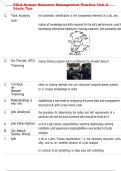
1. Task Analysis the systematic identification of the fundamental elements of a job, and
exam-
ination of knowledge and skills required for the job's performance; used fo
developing institutional objectives, training programs, and evaluation tool
2. On-The-Job (OTJ) means having a person learn a profession by actually doing it
Training
3. Comput- refers to training methods that use interactive computer-based systems
er- to in- crease knowledge or skills
Based
Training
4. Rebranding a establishing a new hotel by employing the same statt and management
Ho- tel structure but with a new moral code
5. Job Analysis the procedure for determining the duties and skill requirements of a
particular job and the kind of person who should be hired for it
6. Job Description a list of a job's duties, responsibilities, reporting relationships, working
conditions, and supervisory responsibilities—one product of a job
8. Go About
Some- thing analysis
7. Job a list of a job's "human requirements," i.e. the necessary education, skills,
ality, and so on—another product of a job analysis
to continue to do something; to keep busy with something
1/
125
, FBLA Human Resource Management Practice Test &
Study Tips
9. reactivity the degree to which something reacts or is likely to react
BrE /ˌriːækˈtɪvɪti/
; NAmE
/ˌriːækˈtɪvɪti/
10. chronologica (of a number of events) arranged in the order in which they happened
l BrE
/ˌkrɒnəˈlɒdʒɪkl/ ;
NAmE
/ˌkrɑːnəˈlɑːdʒɪkl/
11. incumbent
BrE /ɪnˈkʌmbənt/ a person who has an oflcial position
; NAmE /ɪnˈkʌm-
bənt/
12. Job Summary/Job - general nature of the job
Description - major functions/activities job
13. Job Identifica- title
tion/Job Descrip-
tion
FLSA status section preparation
date
preparer
14. Relationships reports to:
supervise
s: works
with:
outside the company:
2/
125
, FBLA Human Resource Management Practice Test &
Study Tips
15. Responsibilitie major responsibilities and duties (essential
s and Duties
functions) decision-making authority
direct supervision
16. Writing Job budgetary limitations
De- scriptions
1. Decide on a Plan
2. Develop an Organization Chart
3. Use a Simplified Job Analysis Questionnaire
4. Obtain List of Job Duties from Occupational Information Network
17. Writing Job (O*NET)
Spec- ifications
5. Compile the Job's Human Requirements from O*NET
6. Finalize the Job Description
1. Analyze the job and decide how to guage job performance.
2. Select personal traits that you believe should predict successful
performance.
18. Off-The-Shelf
3. Test candidates for these traits.
4. Measure the candidates' subsequent job performance.
5. Statistically analyze the relationship between the human traits and
job perfor- mance.
6. Finalize the Job Specifications
3/
125
, FBLA Human Resource Management Practice Test & Study
Tips
a product) not designed or made to order but taken from existing stock
or supplies.
19. viable that can be done; that will be capable of developing and surviving independently
BrE /ˈvaɪəbl/ ; NAmE
/ˈvaɪəbl/ viable candidates
20. Personnel
Plan- ning process of determining an organization's human resource needs
21. Succession
Plan- ning
process for identifying and developing new leaders who can replace
22. Scatter Plot old leaders when they retire or die
(also called a
scat- a graph in which the values of two variables are plotted along two axes, with
ter graph, scat- ter the pattern of the resulting points revealing any correlation present
chart, scatter-
gram, or
scatter
diagram)
23. initiative
BrE /ɪˈnɪʃətɪv/ ;
NAmE /ɪˈnɪʃətɪv/new plan for dealing with a particular problem or for achieving a
particular purpose
24. institutionalize
BrE /ˌɪn- stɪ
ˈtjuːʃənəlaɪz/ ;
NAmE /ˌɪnstɪˈ- *institutionalize somebody :
tuːʃənəlaɪz/ to send somebody who is not capable of living independently to live in a special
building (= an institution) especially when it is for a long period of time
*institutionalize something:
make something become part of an organized system, society or culture, so
that it is considered normal
25. a set of statistics used for measuring something, especially results that
show how well a business, school, computer program, etc. is doing
4/
125
Study Tips
1. Task Analysis the systematic identification of the fundamental elements of a job, and
exam-
ination of knowledge and skills required for the job's performance; used fo
developing institutional objectives, training programs, and evaluation tool
2. On-The-Job (OTJ) means having a person learn a profession by actually doing it
Training
3. Comput- refers to training methods that use interactive computer-based systems
er- to in- crease knowledge or skills
Based
Training
4. Rebranding a establishing a new hotel by employing the same statt and management
Ho- tel structure but with a new moral code
5. Job Analysis the procedure for determining the duties and skill requirements of a
particular job and the kind of person who should be hired for it
6. Job Description a list of a job's duties, responsibilities, reporting relationships, working
conditions, and supervisory responsibilities—one product of a job
8. Go About
Some- thing analysis
7. Job a list of a job's "human requirements," i.e. the necessary education, skills,
ality, and so on—another product of a job analysis
to continue to do something; to keep busy with something
1/
125
, FBLA Human Resource Management Practice Test &
Study Tips
9. reactivity the degree to which something reacts or is likely to react
BrE /ˌriːækˈtɪvɪti/
; NAmE
/ˌriːækˈtɪvɪti/
10. chronologica (of a number of events) arranged in the order in which they happened
l BrE
/ˌkrɒnəˈlɒdʒɪkl/ ;
NAmE
/ˌkrɑːnəˈlɑːdʒɪkl/
11. incumbent
BrE /ɪnˈkʌmbənt/ a person who has an oflcial position
; NAmE /ɪnˈkʌm-
bənt/
12. Job Summary/Job - general nature of the job
Description - major functions/activities job
13. Job Identifica- title
tion/Job Descrip-
tion
FLSA status section preparation
date
preparer
14. Relationships reports to:
supervise
s: works
with:
outside the company:
2/
125
, FBLA Human Resource Management Practice Test &
Study Tips
15. Responsibilitie major responsibilities and duties (essential
s and Duties
functions) decision-making authority
direct supervision
16. Writing Job budgetary limitations
De- scriptions
1. Decide on a Plan
2. Develop an Organization Chart
3. Use a Simplified Job Analysis Questionnaire
4. Obtain List of Job Duties from Occupational Information Network
17. Writing Job (O*NET)
Spec- ifications
5. Compile the Job's Human Requirements from O*NET
6. Finalize the Job Description
1. Analyze the job and decide how to guage job performance.
2. Select personal traits that you believe should predict successful
performance.
18. Off-The-Shelf
3. Test candidates for these traits.
4. Measure the candidates' subsequent job performance.
5. Statistically analyze the relationship between the human traits and
job perfor- mance.
6. Finalize the Job Specifications
3/
125
, FBLA Human Resource Management Practice Test & Study
Tips
a product) not designed or made to order but taken from existing stock
or supplies.
19. viable that can be done; that will be capable of developing and surviving independently
BrE /ˈvaɪəbl/ ; NAmE
/ˈvaɪəbl/ viable candidates
20. Personnel
Plan- ning process of determining an organization's human resource needs
21. Succession
Plan- ning
process for identifying and developing new leaders who can replace
22. Scatter Plot old leaders when they retire or die
(also called a
scat- a graph in which the values of two variables are plotted along two axes, with
ter graph, scat- ter the pattern of the resulting points revealing any correlation present
chart, scatter-
gram, or
scatter
diagram)
23. initiative
BrE /ɪˈnɪʃətɪv/ ;
NAmE /ɪˈnɪʃətɪv/new plan for dealing with a particular problem or for achieving a
particular purpose
24. institutionalize
BrE /ˌɪn- stɪ
ˈtjuːʃənəlaɪz/ ;
NAmE /ˌɪnstɪˈ- *institutionalize somebody :
tuːʃənəlaɪz/ to send somebody who is not capable of living independently to live in a special
building (= an institution) especially when it is for a long period of time
*institutionalize something:
make something become part of an organized system, society or culture, so
that it is considered normal
25. a set of statistics used for measuring something, especially results that
show how well a business, school, computer program, etc. is doing
4/
125