Chapter 1
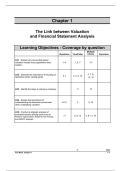
The Link between Valuation
and Financial Statement Analysis
Learning Objectives - Coverage by question
Multiple
Questions True/False Choice Exercises
LO1 - Explain why accounting-based
valuation models may supplement other 1-4 1, 6, 7 1-3
models.
LO2 - Describe the importance of focusing on 4, 7, 8,
5-7 2, 4, 8, 10
operations when valuing equity. 12, 15
LO3 - Identify the steps to valuing a company. 11 13
LO4 - Explain the importance of
understanding the business environment 8-10 3 9, 10
when undertaking valuation.
LO5 - Conduct a strategic analysis of
business/industry utilizing tools such as
11 5, 9, 12 5, 6, 11, 14
Porter’s Value-Chain, Porter’s Five Forces,
and SWOT analysis.
© 2025
Test Bank, Chapter 1 1-1
, QUESTIONS
1. LO: 1
Explain whether valuation concepts, tools, and techniques are applicable beyond the valuation of
publicly traded firms.
The fundamental elements of valuation (i.e., understanding the business, identifying and
evaluating the drivers of value creation, forecasting future payoffs culminating in a valuation) are
applicable to a variety of settings, including valuation of privately held firms, merger transactions,
project analysis, and implementation of accounting standards involving fair value estimates.
2. LO: 1
What is the role of financial accounting with respect to valuation?
Financial accounting provides information about the amount, timing, and uncertainty of future
payoffs; the essential elements required for valuation.
3. LO: 1
What are the advantages of using accounting-based valuation models over cash flow valuation
models?
People typically forecast earnings, not cash flows. The earnings forecast is converted to cash flow
forecasts. Accounting based valuation models avoid the additional step of converting the earnings
to cash flows. Additionally, firms with negative free cash flows are not problematic with earnings-
based forecasts.
4. LO: 1
Explain how negative free cash flows can affect valuation and the alternatives available.
Negative free cash flows complicate valuation as they indicate potential financial distress.
Alternatives include using accounting-based models that focus on earnings and other accounting
measures.
5. LO: 2
What is the benefit of valuing the enterprise operations relative to valuing the firm’s equity?
By valuing the enterprise operations, the analyst does not need to forecast the firm’s future
leverage (i.e., the portion of debt to equity). This approach allows a cleaner analysis with fewer
assumptions.
© 2025
1-2 Valuation Using Financial Statements, 3rd Edition
,6. LO: 2
Explain why the financial statements need to be reformulated when conducting a valuation.
Operating activities are primarily how companies create value. By reformulating the financial
statements between operating and financing activities, there is greater visibility of the value
creation drivers for the organization. This allows for better historical analysis as well as forecasting
future payoffs within the valuation.
7. LO: 2
How do revenues and expenses differ from the resulting cash flows?
The difference between revenues and expenses from the related cash flows is the accruals. The
accruals represent the timing differences between the recognition of the revenue and expense and
the cash flows. Additionally, the accruals include accounting estimates (e.g., bad debt expense).
For example, the change in accounts receivable, including the allowance for bad debts explains the
difference between sale revenues and the resulting cash flows.
8. LO: 4
What is a limitation of using a company’s Form 10-K, section 1A, Risk Factors, as the source of the
material risks facing the company?
The Risk Factors section of the Form 10-K provides an accurate list of potential risks and
uncertainties for the company. However, the number of risk factors disclosed can be extensive and
it effectively weighs all risks equally. The risks need to be evaluated by their impact and relevance
in impacting the firm’s future financial position and performance.
9. LO: 4
How does Understanding the Business and the Business Environment provide a more accurate
valuation?
Without a solid understanding of the business and its environment, the financial analysis, and
subsequent forecasts, can be misleading resulting in poor estimates of expected payoffs. Financial
analysis requires a strong understanding of the business to correctly evaluate the firm’s financial
position and performance. Additionally, having a strong understanding of the business and its
environment allows for better forecasts that reflect the firm’s economic reality. Financial analysis
and forecasting resulting in better estimates of future payoffs results in a more accurate valuation.
10. LO: 4
Identify the fundamentals in Understanding the Business and the Business Environment.
The essential elements to understanding the business are (1) knowing the company’s primary
operating activity(ies), (2) the company’s customers, (3) and suppliers, and (4) identifying the
company’s material risk and uncertainties.
© 2025
Test Bank, Chapter 1 1-3
, 11. LO: 5
How does understanding a company’s life cycle stage impact forecasts of operating asset turnover
and profit margin?
The expectation of operating asset turnover and profit margin change as a company moves
through the various life cycle stages. In the Introduction phase, operating asset turnovers and
profit margins are generally lower than in growth or mature phase. As the company moves to
shake-out or decline, profit margins will decrease as will operating asset turnover. Having an
understanding of the firm’s life cycle stage will facilitate more accurate forecasts.
© 2025
1-4 Valuation Using Financial Statements, 3rd Edition
The Link between Valuation
and Financial Statement Analysis
Learning Objectives - Coverage by question
Multiple
Questions True/False Choice Exercises
LO1 - Explain why accounting-based
valuation models may supplement other 1-4 1, 6, 7 1-3
models.
LO2 - Describe the importance of focusing on 4, 7, 8,
5-7 2, 4, 8, 10
operations when valuing equity. 12, 15
LO3 - Identify the steps to valuing a company. 11 13
LO4 - Explain the importance of
understanding the business environment 8-10 3 9, 10
when undertaking valuation.
LO5 - Conduct a strategic analysis of
business/industry utilizing tools such as
11 5, 9, 12 5, 6, 11, 14
Porter’s Value-Chain, Porter’s Five Forces,
and SWOT analysis.
© 2025
Test Bank, Chapter 1 1-1
, QUESTIONS
1. LO: 1
Explain whether valuation concepts, tools, and techniques are applicable beyond the valuation of
publicly traded firms.
The fundamental elements of valuation (i.e., understanding the business, identifying and
evaluating the drivers of value creation, forecasting future payoffs culminating in a valuation) are
applicable to a variety of settings, including valuation of privately held firms, merger transactions,
project analysis, and implementation of accounting standards involving fair value estimates.
2. LO: 1
What is the role of financial accounting with respect to valuation?
Financial accounting provides information about the amount, timing, and uncertainty of future
payoffs; the essential elements required for valuation.
3. LO: 1
What are the advantages of using accounting-based valuation models over cash flow valuation
models?
People typically forecast earnings, not cash flows. The earnings forecast is converted to cash flow
forecasts. Accounting based valuation models avoid the additional step of converting the earnings
to cash flows. Additionally, firms with negative free cash flows are not problematic with earnings-
based forecasts.
4. LO: 1
Explain how negative free cash flows can affect valuation and the alternatives available.
Negative free cash flows complicate valuation as they indicate potential financial distress.
Alternatives include using accounting-based models that focus on earnings and other accounting
measures.
5. LO: 2
What is the benefit of valuing the enterprise operations relative to valuing the firm’s equity?
By valuing the enterprise operations, the analyst does not need to forecast the firm’s future
leverage (i.e., the portion of debt to equity). This approach allows a cleaner analysis with fewer
assumptions.
© 2025
1-2 Valuation Using Financial Statements, 3rd Edition
,6. LO: 2
Explain why the financial statements need to be reformulated when conducting a valuation.
Operating activities are primarily how companies create value. By reformulating the financial
statements between operating and financing activities, there is greater visibility of the value
creation drivers for the organization. This allows for better historical analysis as well as forecasting
future payoffs within the valuation.
7. LO: 2
How do revenues and expenses differ from the resulting cash flows?
The difference between revenues and expenses from the related cash flows is the accruals. The
accruals represent the timing differences between the recognition of the revenue and expense and
the cash flows. Additionally, the accruals include accounting estimates (e.g., bad debt expense).
For example, the change in accounts receivable, including the allowance for bad debts explains the
difference between sale revenues and the resulting cash flows.
8. LO: 4
What is a limitation of using a company’s Form 10-K, section 1A, Risk Factors, as the source of the
material risks facing the company?
The Risk Factors section of the Form 10-K provides an accurate list of potential risks and
uncertainties for the company. However, the number of risk factors disclosed can be extensive and
it effectively weighs all risks equally. The risks need to be evaluated by their impact and relevance
in impacting the firm’s future financial position and performance.
9. LO: 4
How does Understanding the Business and the Business Environment provide a more accurate
valuation?
Without a solid understanding of the business and its environment, the financial analysis, and
subsequent forecasts, can be misleading resulting in poor estimates of expected payoffs. Financial
analysis requires a strong understanding of the business to correctly evaluate the firm’s financial
position and performance. Additionally, having a strong understanding of the business and its
environment allows for better forecasts that reflect the firm’s economic reality. Financial analysis
and forecasting resulting in better estimates of future payoffs results in a more accurate valuation.
10. LO: 4
Identify the fundamentals in Understanding the Business and the Business Environment.
The essential elements to understanding the business are (1) knowing the company’s primary
operating activity(ies), (2) the company’s customers, (3) and suppliers, and (4) identifying the
company’s material risk and uncertainties.
© 2025
Test Bank, Chapter 1 1-3
, 11. LO: 5
How does understanding a company’s life cycle stage impact forecasts of operating asset turnover
and profit margin?
The expectation of operating asset turnover and profit margin change as a company moves
through the various life cycle stages. In the Introduction phase, operating asset turnovers and
profit margins are generally lower than in growth or mature phase. As the company moves to
shake-out or decline, profit margins will decrease as will operating asset turnover. Having an
understanding of the firm’s life cycle stage will facilitate more accurate forecasts.
© 2025
1-4 Valuation Using Financial Statements, 3rd Edition