Wound Quiz 1 - Accurate Answers To All
Questions
Save
Terms in this set (35)
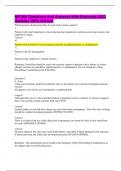
Which cells located in d. Fibroblasts.
the dermis produce
collagen (dermal Fibroblasts' main function is to make connective
building blocks) and tissue and the extracellular matrix, specifically the
elastin (tensile strength)? production of collagen (dermal building blocks) and
elastin (tensile strength) and fibronectin, which
Select one: binds extracellular matrix proteins.
a. Leukotrienes.
b. Mast cells.
c. Macrophages.
d. Fibroblasts.
,A patient has an acute d. Hemostatis, inflammation, proliferation or
full-thickness wound due regeneration, maturation or remodeling phases.
to trauma. What order of
healing would occur with The deeper the tissue layers affected, the greater
this wound? number of wound healing mechanisms required. Full
thickness wounds will experience all four phases of
Select one: wound healing: hemostasis, inflammation,
a. Inflammatory, proliferation where granulation tissue is formed, re-
hemostatis, granulation epithelialization, and finally the maturational or
tissue formation, re- remodeling phase.
epithelialization.
b. Re-epithelialization,
granulation tissue
formation, hemostasis,
remodeling.
c. Hemostatis,
resurfacing, scar
formation, remodeling.
d. Hemostatis,
inflammation,
proliferation or
regeneration, maturation
or remodeling phases.
, Which statement c. Color varies as necrosis worsens, from white/gray
accurately describes the nonviable tissue, to yellow slough, and finally to
characteristic and black eschar.
implication of necrotic
tissue in a wound bed? The level and type of tissue death influence the
clinical appearance of necrotic tissue. Color varies
Select one: as necrosis worsens, from white/gray nonviable
a. Necrosis of muscle tissue to yellow slough, and finally to firm leathery
tissue typically results in hard black eschar.
the formation of stringy,
yellow slough.
b. Consistency refers to
the cohesiveness of the
debris; typically more
advanced necrosis is thin
and wet.
c. Color varies as
necrosis worsens, from
white/gray nonviable
tissue, to yellow slough,
and finally to black
eschar.
d. A soft mushy leather
eschar is not attached to
the base and edges of
wound and is sometimes
mistaken as a scab.
Questions
Save
Terms in this set (35)
Which cells located in d. Fibroblasts.
the dermis produce
collagen (dermal Fibroblasts' main function is to make connective
building blocks) and tissue and the extracellular matrix, specifically the
elastin (tensile strength)? production of collagen (dermal building blocks) and
elastin (tensile strength) and fibronectin, which
Select one: binds extracellular matrix proteins.
a. Leukotrienes.
b. Mast cells.
c. Macrophages.
d. Fibroblasts.
,A patient has an acute d. Hemostatis, inflammation, proliferation or
full-thickness wound due regeneration, maturation or remodeling phases.
to trauma. What order of
healing would occur with The deeper the tissue layers affected, the greater
this wound? number of wound healing mechanisms required. Full
thickness wounds will experience all four phases of
Select one: wound healing: hemostasis, inflammation,
a. Inflammatory, proliferation where granulation tissue is formed, re-
hemostatis, granulation epithelialization, and finally the maturational or
tissue formation, re- remodeling phase.
epithelialization.
b. Re-epithelialization,
granulation tissue
formation, hemostasis,
remodeling.
c. Hemostatis,
resurfacing, scar
formation, remodeling.
d. Hemostatis,
inflammation,
proliferation or
regeneration, maturation
or remodeling phases.
, Which statement c. Color varies as necrosis worsens, from white/gray
accurately describes the nonviable tissue, to yellow slough, and finally to
characteristic and black eschar.
implication of necrotic
tissue in a wound bed? The level and type of tissue death influence the
clinical appearance of necrotic tissue. Color varies
Select one: as necrosis worsens, from white/gray nonviable
a. Necrosis of muscle tissue to yellow slough, and finally to firm leathery
tissue typically results in hard black eschar.
the formation of stringy,
yellow slough.
b. Consistency refers to
the cohesiveness of the
debris; typically more
advanced necrosis is thin
and wet.
c. Color varies as
necrosis worsens, from
white/gray nonviable
tissue, to yellow slough,
and finally to black
eschar.
d. A soft mushy leather
eschar is not attached to
the base and edges of
wound and is sometimes
mistaken as a scab.