Saint Paul School of Business and Law - ZDSFFSDF 21212 Economic Concepts Quiz 2.
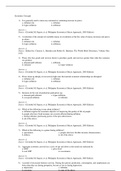
Economic Concepts 1.) It is generally used to mean any sustained or continuing increase in prices. a. inflation rate c. inflation b. hyper-inflation d. deflation Answer: c Source: (Cristobal M, Pagoso, et al, Philippine Economics (Macro Approach), 2003 Edition) 2.) A reduction of the amount of available money in circulation so that the value of money increases and prices go down. a. inflation rate c. inflation b. hyper-inflation d. deflation Answer: d Source: (Edited by: Clarence L. Barnhart and Robert K. Barnhart, The World Book Dictionary, Volume One: A-K) 3.) Those who buy goods and services desire to purchase goods and services greater than what the economy can produce. a. demand-pull inflation c. deflation b. inflation d. hyper-inflation Answer: a Source: (Cristobal M, Pagoso, et al, Philippine Economics (Macro Approach), 2003 Edition) 4.) Prices shoot up sharply at excessively high rates that normal economic relationships are disrupted. a. inflation rate c. inflation b. hyper-inflation d. deflation Answer: b Source: (Cristobal M, Pagoso, et al, Philippine Economics (Macro Approach), 2003 Edition) 5.) Increases in the cost of production push prices up. a. demand-pull inflation c. hyper-inflation b. cost-push-inflation d. inflation Answer: b Source: (Cristobal M, Pagoso, et al, Philippine Economics (Macro Approach), 2003 Edition) 6.) Which of the following is true about inflation? a. inflation negates the economic objective of improving the quality of life of people. b. people who have fixed incomes are severely affected during inflation. c. during inflation, purchasing power of the peso deteriorates. d. all of the above. Answer: d Source: (Cristobal M, Pagoso, et al, Philippine Economics (Macro Approach), 2003 Edition) 7.) Which of the following is a gainer during inflation? a. speculators c. people who have flexible incomes (businessmen) b. debtors d. all of the above Answer: d Source: (Cristobal M, Pagoso, et al, Philippine Economics (Macro Approach), 2003 Edition) 8.) Aggregate economic activity has a cycle of ups and down as the trends are indicated by a. GDP c. price level b. real GNP d. investments Answer: b Source: (Cristobal M, Pagoso, et al, Philippine Economics (Macro Approach), 2003 Edition 9.) A period of decreased business activity. During this period, production, consumption, and employment are lower than they are during prosperity, but not as low as during depression. a. depression c. inflation b. recession d. none of the above 2 Answer: b Source: (The World Book Encyclopedia, Volume 6) 10.) An extended slump in business activity. a. depression c. inflation b. recession d. none of the above Answer: a Source: (The World Book Encyclopedia, Volume 6) 11.) The amount of which a thing is sold or can be bought. a. barter c. expense b. money d. price Answer: d Source: (Edited by: Clarence L. Barnhart and Robert K. Barnhart, The World Book Dictionary, Volume Two: L-Z) 12.) The fixing of prices, usually by a government agency, establishing maximum or minimum prices for commodities and rents. a. fixed price c. price control b. price d. price level Answer: c Source: (Edited by: Clarence L. Barnhart and Robert K. Barnhart, The World Book Dictionary, Volume Two: L-Z) 13.) The general level of prices, as may be shown by a consumer price index. a. fixed price c. price control b. price d. price level Answer: d Source: (Edited by: Clarence L. Barnhart and Robert K. Barnhart, The World Book Dictionary, Volume Two: L-Z) 14.) The compensation paid by the borrower of funds to the lender; from the borrower’s point of view, the cost of borrowing funds. a. interest rate c. penalty b. interest rate risk d. net present value Answer: a Source: (Lawrence J. Gitman, Principles of Managerial Finance, 10th Edition) 15.) The chance that interest rates will change and thereby change the required return and bond value. a. net present value c. internal rate of return b. interest rate d. interest rate risk Answer: d Source: (Lawrence J. Gitman, Principles of Managerial Finance, 10th Edition)
Document information
- Uploaded on
- January 5, 2021
- Number of pages
- 14
- Written in
- 2020/2021
- Type
- Exam (elaborations)
- Contains
- Questions & answers