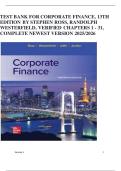
TEST BANK FOR CORPORATE FINANCE, 13TH
EDITION BY STEPHEN ROSS, RANDOLPH
WESTERFIELD, VERIFIED CHAPTERS 1 - 31,
COMPLETE NEWEST VERSION 2025/2026
Version 1 1
,TABLE OF CONTENTS
PART 1: OVERVIEW OF CORPORATE FINANCE
1. Introduction to Corporate Finance
2. Financial Statements, Taxes, and Cash Flow
PART 2: FINANCIAL STATEMENTS AND LONG-TERM FINANCIAL PLANNING
3. Working with Financial Statements
4. Long-Term Financial Planning and Growth
PART 3: VALUATION OF FUTURE CASH FLOWS
5. Introduction to Valuation: The Time Value of Money
6. Discounted Cash Flow Valuation
7. Interest Rates and Bond Valuation
8. Stock Valuation
PART 4: CAPITAL BUDGETING
9. Net Present Value and Other Investment Criteria
10. Making Capital Investment Decisions
11. Project Analysis and Evaluation
PART 5: RISK AND RETURN
12. Some Lessons from Capital Market History
13. Return, Risk, and the Security Market Line
PART 6: COST OF CAPITAL AND LONG-TERM FINANCIAL POLICY
14. Cost of Capital
15. Raising Capital
16. Financial Leverage and Capital Structure Policy
17. Dividends and Payout Policy
PART 7: SHORT-TERM FINANCIAL PLANNING AND MANAGEMENT
18. Short-Term Finance and Planning
19. Cash and Liquidity Management
20. Credit and Inventory Management
PART 8: TOPICS IN CORPORATE FINANCE
21. International Corporate Finance
22. Behavioral Finance Implications for Financial Management
23. Enterprise Risk Management
24. Options and Corporate Finance
25. Option Valuation
26. Mergers and Acquisitions
27. Leasing
Version 1 2
,Chapter 1
Student Name:_
MULTIPLE CHOICE - Choose The One Alternative That Best Completes The Statement Or Answers
The Question.
1) Generally, Among Those Who Report Directly To The Are The Treasurer And
The Controller Of A Corporation.
A) Board Of Directors
B) Chairperson Of The Board
C) Chief Executive Officer
D) President
E) Chief Financial Officer
2) A Typical Chain Of Command In A Corporation Is Described By Which One Of The Following
Statements?
A) The Information Systems Manager Reports To The Treasurer.
B) The Credit Manager Reports To The Treasurer.
C) The Controller Reports To The Chief Executive Officer.
D) The Tax Manager Reports To The Treasurer.
E) The Capital Expenditures Manager Reports To The Controller.
3) Answering Which One Of The Following Questions Involves Making A Capital Budgeting
Decision?
Version 1 3
, A) How Much Debt Should The Firm Borrow From A Particular Lender?
B) Should The Firm Build A New Production Facility?
C) Should The Firm Issue New Equity To Pay For Its Growth Goals?
D) How Much Inventory Should The Firm Keep On Hand?
E) How Much Credit Should The Firm Extend To A Particular Customer?
4) Which One Of The Following Statements Is Accurate?
A) Net Working Capital Equals Current Assets Plus Current Liabilities.
B) Current Liabilities Are Debts That Must Be Repaid In 18 Months Or Less.
C) Current Assets Are Assets With Short Lives, Such As Accounts Receivable.
D) Long-Term Debt Is Defined As A Residual Claim On A Firm’s Assets.
E) Tangible Assets Are Fixed Assets Such As Patents.
5) Among The Typical Responsibilities Of the Corporate Controller Is:
q
A) Capitalexpenditures Management.
B) Cash Management.
C) Tax Reporting.
D) Financial Planning.
E) Credit Management.
6) Is Typically The Responsibility of the Corporate Treasurer.
q q
A) Financial Planning
B) Cost Accounting
C) Tax Reporting
D) Information Systems
E) Financial Accounting
7) A Firm’s Define(S) Its Capital Structure.
Version 1 4
EDITION BY STEPHEN ROSS, RANDOLPH
WESTERFIELD, VERIFIED CHAPTERS 1 - 31,
COMPLETE NEWEST VERSION 2025/2026
Version 1 1
,TABLE OF CONTENTS
PART 1: OVERVIEW OF CORPORATE FINANCE
1. Introduction to Corporate Finance
2. Financial Statements, Taxes, and Cash Flow
PART 2: FINANCIAL STATEMENTS AND LONG-TERM FINANCIAL PLANNING
3. Working with Financial Statements
4. Long-Term Financial Planning and Growth
PART 3: VALUATION OF FUTURE CASH FLOWS
5. Introduction to Valuation: The Time Value of Money
6. Discounted Cash Flow Valuation
7. Interest Rates and Bond Valuation
8. Stock Valuation
PART 4: CAPITAL BUDGETING
9. Net Present Value and Other Investment Criteria
10. Making Capital Investment Decisions
11. Project Analysis and Evaluation
PART 5: RISK AND RETURN
12. Some Lessons from Capital Market History
13. Return, Risk, and the Security Market Line
PART 6: COST OF CAPITAL AND LONG-TERM FINANCIAL POLICY
14. Cost of Capital
15. Raising Capital
16. Financial Leverage and Capital Structure Policy
17. Dividends and Payout Policy
PART 7: SHORT-TERM FINANCIAL PLANNING AND MANAGEMENT
18. Short-Term Finance and Planning
19. Cash and Liquidity Management
20. Credit and Inventory Management
PART 8: TOPICS IN CORPORATE FINANCE
21. International Corporate Finance
22. Behavioral Finance Implications for Financial Management
23. Enterprise Risk Management
24. Options and Corporate Finance
25. Option Valuation
26. Mergers and Acquisitions
27. Leasing
Version 1 2
,Chapter 1
Student Name:_
MULTIPLE CHOICE - Choose The One Alternative That Best Completes The Statement Or Answers
The Question.
1) Generally, Among Those Who Report Directly To The Are The Treasurer And
The Controller Of A Corporation.
A) Board Of Directors
B) Chairperson Of The Board
C) Chief Executive Officer
D) President
E) Chief Financial Officer
2) A Typical Chain Of Command In A Corporation Is Described By Which One Of The Following
Statements?
A) The Information Systems Manager Reports To The Treasurer.
B) The Credit Manager Reports To The Treasurer.
C) The Controller Reports To The Chief Executive Officer.
D) The Tax Manager Reports To The Treasurer.
E) The Capital Expenditures Manager Reports To The Controller.
3) Answering Which One Of The Following Questions Involves Making A Capital Budgeting
Decision?
Version 1 3
, A) How Much Debt Should The Firm Borrow From A Particular Lender?
B) Should The Firm Build A New Production Facility?
C) Should The Firm Issue New Equity To Pay For Its Growth Goals?
D) How Much Inventory Should The Firm Keep On Hand?
E) How Much Credit Should The Firm Extend To A Particular Customer?
4) Which One Of The Following Statements Is Accurate?
A) Net Working Capital Equals Current Assets Plus Current Liabilities.
B) Current Liabilities Are Debts That Must Be Repaid In 18 Months Or Less.
C) Current Assets Are Assets With Short Lives, Such As Accounts Receivable.
D) Long-Term Debt Is Defined As A Residual Claim On A Firm’s Assets.
E) Tangible Assets Are Fixed Assets Such As Patents.
5) Among The Typical Responsibilities Of the Corporate Controller Is:
q
A) Capitalexpenditures Management.
B) Cash Management.
C) Tax Reporting.
D) Financial Planning.
E) Credit Management.
6) Is Typically The Responsibility of the Corporate Treasurer.
q q
A) Financial Planning
B) Cost Accounting
C) Tax Reporting
D) Information Systems
E) Financial Accounting
7) A Firm’s Define(S) Its Capital Structure.
Version 1 4