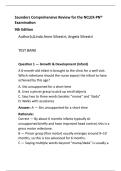
Saunders Comprehensive Review for the NCLEX-PN®
Examination
9th Edition
Author(s)Linda Anne Silvestri; Angela Silvestri
TEST BANK
Question 1 — Growth & Development (Infant)
A 6-month-old infant is brought to the clinic for a well visit.
Which milestone should the nurse expect the infant to have
achieved by this age?
A. Sits unsupported for a short time
B. Uses a pincer grasp to pick up small objects
C. Says two to three words besides “mama” and “dada”
D. Walks with assistance
Answer: A — Sits unsupported for a short time
Rationale:
Correct — By about 6 months infants typically sit
unsupported briefly and have improved head control; this is a
gross motor milestone.
B — Pincer grasp (fine motor) usually emerges around 9–10
months, so this is too advanced for 6 months.
C — Saying multiple words beyond “mama/dada” is usually a
,12–15 month skill (language develops later).
D — Walking with assistance generally begins between 9–15
months (pull to stand ~9 months, walking later).
Question 2 — Respiratory (Croup)
A 2-year-old is admitted with a typical viral croup. Which
nursing intervention is highest priority in the first hour?
A. Encourage oral fluids
B. Provide a cool-mist nebulizer or exposure to cool night air
C. Administer oral antibiotics
D. Place the child supine for observation
Answer: B — Provide a cool-mist nebulizer or exposure to
cool night air
Rationale:
Correct — Croup (viral laryngotracheobronchitis) commonly
causes inspiratory stridor and a barky cough. Humidified cool
mist or exposure to cool air can reduce airway swelling and
decrease stridor; it is an immediate, noninvasive first-line
comfort measure.
A — Oral fluids are important but airway management and
reducing obstruction risk come first.
C — Antibiotics are not indicated for viral croup unless
secondary bacterial infection is present.
D — Supine positioning may not relieve respiratory distress;
sitting upright is often more effective for easier breathing.
,Question 3 — Cardiac (Tetralogy of Fallot)
A 9-month-old with Tetralogy of Fallot (TOF) becomes acutely
cyanotic and irritable. The nurse notes the infant is drawing
knees to chest. Which action should the nurse perform
immediately?
A. Place the infant supine and call the surgeon
B. Administer oxygen by blow-by and calm the parent;
prepare for a “tet” spell intervention (knees-to-chest already
observed)
C. Offer a bottle to distract the infant
D. Start an IV and give an immediate bolus of 20 mL/kg
normal saline
Answer: B — Administer oxygen by blow-by and calm the
parent; prepare for a “tet” spell intervention
Rationale:
Correct — Infants with TOF can have hypercyanotic (“tet”)
spells. Immediate actions: calm the infant/parent, place
infant in knee-to-chest position (reduces venous return and
increases systemic vascular resistance), give oxygen, and be
prepared for morphine, IV fluids, or beta-blocker per
protocol. The nurse should provide oxygen and initiate the
protocol.
A — Placing supine may worsen hypoxia. Calling the surgeon
is not the immediate priority compared with
, airway/oxygenation and established tet-spell measures.
C — Offering a bottle could increase work of breathing and
aspiration risk during severe cyanosis.
D — IV fluids may be part of management but not the
immediate first action before oxygen and calming; IV access
can be obtained concurrently.
Question 4 — Infectious Disease (Meningitis, pediatric)
A 4-year-old is suspected of bacterial meningitis. Which
assessment finding is most indicative of increased intracranial
pressure (ICP) in this age group?
A. Bulging fontanelle
B. Photophobia only
C. Hair loss behind the ear
D. Hyperactive deep tendon reflexes
Answer: A — Bulging fontanelle
Rationale:
Correct — In young children (especially under 18 months
with open fontanelles), a bulging fontanelle is a classic sign of
increased ICP. This is highly suggestive when seen with
fever/meningitic symptoms.
B — Photophobia can be present with meningitis but is not
specific to increased ICP.
C — Hair loss behind the ear is not related to ICP.
Examination
9th Edition
Author(s)Linda Anne Silvestri; Angela Silvestri
TEST BANK
Question 1 — Growth & Development (Infant)
A 6-month-old infant is brought to the clinic for a well visit.
Which milestone should the nurse expect the infant to have
achieved by this age?
A. Sits unsupported for a short time
B. Uses a pincer grasp to pick up small objects
C. Says two to three words besides “mama” and “dada”
D. Walks with assistance
Answer: A — Sits unsupported for a short time
Rationale:
Correct — By about 6 months infants typically sit
unsupported briefly and have improved head control; this is a
gross motor milestone.
B — Pincer grasp (fine motor) usually emerges around 9–10
months, so this is too advanced for 6 months.
C — Saying multiple words beyond “mama/dada” is usually a
,12–15 month skill (language develops later).
D — Walking with assistance generally begins between 9–15
months (pull to stand ~9 months, walking later).
Question 2 — Respiratory (Croup)
A 2-year-old is admitted with a typical viral croup. Which
nursing intervention is highest priority in the first hour?
A. Encourage oral fluids
B. Provide a cool-mist nebulizer or exposure to cool night air
C. Administer oral antibiotics
D. Place the child supine for observation
Answer: B — Provide a cool-mist nebulizer or exposure to
cool night air
Rationale:
Correct — Croup (viral laryngotracheobronchitis) commonly
causes inspiratory stridor and a barky cough. Humidified cool
mist or exposure to cool air can reduce airway swelling and
decrease stridor; it is an immediate, noninvasive first-line
comfort measure.
A — Oral fluids are important but airway management and
reducing obstruction risk come first.
C — Antibiotics are not indicated for viral croup unless
secondary bacterial infection is present.
D — Supine positioning may not relieve respiratory distress;
sitting upright is often more effective for easier breathing.
,Question 3 — Cardiac (Tetralogy of Fallot)
A 9-month-old with Tetralogy of Fallot (TOF) becomes acutely
cyanotic and irritable. The nurse notes the infant is drawing
knees to chest. Which action should the nurse perform
immediately?
A. Place the infant supine and call the surgeon
B. Administer oxygen by blow-by and calm the parent;
prepare for a “tet” spell intervention (knees-to-chest already
observed)
C. Offer a bottle to distract the infant
D. Start an IV and give an immediate bolus of 20 mL/kg
normal saline
Answer: B — Administer oxygen by blow-by and calm the
parent; prepare for a “tet” spell intervention
Rationale:
Correct — Infants with TOF can have hypercyanotic (“tet”)
spells. Immediate actions: calm the infant/parent, place
infant in knee-to-chest position (reduces venous return and
increases systemic vascular resistance), give oxygen, and be
prepared for morphine, IV fluids, or beta-blocker per
protocol. The nurse should provide oxygen and initiate the
protocol.
A — Placing supine may worsen hypoxia. Calling the surgeon
is not the immediate priority compared with
, airway/oxygenation and established tet-spell measures.
C — Offering a bottle could increase work of breathing and
aspiration risk during severe cyanosis.
D — IV fluids may be part of management but not the
immediate first action before oxygen and calming; IV access
can be obtained concurrently.
Question 4 — Infectious Disease (Meningitis, pediatric)
A 4-year-old is suspected of bacterial meningitis. Which
assessment finding is most indicative of increased intracranial
pressure (ICP) in this age group?
A. Bulging fontanelle
B. Photophobia only
C. Hair loss behind the ear
D. Hyperactive deep tendon reflexes
Answer: A — Bulging fontanelle
Rationale:
Correct — In young children (especially under 18 months
with open fontanelles), a bulging fontanelle is a classic sign of
increased ICP. This is highly suggestive when seen with
fever/meningitic symptoms.
B — Photophobia can be present with meningitis but is not
specific to increased ICP.
C — Hair loss behind the ear is not related to ICP.