The Modernist World Chapter 14 Sayre
How would you define modernism, and how do Cubism, Fauvism, Futurism, and Expressionism reflect
its spirit?
What were the effects of the Great War on the Western imagination?
The machine regulated after the 1850s; the steam engine, train, automobile and later the airplane. In
1895 the motion picture was developed and in 1905 the Nickelodeon, the first motion-picture
theatre in the world. In 1908, assembly-line production as we know it was born. Max Planck
proposed the theory of matter and energy known as quantum mechanics. In quantum mechanics,
the fundamental particles are unknowable, and are only hypothetical things represented by
mathematics. Danish physicist Niels Bohr built on quantum physics to propose a new theory of
complementarity: two statements, apparently contradictory, might at any moment be equally true.
J. J. Thompson detected the existence of separate components in the previously indivisible atom. He
called them “electrons,” and by 1911, Ernest Rutherford had introduced a new model of the atom. In
1905, Albert Einstein had published his theory of relativity and by 1915 had produced the General
Principles of Relativity, with its model of the non-Euclidean, four-dimensional space-time continuum.
Between 1895 and 1915, the traditional physical universe had literally been transformed.
Over the course of the last two decades of the nineteenth century and the first decade of the
twentieth, the way we understood the physical universe radically changed. The arts responded. In
painting, those who followed upon the Impressionist generation—the Post-Impressionists, as they
were soon known—saw themselves as inventing a new future for painting, one that reflected the
spirit of innovation that defined modernity. In Paris, the studio of Spanish-born Pablo Picasso was
quickly recognized by artists and intellectuals as the center of artistic innovation in the new century.
From around Europe and America, artists flocked to see his work, and they carried his spirit— and
the spirit of French painting generally—back with them to Italy, Germany, and America. New art
movements—new “isms,” including Delaunay’s Simultanism—succeeded one another in rapid fire.
Picasso’s work also encouraged radical approaches to poetry and
to music, where the discordant, sometimes violent distortions of
his paintings found their expression in sound.
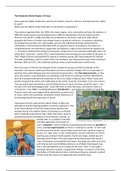
Impressionist works captured the optical effects of light and
atmosphere and the fleeting qualities of sensory experience. One
of the most talented of the Post-Impressionist painters was
Georges Seurat. The subject matter of A Sunday on La Grande
Jatte is typically Impressionist, but it lacks that style’s sense of
spontaneity and the immediacy of its brushwork. Instead, La
Grande Jatte is a carefully controlled,
scientific application of tiny dots of
color—pointilles—and his method of painting became known as pointillis to
some, and neo-impressionism to others. In setting his “points” of color side
by side across the canvas, Seurat determined that color could be mixed, as
he put it, in “gay, calm, or sad” combinations. Seurat’s influence on French
painting was profound. Dutch painter Vincent van Gogh, studied Seurat’s
paintings while living in Paris and experimented extensively with Seurat’s
color combinations and pointillist technique. Van Gogh was often overcome
with intense and uncontrollable emotions, an attribute that played a key
role in the development of his unique artistic style. Color, in van Gogh’s
paintings, becomes symbolic, charged with feelings. To viewers at the time,
the dashes of thickly painted color, a technique known as impasto, seemed
thrown onto the canvas as a haphazard and unrefined mess.
, Paul Cézanne was the only one who continued to paint en
plein air. In this regard, he remained an Impressionist, and he
continued to paint what he called “optics.” Since the
Renaissance, Western art had been dedicated to representing
the world as the eye sees it—that is, in terms of perspectival
space. But Cézanne realized that we see the world in far more
complex terms than just the retinal image before us. We see
it through the multiple lenses of our lived experience. His
tension between spatial perspectives and surface flatness
that would become one of the chief preoccupations of
modern painting in the forthcoming century.
The story of Gertrude Stein’s portrait is a parable for the birth
of modern art. It narrates the shift in painting from an optical
art—painting what one sees—to an
imaginative construct—painting what one
thinks about what one sees. The object of
painting shifts, in other words, from the literal
to the conceptual. The
painting that most
thoroughly embodied
this shift was Les
Demoiselles d’Avignon.
He wanted to connect his prostitutes to the seemingly
authentic—and emotionally energizing—forces that
Gauguin had discovered in the “primitive”. Les
Demoiselles, then, was an act of liberation, an exorcism
of past traditions, perhaps even of painting itself. It
would allow Picasso to move forward into a kind of
painting that was totally new. Picasso scholar Patricia
Leighten has argued convincingly that the African masks in Les Demoiselles are
designed not only to challenge and mock Western artistic traditions but also to
evoke and critique the deplorable exploitation by Europeans of black Africans,
particularly in the Congo. Thus Picasso’s painting confronts a variety of
idealizations: the idealization of the world as reflected in
traditional European art, the idealization of sexuality—and
love—and the idealization of the colonizing mission of the
European state. It acknowledges, in other words, the artist’s
obligation to confront the horrific truths that lie behind and
support bourgeois complacency.
Georges Braque was fascinated by Picasso and started to make
paintings like Houses at l’Estaque. Picasso was fascinated with
their spatial ambiguity and cube-like shapes. Braque is
contemptuous of form, reduces everything, sites and figures
and houses to geometric schemas, to cubes. But the movement
known as Cubism was born out of collaboration between
Braque and Picasso. They began to understand that they were
questioning the very nature of reality, the nature of “truth”
itself. This is the function of the trumpe-l’oeil nail casting its
shadow onto the canvas at the top of Braque’s painting. It
announces its own artifice, the practice of illusionistically
How would you define modernism, and how do Cubism, Fauvism, Futurism, and Expressionism reflect
its spirit?
What were the effects of the Great War on the Western imagination?
The machine regulated after the 1850s; the steam engine, train, automobile and later the airplane. In
1895 the motion picture was developed and in 1905 the Nickelodeon, the first motion-picture
theatre in the world. In 1908, assembly-line production as we know it was born. Max Planck
proposed the theory of matter and energy known as quantum mechanics. In quantum mechanics,
the fundamental particles are unknowable, and are only hypothetical things represented by
mathematics. Danish physicist Niels Bohr built on quantum physics to propose a new theory of
complementarity: two statements, apparently contradictory, might at any moment be equally true.
J. J. Thompson detected the existence of separate components in the previously indivisible atom. He
called them “electrons,” and by 1911, Ernest Rutherford had introduced a new model of the atom. In
1905, Albert Einstein had published his theory of relativity and by 1915 had produced the General
Principles of Relativity, with its model of the non-Euclidean, four-dimensional space-time continuum.
Between 1895 and 1915, the traditional physical universe had literally been transformed.
Over the course of the last two decades of the nineteenth century and the first decade of the
twentieth, the way we understood the physical universe radically changed. The arts responded. In
painting, those who followed upon the Impressionist generation—the Post-Impressionists, as they
were soon known—saw themselves as inventing a new future for painting, one that reflected the
spirit of innovation that defined modernity. In Paris, the studio of Spanish-born Pablo Picasso was
quickly recognized by artists and intellectuals as the center of artistic innovation in the new century.
From around Europe and America, artists flocked to see his work, and they carried his spirit— and
the spirit of French painting generally—back with them to Italy, Germany, and America. New art
movements—new “isms,” including Delaunay’s Simultanism—succeeded one another in rapid fire.
Picasso’s work also encouraged radical approaches to poetry and
to music, where the discordant, sometimes violent distortions of
his paintings found their expression in sound.
Impressionist works captured the optical effects of light and
atmosphere and the fleeting qualities of sensory experience. One
of the most talented of the Post-Impressionist painters was
Georges Seurat. The subject matter of A Sunday on La Grande
Jatte is typically Impressionist, but it lacks that style’s sense of
spontaneity and the immediacy of its brushwork. Instead, La
Grande Jatte is a carefully controlled,
scientific application of tiny dots of
color—pointilles—and his method of painting became known as pointillis to
some, and neo-impressionism to others. In setting his “points” of color side
by side across the canvas, Seurat determined that color could be mixed, as
he put it, in “gay, calm, or sad” combinations. Seurat’s influence on French
painting was profound. Dutch painter Vincent van Gogh, studied Seurat’s
paintings while living in Paris and experimented extensively with Seurat’s
color combinations and pointillist technique. Van Gogh was often overcome
with intense and uncontrollable emotions, an attribute that played a key
role in the development of his unique artistic style. Color, in van Gogh’s
paintings, becomes symbolic, charged with feelings. To viewers at the time,
the dashes of thickly painted color, a technique known as impasto, seemed
thrown onto the canvas as a haphazard and unrefined mess.
, Paul Cézanne was the only one who continued to paint en
plein air. In this regard, he remained an Impressionist, and he
continued to paint what he called “optics.” Since the
Renaissance, Western art had been dedicated to representing
the world as the eye sees it—that is, in terms of perspectival
space. But Cézanne realized that we see the world in far more
complex terms than just the retinal image before us. We see
it through the multiple lenses of our lived experience. His
tension between spatial perspectives and surface flatness
that would become one of the chief preoccupations of
modern painting in the forthcoming century.
The story of Gertrude Stein’s portrait is a parable for the birth
of modern art. It narrates the shift in painting from an optical
art—painting what one sees—to an
imaginative construct—painting what one
thinks about what one sees. The object of
painting shifts, in other words, from the literal
to the conceptual. The
painting that most
thoroughly embodied
this shift was Les
Demoiselles d’Avignon.
He wanted to connect his prostitutes to the seemingly
authentic—and emotionally energizing—forces that
Gauguin had discovered in the “primitive”. Les
Demoiselles, then, was an act of liberation, an exorcism
of past traditions, perhaps even of painting itself. It
would allow Picasso to move forward into a kind of
painting that was totally new. Picasso scholar Patricia
Leighten has argued convincingly that the African masks in Les Demoiselles are
designed not only to challenge and mock Western artistic traditions but also to
evoke and critique the deplorable exploitation by Europeans of black Africans,
particularly in the Congo. Thus Picasso’s painting confronts a variety of
idealizations: the idealization of the world as reflected in
traditional European art, the idealization of sexuality—and
love—and the idealization of the colonizing mission of the
European state. It acknowledges, in other words, the artist’s
obligation to confront the horrific truths that lie behind and
support bourgeois complacency.
Georges Braque was fascinated by Picasso and started to make
paintings like Houses at l’Estaque. Picasso was fascinated with
their spatial ambiguity and cube-like shapes. Braque is
contemptuous of form, reduces everything, sites and figures
and houses to geometric schemas, to cubes. But the movement
known as Cubism was born out of collaboration between
Braque and Picasso. They began to understand that they were
questioning the very nature of reality, the nature of “truth”
itself. This is the function of the trumpe-l’oeil nail casting its
shadow onto the canvas at the top of Braque’s painting. It
announces its own artifice, the practice of illusionistically