1
The d & f Block Elements
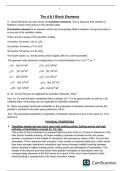
d – block elements are also known as transition elements. This is because their position is
between s-block and p-block in the periodic table.
A transition element is an element which has incompletely filled d-orbitals in its ground state or
in any one of its oxidation states.
There are four series of the transition metals.
1st series: 3d series 21Sc to 30Zn
2nd series: 4d series 39Y to 48Cd
3rd series: 5d series 57La to 80Hg
The fourth series i.e., the 6d series which begins with Ac is still incomplete.
The general outer electronic configuration of a d-block element is (n-1) d1-10 ns 1-2
Q. Zn, Cd and Hg are not regarded as transition elements. Why?
Ans: Zn, Cd and Hg have completely filled d orbitals (3d 10) in its ground state as well as in its
oxidised state, hence they are not regarded as transition elements.
Q. There are greater horizontal similarities in the properties of transition elements (across the
period) in contrast to the main group elements. Why?
Ans: The horizontal similarities in properties of transition elements is due to the same no: of ns
electrons.
PHYSICAL PROPERTIES
1. Transition metals are very hard, have high melting points, boiling points and high
enthalpy of atomization (except Zn, Cd, Hg):
This is due to the involvement of unpaired electrons from both (n-1)d and ns electrons in the
inter atomic metallic bonding. All these metallic properties increases across the series,
reaches a maximum at the middle d5 (except for the anomalous values of Mn, Tc) and then
decreases. This is because with increase in the number of unpaired electrons in their atoms
they have stronger interatomic interaction and hence stronger metallic bonding between
atoms resulting in higher melting points, boiling points and enthalpies of atomisation. The
metals of the second and third series have greater enthalpies of atomisation than the
corresponding elements of the first series as a result of the much more frequent metal –
metal bonding in compounds of the heavy transition metals.
, 2
2. Atomic and ionic sizes:
In general, atomic and ionic size progressively decreases across the series with
increasing atomic number as a result of increased nuclear charge and ineffective
shielding effect of d electrons. Atomic & ionic size increases down the group. There is
an increase in atomic and ionic radii from the first (3d) series to the corresponding elements
of second (4d) series, but the atomic and ionic radii of the second (4d) and the corresponding
elements of third (5d) series are similar and this is due to Lanthanoid contraction. For e.g., Zr
(160 pm) of 4d series & Hf of 5d series (159 pm) have similar atomic radii.
3. Density: [ density = mass / volume ]
The decrease in atomic size (volume) coupled with increase in atomic mass results in a
general increase in the density of these elements across the series. Thus, from titanium (Z =
22) to copper (Z = 29) an increase in the density can be observed.
4. Ionization enthalpies:
Ionization enthalpies are generally seen to increase with increase in atomic number
across a series due to increased nuclear charge along with filling of inner d-orbitals
which has poor shielding effect. The irregular trend in the first and second ionization
enthalpy of the 3d series is mainly attributed to varying degree of stability of different 3d-
configurations (e.g., d0 , d3 , d5 , d10 are exceptionally stable) and so the removal of an
electron alters the relative energies of 4s and 3d orbitals.
The first I.E of Zn, Cd & Hg are high due to the stable 3d10 4s2 configuration while their
second I.E are low because after the removal of the second electron a stable d 10
configuration is attained.
The second I.E of Cr & Cu is high as the second electron has to be removed from a stable d 5
& d10 configuration respectively while their first I.E is low.
The third I.E of Sc & Fe is low as the removal of the third electron leads to a stable d 0 (Sc3+)
and d 5 (Fe3+) configurations respectively.
The second I.E of Mn is low as the removal of the second electron leads to a stable d 5
configuration while its third I.E is high as the third electron has to be removed from a stable
d5 configuration.
5. Oxidation states:
Transition elements show variable oxidation states due to participation of ns and (n-
1)d electrons in bonding. Lower oxidation state is seen when only the ns electrons
participate in bonding and these compounds are mostly ionic compounds. Higher oxidation
state is seen when both ns and (n-1)d electrons participate in bonding and these compounds
are mostly covalent compounds.
The d & f Block Elements
d – block elements are also known as transition elements. This is because their position is
between s-block and p-block in the periodic table.
A transition element is an element which has incompletely filled d-orbitals in its ground state or
in any one of its oxidation states.
There are four series of the transition metals.
1st series: 3d series 21Sc to 30Zn
2nd series: 4d series 39Y to 48Cd
3rd series: 5d series 57La to 80Hg
The fourth series i.e., the 6d series which begins with Ac is still incomplete.
The general outer electronic configuration of a d-block element is (n-1) d1-10 ns 1-2
Q. Zn, Cd and Hg are not regarded as transition elements. Why?
Ans: Zn, Cd and Hg have completely filled d orbitals (3d 10) in its ground state as well as in its
oxidised state, hence they are not regarded as transition elements.
Q. There are greater horizontal similarities in the properties of transition elements (across the
period) in contrast to the main group elements. Why?
Ans: The horizontal similarities in properties of transition elements is due to the same no: of ns
electrons.
PHYSICAL PROPERTIES
1. Transition metals are very hard, have high melting points, boiling points and high
enthalpy of atomization (except Zn, Cd, Hg):
This is due to the involvement of unpaired electrons from both (n-1)d and ns electrons in the
inter atomic metallic bonding. All these metallic properties increases across the series,
reaches a maximum at the middle d5 (except for the anomalous values of Mn, Tc) and then
decreases. This is because with increase in the number of unpaired electrons in their atoms
they have stronger interatomic interaction and hence stronger metallic bonding between
atoms resulting in higher melting points, boiling points and enthalpies of atomisation. The
metals of the second and third series have greater enthalpies of atomisation than the
corresponding elements of the first series as a result of the much more frequent metal –
metal bonding in compounds of the heavy transition metals.
, 2
2. Atomic and ionic sizes:
In general, atomic and ionic size progressively decreases across the series with
increasing atomic number as a result of increased nuclear charge and ineffective
shielding effect of d electrons. Atomic & ionic size increases down the group. There is
an increase in atomic and ionic radii from the first (3d) series to the corresponding elements
of second (4d) series, but the atomic and ionic radii of the second (4d) and the corresponding
elements of third (5d) series are similar and this is due to Lanthanoid contraction. For e.g., Zr
(160 pm) of 4d series & Hf of 5d series (159 pm) have similar atomic radii.
3. Density: [ density = mass / volume ]
The decrease in atomic size (volume) coupled with increase in atomic mass results in a
general increase in the density of these elements across the series. Thus, from titanium (Z =
22) to copper (Z = 29) an increase in the density can be observed.
4. Ionization enthalpies:
Ionization enthalpies are generally seen to increase with increase in atomic number
across a series due to increased nuclear charge along with filling of inner d-orbitals
which has poor shielding effect. The irregular trend in the first and second ionization
enthalpy of the 3d series is mainly attributed to varying degree of stability of different 3d-
configurations (e.g., d0 , d3 , d5 , d10 are exceptionally stable) and so the removal of an
electron alters the relative energies of 4s and 3d orbitals.
The first I.E of Zn, Cd & Hg are high due to the stable 3d10 4s2 configuration while their
second I.E are low because after the removal of the second electron a stable d 10
configuration is attained.
The second I.E of Cr & Cu is high as the second electron has to be removed from a stable d 5
& d10 configuration respectively while their first I.E is low.
The third I.E of Sc & Fe is low as the removal of the third electron leads to a stable d 0 (Sc3+)
and d 5 (Fe3+) configurations respectively.
The second I.E of Mn is low as the removal of the second electron leads to a stable d 5
configuration while its third I.E is high as the third electron has to be removed from a stable
d5 configuration.
5. Oxidation states:
Transition elements show variable oxidation states due to participation of ns and (n-
1)d electrons in bonding. Lower oxidation state is seen when only the ns electrons
participate in bonding and these compounds are mostly ionic compounds. Higher oxidation
state is seen when both ns and (n-1)d electrons participate in bonding and these compounds
are mostly covalent compounds.