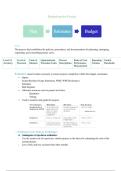
Budgeting the Project
Plan
The process that establishes the policies, procedures, and documentation for planning, managing,
expending, and controlling project costs.
Level of Level of Units of Organizational Process Rules of Cost Reporting Control
Accuracy Precision Measure Procedure Links Descriptions Performance Formats Thresholds
Measurement
Estimates must be taken seriously to ensure project completion within the budget constraints.
● Inputs:
- Scope Baseline (Scope Statement, WBS, WBS Dictionary)
- Schedule
- Risk Register
● Allocates resource costs to project activities.
- Quantities
- Timing
● Used to monitor and guide the project.
→ Estimate Costs Tools & Techniques
● Analogous or top-down estimates:
- Use the actual cost of a previous, similar project as the basis for estimating the cost of the
current project
- Less costly and less accurate than other models
, ● Bottom-up estimates (activity based costing):
- Estimate individual work items or activities and sum them to get a project total
- Size of work items and experience of estimators drives accuracy
- Time intensive and expensive
● Parametric modeling:
- Use project characteristics (parameters) in a mathematical model to estimate project costs
(e.g. $25/line of code; $ per sq. foot)
- Higher accuracy when historical info used to build model is accurate
● Three Point Estimates
Estimate Costs: Problems with Estimates
➔ Management Desires Accuracy
➔ Done Too Quickly
➔ People Lack Experience
➔ Human Beings are Biased towards Underestimation
Estimate Costs: Ground Rules
➔ Before creating an estimate, know what it will be used for
➔ Gather as much information as possible
➔ If possible, estimate costs by major WBS categories Create a cost model
◆ It will make it easy to make changes
◆ Helps document cost estimate
Budget → Output Cost Baseline
Plan
The process that establishes the policies, procedures, and documentation for planning, managing,
expending, and controlling project costs.
Level of Level of Units of Organizational Process Rules of Cost Reporting Control
Accuracy Precision Measure Procedure Links Descriptions Performance Formats Thresholds
Measurement
Estimates must be taken seriously to ensure project completion within the budget constraints.
● Inputs:
- Scope Baseline (Scope Statement, WBS, WBS Dictionary)
- Schedule
- Risk Register
● Allocates resource costs to project activities.
- Quantities
- Timing
● Used to monitor and guide the project.
→ Estimate Costs Tools & Techniques
● Analogous or top-down estimates:
- Use the actual cost of a previous, similar project as the basis for estimating the cost of the
current project
- Less costly and less accurate than other models
, ● Bottom-up estimates (activity based costing):
- Estimate individual work items or activities and sum them to get a project total
- Size of work items and experience of estimators drives accuracy
- Time intensive and expensive
● Parametric modeling:
- Use project characteristics (parameters) in a mathematical model to estimate project costs
(e.g. $25/line of code; $ per sq. foot)
- Higher accuracy when historical info used to build model is accurate
● Three Point Estimates
Estimate Costs: Problems with Estimates
➔ Management Desires Accuracy
➔ Done Too Quickly
➔ People Lack Experience
➔ Human Beings are Biased towards Underestimation
Estimate Costs: Ground Rules
➔ Before creating an estimate, know what it will be used for
➔ Gather as much information as possible
➔ If possible, estimate costs by major WBS categories Create a cost model
◆ It will make it easy to make changes
◆ Helps document cost estimate
Budget → Output Cost Baseline