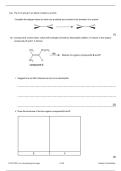
1(a) The C=C group in an alkene contains a p-bond.
Complete the diagram below to show how p-orbitals are involved in the formation of a p-bond.
[1]
(b) Compound D, shown below, reacts with hydrogen bromide by electrophilic addition. A mixture of two organic
compounds, E and F, is formed.
i. Suggest how an HBr molecule can act as an electrophile.
[1]
ii. Draw the structures of the two organic compounds E and F.
E F
[2]
© OCR 2025. You may photocopy this page. 1 of 98 Created in ExamBuilder
, iii. Outline the mechanism of the reaction between compound D and hydrogen bromide to form either compound
E or compound F.
Include curly arrows and relevant dipoles.
[3]
iv. Which of E or F is the major organic product?
Explain your answer.
Major organic product
Explanation
[1]
© OCR 2025. You may photocopy this page. 2 of 98 Created in ExamBuilder
, (c) Myrcene, C10H16, is a naturally occurring hydrocarbon containing more than one carbon-carbon double bond.
i. Reaction of 204 mg of myrcene with hydrogen gas produces a saturated alkane.
Calculate the volume of hydrogen gas, in cm3 and measured at RTP, needed for this reaction.
Show your working.
volume = _ _ _ _ _ _ _ _ _ _ _ _ _ _ _ _ _ _ _ cm3 [2]
ii. ß-Carotene is a naturally occurring unsaturated hydrocarbon found in carrots.
A ß-carotene molecule contains 40 carbon atoms, has two rings, and a branched chain.
0.0200 mol of ß-carotene reacts with 5.28 dm3 of hydrogen gas to form a saturated hydrocarbon.
Using molecular formulae, construct a balanced equation for this reaction.
Include relevant calculations and reasoning.
Equation _ _ _ _ _ _ _ _ _ _ _ _ _ _ _ _ _ _ _ _ _ _ _ _ _ _ _ _ _ _ _ _ _ _ _ _ _ _ _ _ _ _ _ _ _ _ _ _ [4]
© OCR 2025. You may photocopy this page. 3 of 98 Created in ExamBuilder
, (d) This question is about unsaturated hydrocarbons.
Compound A and compound B are isomers.
Compound A has a lower melting point than compound B.
Suggest why.
[2]
2 What is the systematic name of the compound below?
A E-2-bromobut-2-ene
B Z-2-bromobut-2-ene
C E-1,2-dimethyl-1-bromoethene
D Z-1,2-dimethyl-1-bromoethene
Your answer [1]
© OCR 2025. You may photocopy this page. 4 of 98 Created in ExamBuilder
Complete the diagram below to show how p-orbitals are involved in the formation of a p-bond.
[1]
(b) Compound D, shown below, reacts with hydrogen bromide by electrophilic addition. A mixture of two organic
compounds, E and F, is formed.
i. Suggest how an HBr molecule can act as an electrophile.
[1]
ii. Draw the structures of the two organic compounds E and F.
E F
[2]
© OCR 2025. You may photocopy this page. 1 of 98 Created in ExamBuilder
, iii. Outline the mechanism of the reaction between compound D and hydrogen bromide to form either compound
E or compound F.
Include curly arrows and relevant dipoles.
[3]
iv. Which of E or F is the major organic product?
Explain your answer.
Major organic product
Explanation
[1]
© OCR 2025. You may photocopy this page. 2 of 98 Created in ExamBuilder
, (c) Myrcene, C10H16, is a naturally occurring hydrocarbon containing more than one carbon-carbon double bond.
i. Reaction of 204 mg of myrcene with hydrogen gas produces a saturated alkane.
Calculate the volume of hydrogen gas, in cm3 and measured at RTP, needed for this reaction.
Show your working.
volume = _ _ _ _ _ _ _ _ _ _ _ _ _ _ _ _ _ _ _ cm3 [2]
ii. ß-Carotene is a naturally occurring unsaturated hydrocarbon found in carrots.
A ß-carotene molecule contains 40 carbon atoms, has two rings, and a branched chain.
0.0200 mol of ß-carotene reacts with 5.28 dm3 of hydrogen gas to form a saturated hydrocarbon.
Using molecular formulae, construct a balanced equation for this reaction.
Include relevant calculations and reasoning.
Equation _ _ _ _ _ _ _ _ _ _ _ _ _ _ _ _ _ _ _ _ _ _ _ _ _ _ _ _ _ _ _ _ _ _ _ _ _ _ _ _ _ _ _ _ _ _ _ _ [4]
© OCR 2025. You may photocopy this page. 3 of 98 Created in ExamBuilder
, (d) This question is about unsaturated hydrocarbons.
Compound A and compound B are isomers.
Compound A has a lower melting point than compound B.
Suggest why.
[2]
2 What is the systematic name of the compound below?
A E-2-bromobut-2-ene
B Z-2-bromobut-2-ene
C E-1,2-dimethyl-1-bromoethene
D Z-1,2-dimethyl-1-bromoethene
Your answer [1]
© OCR 2025. You may photocopy this page. 4 of 98 Created in ExamBuilder