LEO Legal 5 UPDATED ACTUAL Questions and CORRECT Answers
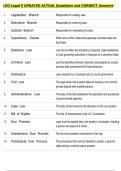
1. Legislative Branch Responsible for creating laws.
2. Executive Branch Responsible for enforcing laws.
3. Judicial Branch Responsible for interpreting the laws.
4. Supremacy Clause When laws conflict, federal law generally overrules state and
local law.
5. Statutory Law Law that is written and enacted by Congress, state legislatures,
or local governing authorities in response to a perceived need.
6. Criminal Law Law that identifies behaviors deemed unacceptable by society
and also sets punishments for those behaviors.
7. Ordinance Laws enacted by a municipal (city) or county government.
8. Civil Law The legal action that a person takes to resolve a non-criminal
private dispute with another person.
9. Administrative Law The body of law that establishes the operations and procedures
of governmental agencies.
10. Case Law The body of law formed by the decisions of the court system.
11. Bill of Rights The first 10 Amendments to the U.S. Constitution.
12. Due Process Laws must be applied fairly and equally to all people, including
a person accused of a crime.
13. Substantive Due Process The fair and consistent enforcement of the law.
14. Procedural Due Process The procedures that must be followed to protect a person's
rights during a criminal justice process.
, 15. 1st Amendment Protects the right to free speech, press, assembly and religion.
16. 14th Amendment Establishes due process and equal protection of the laws.
17. 5th Amendment Protects against self-incrimination and guarantees due process.
18. 2nd Amendment Protects the right to bear arms.
19. 4th Amendment Protects from unreasonable search and seizure.
20. 8th Amendment Protects against cruel and unusual punishment and prohibits
the use of excessive bail or fines.
21. Offense A breach of law.
22. Civil Infraction Another name for a non-criminal violation.
23. Misdemeanor Any criminal offense with a maximum incarceration penalty in a
county jail of up to one year.
24. Felony Any criminal offense committed where the maximum penalty is
death or incarceration in a state correctional facility for more
than one year.
25. Felony Classifications Five classifications; Capital felony is the highest classification.
26. Enhanced Penalty A sentence that is increased from one classification of offense
to a more serious classification due to a prior conviction or the
serious nature of the circumstances involved.
27. Principal in the First Degree Commits crime or aids, abets, counsels, hires, or persuades an
offense to be committed or attempted.
28. Accessory after the fact gives the principal any aid with the intent that the principal
avoids or escapes detention, arrest, trial, or punishment
1. Legislative Branch Responsible for creating laws.
2. Executive Branch Responsible for enforcing laws.
3. Judicial Branch Responsible for interpreting the laws.
4. Supremacy Clause When laws conflict, federal law generally overrules state and
local law.
5. Statutory Law Law that is written and enacted by Congress, state legislatures,
or local governing authorities in response to a perceived need.
6. Criminal Law Law that identifies behaviors deemed unacceptable by society
and also sets punishments for those behaviors.
7. Ordinance Laws enacted by a municipal (city) or county government.
8. Civil Law The legal action that a person takes to resolve a non-criminal
private dispute with another person.
9. Administrative Law The body of law that establishes the operations and procedures
of governmental agencies.
10. Case Law The body of law formed by the decisions of the court system.
11. Bill of Rights The first 10 Amendments to the U.S. Constitution.
12. Due Process Laws must be applied fairly and equally to all people, including
a person accused of a crime.
13. Substantive Due Process The fair and consistent enforcement of the law.
14. Procedural Due Process The procedures that must be followed to protect a person's
rights during a criminal justice process.
, 15. 1st Amendment Protects the right to free speech, press, assembly and religion.
16. 14th Amendment Establishes due process and equal protection of the laws.
17. 5th Amendment Protects against self-incrimination and guarantees due process.
18. 2nd Amendment Protects the right to bear arms.
19. 4th Amendment Protects from unreasonable search and seizure.
20. 8th Amendment Protects against cruel and unusual punishment and prohibits
the use of excessive bail or fines.
21. Offense A breach of law.
22. Civil Infraction Another name for a non-criminal violation.
23. Misdemeanor Any criminal offense with a maximum incarceration penalty in a
county jail of up to one year.
24. Felony Any criminal offense committed where the maximum penalty is
death or incarceration in a state correctional facility for more
than one year.
25. Felony Classifications Five classifications; Capital felony is the highest classification.
26. Enhanced Penalty A sentence that is increased from one classification of offense
to a more serious classification due to a prior conviction or the
serious nature of the circumstances involved.
27. Principal in the First Degree Commits crime or aids, abets, counsels, hires, or persuades an
offense to be committed or attempted.
28. Accessory after the fact gives the principal any aid with the intent that the principal
avoids or escapes detention, arrest, trial, or punishment