

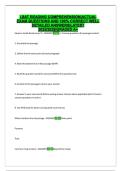
EXAM QUESTIONS AND 100% CORRECT WELL
DETAILED ANSWERS|LATEST
Steps to tackle Read comp ?S - ANSWER 1. Preview questions for passage content
2. Annotate the passage
3. Define the the main point of each paragraph
4. Note the bottom line of the passage (MAP)
5. Read the question word for word and define the question task
6. Go back to the passage to prove your answer
7. Answer in your own words before seeing answer choices when applicable (don't have to
answer questions in order)
8. Use POE (look for what is wrong with each choice)
What is bottom line of passage - ANSWER Main point
Purpose
Tone
Common trap answers - ANSWER Beyond the scope
,Opposite
Doesn't answer the question
Too extreme
Translate Question Stem
Based on the passage, with which one of the following statements would the author most likely
agree? - ANSWER What can you infer?
- like in argument section- what answer can you best support to prove using ONLY info from the
passage
Translate Question Stem
Which of the following best exemplifies the type of situation discussed in the 3rd paragraph ? -
ANSWER What matches the situation in the 3rd paragraph?
-go back to the passage and read the situation in the 3rd paragraph then generalize/summarize
it
- the right answer will be a new example that matches summary of the passage
Translate Question Stem
Given the info in the passage, which one of the following hypothetical events is least likely to
occur? - ANSWER What can you infer is NOT going to happen?
, - the other 4 answers will have direct evidence in the passage that they will happen
- the right answer will either have that won't happen; be opposite; or never mentioned in the
paragraph
Translate Question Stem
The author discusses the critics in the 2nd paragraph primarily in order to? -
ANSWER Why does the author talk about the critics?
-if you go back and try to read what the critics say you will get the question wrong
- have to think about why the author introduced the critics in the first place - what other big
idea are the critics supporting
Active reading - ANSWER - understanding how a text is put together
- anticipating the points the author will make next
- reading for tone and different points of view
- following complex lines of reasoning
- seeing beyond the details to the bigger picture
Construction of passage - ANSWER 1. Even a neutral tell a story passage is an argument
(author wants to communicate core idea or persuade you to accept their core idea)
2. Argument consists of series of statements that express an authors beliefs
DETAILED ANSWERS|LATEST
Steps to tackle Read comp ?S - ANSWER 1. Preview questions for passage content
2. Annotate the passage
3. Define the the main point of each paragraph
4. Note the bottom line of the passage (MAP)
5. Read the question word for word and define the question task
6. Go back to the passage to prove your answer
7. Answer in your own words before seeing answer choices when applicable (don't have to
answer questions in order)
8. Use POE (look for what is wrong with each choice)
What is bottom line of passage - ANSWER Main point
Purpose
Tone
Common trap answers - ANSWER Beyond the scope
,Opposite
Doesn't answer the question
Too extreme
Translate Question Stem
Based on the passage, with which one of the following statements would the author most likely
agree? - ANSWER What can you infer?
- like in argument section- what answer can you best support to prove using ONLY info from the
passage
Translate Question Stem
Which of the following best exemplifies the type of situation discussed in the 3rd paragraph ? -
ANSWER What matches the situation in the 3rd paragraph?
-go back to the passage and read the situation in the 3rd paragraph then generalize/summarize
it
- the right answer will be a new example that matches summary of the passage
Translate Question Stem
Given the info in the passage, which one of the following hypothetical events is least likely to
occur? - ANSWER What can you infer is NOT going to happen?
, - the other 4 answers will have direct evidence in the passage that they will happen
- the right answer will either have that won't happen; be opposite; or never mentioned in the
paragraph
Translate Question Stem
The author discusses the critics in the 2nd paragraph primarily in order to? -
ANSWER Why does the author talk about the critics?
-if you go back and try to read what the critics say you will get the question wrong
- have to think about why the author introduced the critics in the first place - what other big
idea are the critics supporting
Active reading - ANSWER - understanding how a text is put together
- anticipating the points the author will make next
- reading for tone and different points of view
- following complex lines of reasoning
- seeing beyond the details to the bigger picture
Construction of passage - ANSWER 1. Even a neutral tell a story passage is an argument
(author wants to communicate core idea or persuade you to accept their core idea)
2. Argument consists of series of statements that express an authors beliefs


