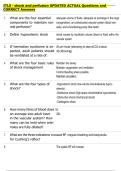
ITLS - shock and perfusion UPDATED ACTUAL Questions and
CORRECT Answers
1. What are the four essential adequate volume of fluids, adequate air exchange in the lungs
components to maintain nor- (oxygenation), an unobstructed vascular system (blood ves-
mal perfusion? sels), and a functioning pump (the heart)
2. Define hypovolemic shock shock caused by insuflcient volume (blood or fluid) within the
vascular system
3. If herniation syndrome is ex- 20 per minute (attempting to keep etCO2 at about
pected, adult patients should 30-35mmHg)
be ventilated at a rate of:
4. What are the four basic rules Maintain the airway
of shock management Maintain oxygenation and ventilation
Control bleeding where possible
Maintain circulation
5. What are the four types of -Hypovolemic shock (low-volume shock/absolute hypov-
shock? olemia)
-Distributive shock (high-space shock/relative hypovolemia)
-Obstructive shock (mechanical shock)
-Cardiogenic shock
6. How many litres of blood does 5L
an average size adult have 25L
in the vascular system? How
many can be held when arte-
rioles are fully dilated?
7. What are the three indications Increased BP, irregular breathing and bradycardia
for Cushing's reflex?
8. The systolic BP will increase
, How does increased cerebral
pressure affect blood pres-
sure?
9. Explain how the GCS score If patient has extensor posturing, unresponsive with dilated
works with cerebral hernia- pupils, or a drop in GCS score of <2
tion syndrome
10. What is a coup? an injury to the brain in the area of original impact
11. What is a contracoup? an injury to the brain on the opposite side of the original impact
12. What is hypovolemic shock caused by hemorrhage or other major body fluid loss
caused by?
13. What is high-space/distribu- caused by spinal injury, vasovagal syncope, sepsis, anaphylaxis,
tive shock caused by? and certain drug overdoses that dilate the blood vessels and
redistribute blood flow to a larger vascular volume
14. What is mechanical/obstruc- conditions preventing the filling of the heart or something
tive shock caused by? obstructing blood flow through the lungs (example a tension
pneumothorax or a pericardial tamponade)
15. What is cardiogenic shock a damaged heart (example myocardial contusion)
caused by?
16. What sounds will you hear a hollow or hypo-resonate sound
when percussing a patient
with a tension pneumotho-
rax?
17. What sounds will you hear a dull sound
when percussing a patient
with a hemothorax?
2/5
CORRECT Answers
1. What are the four essential adequate volume of fluids, adequate air exchange in the lungs
components to maintain nor- (oxygenation), an unobstructed vascular system (blood ves-
mal perfusion? sels), and a functioning pump (the heart)
2. Define hypovolemic shock shock caused by insuflcient volume (blood or fluid) within the
vascular system
3. If herniation syndrome is ex- 20 per minute (attempting to keep etCO2 at about
pected, adult patients should 30-35mmHg)
be ventilated at a rate of:
4. What are the four basic rules Maintain the airway
of shock management Maintain oxygenation and ventilation
Control bleeding where possible
Maintain circulation
5. What are the four types of -Hypovolemic shock (low-volume shock/absolute hypov-
shock? olemia)
-Distributive shock (high-space shock/relative hypovolemia)
-Obstructive shock (mechanical shock)
-Cardiogenic shock
6. How many litres of blood does 5L
an average size adult have 25L
in the vascular system? How
many can be held when arte-
rioles are fully dilated?
7. What are the three indications Increased BP, irregular breathing and bradycardia
for Cushing's reflex?
8. The systolic BP will increase
, How does increased cerebral
pressure affect blood pres-
sure?
9. Explain how the GCS score If patient has extensor posturing, unresponsive with dilated
works with cerebral hernia- pupils, or a drop in GCS score of <2
tion syndrome
10. What is a coup? an injury to the brain in the area of original impact
11. What is a contracoup? an injury to the brain on the opposite side of the original impact
12. What is hypovolemic shock caused by hemorrhage or other major body fluid loss
caused by?
13. What is high-space/distribu- caused by spinal injury, vasovagal syncope, sepsis, anaphylaxis,
tive shock caused by? and certain drug overdoses that dilate the blood vessels and
redistribute blood flow to a larger vascular volume
14. What is mechanical/obstruc- conditions preventing the filling of the heart or something
tive shock caused by? obstructing blood flow through the lungs (example a tension
pneumothorax or a pericardial tamponade)
15. What is cardiogenic shock a damaged heart (example myocardial contusion)
caused by?
16. What sounds will you hear a hollow or hypo-resonate sound
when percussing a patient
with a tension pneumotho-
rax?
17. What sounds will you hear a dull sound
when percussing a patient
with a hemothorax?
2/5