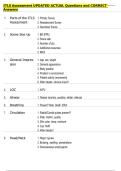
ITLS Assessment UPDATED ACTUAL Questions and CORRECT
Answers
1. Parts of the ITLS 1. Primary Survey
Assessment 2. Reassessment Survey
3. Secondary Survey
2. Scene Size Up 1. BSI (PPE)
2. Scene safe
3. Number of pts
4. Additional resources
5. MOI
3. General Impres- 1. Age, sex, weight
sion 2. General appearance
3. Body position
4. Position in environment
5. Patient activity (movement)
6. Killer bleeds, obvious injury‼
4. LOC 1. AVPU
5. Airway 1. Noises (snoring, gurgling, strider, silence)
6. Breathing 1. Present? Rate, Depth, Effort
7. Circulation 1. Radial/Carotid pulses present?
2. Rate, rhythm, quality
3. Skin color, temp, moisture
4. Cap. Refill
5. Killer bleeds‼
8. Head/Neck 1. Major injuries
2. Bruising, swelling, penetrations
3. Subcutaneous emphysema
, 4. JVD (Pump Failure)
5. Tracheal tugging
9. Chest 1. Asymmetry, contusion, penetrations, paradoxical movement, chest rise
2. Tenderness, instability, crepitus
10. Breath Sounds 1. Present? Equal?
2. If decreased, percussion
3. Heart tones‼
11. Abdomen 1. Bruising, penetrations, evisceration
2. Tenderness, rigidity, distention
12. Pelvis 1. Deformities, penetrations, TIC
13. Lower Ex 1. (U) Swelling, deformities, TIC
2. (L) Wounds, swelling, deformities
3. Motor, sensory before backboard
14. Upper Ex 1. (U) Swelling, deformities, TIC
2. (L) Wounds, swelling, deformities
3. Motor, sensory before backboard
15. Posterior 1. Penetrations, deformity, edema
16. ‼CRITICAL/NON- If critical, TRANSFER to AMBULANCE
CRITICAL‼
17. Baseline Vitals 1. Heart rate
2. Resp. Rate
3. Blood pressure
18. History SAMPLE
2/5
Answers
1. Parts of the ITLS 1. Primary Survey
Assessment 2. Reassessment Survey
3. Secondary Survey
2. Scene Size Up 1. BSI (PPE)
2. Scene safe
3. Number of pts
4. Additional resources
5. MOI
3. General Impres- 1. Age, sex, weight
sion 2. General appearance
3. Body position
4. Position in environment
5. Patient activity (movement)
6. Killer bleeds, obvious injury‼
4. LOC 1. AVPU
5. Airway 1. Noises (snoring, gurgling, strider, silence)
6. Breathing 1. Present? Rate, Depth, Effort
7. Circulation 1. Radial/Carotid pulses present?
2. Rate, rhythm, quality
3. Skin color, temp, moisture
4. Cap. Refill
5. Killer bleeds‼
8. Head/Neck 1. Major injuries
2. Bruising, swelling, penetrations
3. Subcutaneous emphysema
, 4. JVD (Pump Failure)
5. Tracheal tugging
9. Chest 1. Asymmetry, contusion, penetrations, paradoxical movement, chest rise
2. Tenderness, instability, crepitus
10. Breath Sounds 1. Present? Equal?
2. If decreased, percussion
3. Heart tones‼
11. Abdomen 1. Bruising, penetrations, evisceration
2. Tenderness, rigidity, distention
12. Pelvis 1. Deformities, penetrations, TIC
13. Lower Ex 1. (U) Swelling, deformities, TIC
2. (L) Wounds, swelling, deformities
3. Motor, sensory before backboard
14. Upper Ex 1. (U) Swelling, deformities, TIC
2. (L) Wounds, swelling, deformities
3. Motor, sensory before backboard
15. Posterior 1. Penetrations, deformity, edema
16. ‼CRITICAL/NON- If critical, TRANSFER to AMBULANCE
CRITICAL‼
17. Baseline Vitals 1. Heart rate
2. Resp. Rate
3. Blood pressure
18. History SAMPLE
2/5