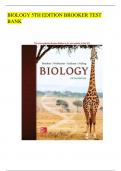
Laboratory Manual
Biology
By Vodopich And Moore
13th Edition
,Contents
Preface V Exercise 16
Teaching And Learning Tools Ix Molecular Biology And Biotechnology: Dna Isolation And Genetic
Transformation 175
Welcome To The Biology Laboratory
Xii
Exercise 17
Genetics: The Principles Of Mendel 183
Exercise 1
Scientific Method: The Process Of Science 1
Exercise 18
Evolution: Natural Selection And Morphological Change In
Exercise 2 Green Algae 199
Measurements In Biology: The Metric System And Data Analysis 11
Exercise 19
Exercise 3 Human Evolution: Skull Examination 211
The Microscope: Basic Skills Of Light Microscopy 21
Exercise 20
Exercise 4 Ecology: Diversity And Interaction In Plant Communities 223
The Cell: Structure And Function 33
Exercise 21
Exercise 5 Community Succession 233
Solutions, Acids, And Bases: The Ph Scale 51
Exercise 22
Exercise 6 Population Growth: Limitations Of The Environment 241
Biologically Important Molecules: Carbohydrates, Proteins, Lipids,
And Nucleic Acids 59
Exercise 23
Pollution: The Effects Of Chemical, Thermal, And Acidic Pollution 249
Exercise 7
Separating Organic Compounds: Column Chromatography, Paper
Chromatography, And Gel Electrophoresis 73
Exercise 24
Survey Of Prokaryotes: Domains Archaea And Bacteria 259
Exercise 8 Exercise 25
Spectrophotometry: Identifying Solutes And Determining
Survey Of Protists: Algal Autotrophs 275
TheirConcentration 83
Exercise 9 Exercise 26
Survey Of Protists: Protozoan Heterotrophs 289
Diffusion And Osmosis: Passive Movement Of Molecules In
BiologicalSystems 95
Exercise 27
Survey Of The Kingdom Fungi: Molds, Sac Fungi, Mushrooms,
Exercise 10 AndLichens 299
Cellular Membranes: Effects Of Physical And Chemical Stress 109
Exercise 11 Exercise 28
Survey Of The Plant Kingdom: Liverworts, Mosses, And Hornworts Of
Enzymes: Factors Affecting The Rate Of Activity 117
Phyla Hepatophyta, Bryophyta, And Anthocerophyta 315
Exercise 12 Exercise 29
Respiration: Aerobic And Anaerobic Oxidation Of
Survey Of The Plant Kingdom: Seedless Vascular Plants Of Phyla
OrganicMolecules 129
Pterophyta And Lycophyta 325
Exercise 13 Exercise 30
Photosynthesis: Pigment Separation, Starch Production, And Co2
Survey Of The Plant Kingdom: Gymnosperms Of Phyla Cycadophyta,
Uptake 141
Ginkgophyta, Coniferophyta, And Gnetophyta 337
Exercise 14 Exercise 31
Mitosis: Replication Of Eukaryotic Cells 153
Survey Of The Plant Kingdom: Angiosperms 347
Exercise 15
Meiosis: Reduction Division And Gametogenesis 163
iii
Toc–1
,Exercise 32 Exercise 43
Plant Anatomy: Vegetative Structure Of Vascular Plants 363 Human Biology: Muscles And Muscle Contraction 507
Exercise 33 Exercise 44
Plant Physiology: Transpiration 377 Human Biology: Breathing 515
Exercise 34 Exercise 45
Plant Physiology: Tropisms, Nutrition, And Growth Regulators 385 Human Biology: Circulation And Blood Pressure 525
Exercise 35 Exercise 46
Bioassay: Measuring Physiologically Active Substances 397 Human Biology: Sensory Perception 539
Exercise 36 Exercise 47
Survey Of The Animal Kingdom: Phyla Porifera And Cnidaria 403 Vertebrate Anatomy: External Features And
SkeletalSystem Of The Rat 549
Exercise 37
Survey Of The Animal Kingdom: Phyla Platyhelminthes Exercise 48
AndMollusca 419 Vertebrate Anatomy: Muscles And Internal Organs Of The Rat 557
Exercise 38 Exercise 49
Survey Of The Animal Kingdom: Phyla Annelida And Nematoda 435 Vertebrate Anatomy: Urogenital And Circulatory Systems Of The Rat 567
Exercise 39 Exercise 50
Survey Of The Animal Kingdom: Phylum Arthropoda 449 Embryology: Comparative Morphologies And
Strategies Of Development 579
Exercise 40
Survey Of The Animal Kingdom: Phyla Echinodermata Exercise 51
And Chordata 463 Animal Behavior: Taxis, Kinesis, And Agonistic Behavior 589
Exercise 41 Appendix I
Vertebrate Animal Tissues: Epithelial, Connective, Muscular, And Dissection Of A Fetal Pig 595
Nervous Tissues 483
Appendix Ii
Exercise 42 Conversion Of Metric Units To English Units 602
Human Biology: The Human Skeletal System 499
iv toc–2
, Preface
W e have designed this laboratory manual for an intro-
ductory biology course with a broad survey of basic
laboratory techniques. the experiments and procedures are
biology. we’ve tried to guide students from observations to
conclusions, to help students make their own discoveries,
and to make the transition from observation to understand-
simple, safe, easy to perform, and especially appropriate for ing biological principles. but discussions and interactions
large classes. few experiments require more than one class between student and instructor are major components of a
meeting to complete the procedure. each exercise includes successful laboratory experience. be sure to examine the
many photographs and illustrations, traditional topics, and “questions for further study and inquiry” in each exercise.
experiments that help students do biology as they learn about we hope they will help you expand students’ perceptions
life. procedures within each exercise are numerous and dis- that each exercise has broad application to their world.
crete so that an exercise can be tailored to the needs of the stu-
dents, the style of the instructor, and the facilities available.
Digital Integration
To The Student today’s students are digital learners, and this lab manual
integrates that learning with interesting activities that help
we hope this manual is an interesting guide to many areas
students learn about biology. virtually every exercise of this
of biology. as you read about these areas, you’ll probably
manual is accompanied by tailor-made digital resources,
spend equal amounts of time observing and experimenting.
including assignable questions and a variety of high-definition
don’t hesitate to go beyond the observations that we’ve
videos, powerpoint images, and other resources that demon-
outlined—your future success as a scientist and an informed
strate basic techniques, emphasize biological principles, test
citizen depends on your ability to seek and notice things that
for understanding, and engage students as they learn biology
others may overlook. now is the time to develop this ability
in the laboratory.
with a mixture of hard work and relaxed observation. have
digital resources are available to instructors at connect
fun, and learning will come easily. also, remember that this
.mheducation.com. instructors will want to assign these
manual is designed with your instructors in mind as well. go
resources to help students know what they’ll be doing, what
to them often with questions—their experience is a valuable
principles they’ll be investigating, and what concepts they’ll
tool that you should use as you work.
need to understand before coming to lab.
To The Instructor
What’s New In This Edition
this manual’s simple, straightforward approach emphasizes
experiments and activities that optimize students’ investment throughout the manual, we have expanded and improved
of time and your investment of supplies, equipment, and several of the most popular and effective features of
preparation. simple, safe, and straightforward experiments previous editions, including
are most effective if you interpret the work in depth. most ∙ learning objectives have been updated to provide an
experiments can be done easily by a student in 2 to 3 hours. overview of what students will do and learn in the exercise.
terminology, structures, photographs, and concepts are lim-
ited to those that the student can readily observe and under- ∙ procedures and doing biology yourself require stu-
stand. in each exercise we have included a few activities dents to do biology as they apply skills they’ve learned to
requiring a greater investment of effort if resources are avail- develop and study hypotheses they formulate about biology.
able, but omitting them will not detract from the objectives. ∙ questions throughout each exercise encourage students to
this manual functions best with an instructor’s guid- pause and think about their data and what they’ve learned.
ance and is not an autotutorial system. we've provided back-
ground information for context and understanding, but the ∙ questions for further study and inquiry at the end
focus of each exercise remains on students doing interesting of each exercise help students apply what they’ve
and meaningful activities to learn basic information about learned to broader topics and issues in biology.
vi P–2
Biology
By Vodopich And Moore
13th Edition
,Contents
Preface V Exercise 16
Teaching And Learning Tools Ix Molecular Biology And Biotechnology: Dna Isolation And Genetic
Transformation 175
Welcome To The Biology Laboratory
Xii
Exercise 17
Genetics: The Principles Of Mendel 183
Exercise 1
Scientific Method: The Process Of Science 1
Exercise 18
Evolution: Natural Selection And Morphological Change In
Exercise 2 Green Algae 199
Measurements In Biology: The Metric System And Data Analysis 11
Exercise 19
Exercise 3 Human Evolution: Skull Examination 211
The Microscope: Basic Skills Of Light Microscopy 21
Exercise 20
Exercise 4 Ecology: Diversity And Interaction In Plant Communities 223
The Cell: Structure And Function 33
Exercise 21
Exercise 5 Community Succession 233
Solutions, Acids, And Bases: The Ph Scale 51
Exercise 22
Exercise 6 Population Growth: Limitations Of The Environment 241
Biologically Important Molecules: Carbohydrates, Proteins, Lipids,
And Nucleic Acids 59
Exercise 23
Pollution: The Effects Of Chemical, Thermal, And Acidic Pollution 249
Exercise 7
Separating Organic Compounds: Column Chromatography, Paper
Chromatography, And Gel Electrophoresis 73
Exercise 24
Survey Of Prokaryotes: Domains Archaea And Bacteria 259
Exercise 8 Exercise 25
Spectrophotometry: Identifying Solutes And Determining
Survey Of Protists: Algal Autotrophs 275
TheirConcentration 83
Exercise 9 Exercise 26
Survey Of Protists: Protozoan Heterotrophs 289
Diffusion And Osmosis: Passive Movement Of Molecules In
BiologicalSystems 95
Exercise 27
Survey Of The Kingdom Fungi: Molds, Sac Fungi, Mushrooms,
Exercise 10 AndLichens 299
Cellular Membranes: Effects Of Physical And Chemical Stress 109
Exercise 11 Exercise 28
Survey Of The Plant Kingdom: Liverworts, Mosses, And Hornworts Of
Enzymes: Factors Affecting The Rate Of Activity 117
Phyla Hepatophyta, Bryophyta, And Anthocerophyta 315
Exercise 12 Exercise 29
Respiration: Aerobic And Anaerobic Oxidation Of
Survey Of The Plant Kingdom: Seedless Vascular Plants Of Phyla
OrganicMolecules 129
Pterophyta And Lycophyta 325
Exercise 13 Exercise 30
Photosynthesis: Pigment Separation, Starch Production, And Co2
Survey Of The Plant Kingdom: Gymnosperms Of Phyla Cycadophyta,
Uptake 141
Ginkgophyta, Coniferophyta, And Gnetophyta 337
Exercise 14 Exercise 31
Mitosis: Replication Of Eukaryotic Cells 153
Survey Of The Plant Kingdom: Angiosperms 347
Exercise 15
Meiosis: Reduction Division And Gametogenesis 163
iii
Toc–1
,Exercise 32 Exercise 43
Plant Anatomy: Vegetative Structure Of Vascular Plants 363 Human Biology: Muscles And Muscle Contraction 507
Exercise 33 Exercise 44
Plant Physiology: Transpiration 377 Human Biology: Breathing 515
Exercise 34 Exercise 45
Plant Physiology: Tropisms, Nutrition, And Growth Regulators 385 Human Biology: Circulation And Blood Pressure 525
Exercise 35 Exercise 46
Bioassay: Measuring Physiologically Active Substances 397 Human Biology: Sensory Perception 539
Exercise 36 Exercise 47
Survey Of The Animal Kingdom: Phyla Porifera And Cnidaria 403 Vertebrate Anatomy: External Features And
SkeletalSystem Of The Rat 549
Exercise 37
Survey Of The Animal Kingdom: Phyla Platyhelminthes Exercise 48
AndMollusca 419 Vertebrate Anatomy: Muscles And Internal Organs Of The Rat 557
Exercise 38 Exercise 49
Survey Of The Animal Kingdom: Phyla Annelida And Nematoda 435 Vertebrate Anatomy: Urogenital And Circulatory Systems Of The Rat 567
Exercise 39 Exercise 50
Survey Of The Animal Kingdom: Phylum Arthropoda 449 Embryology: Comparative Morphologies And
Strategies Of Development 579
Exercise 40
Survey Of The Animal Kingdom: Phyla Echinodermata Exercise 51
And Chordata 463 Animal Behavior: Taxis, Kinesis, And Agonistic Behavior 589
Exercise 41 Appendix I
Vertebrate Animal Tissues: Epithelial, Connective, Muscular, And Dissection Of A Fetal Pig 595
Nervous Tissues 483
Appendix Ii
Exercise 42 Conversion Of Metric Units To English Units 602
Human Biology: The Human Skeletal System 499
iv toc–2
, Preface
W e have designed this laboratory manual for an intro-
ductory biology course with a broad survey of basic
laboratory techniques. the experiments and procedures are
biology. we’ve tried to guide students from observations to
conclusions, to help students make their own discoveries,
and to make the transition from observation to understand-
simple, safe, easy to perform, and especially appropriate for ing biological principles. but discussions and interactions
large classes. few experiments require more than one class between student and instructor are major components of a
meeting to complete the procedure. each exercise includes successful laboratory experience. be sure to examine the
many photographs and illustrations, traditional topics, and “questions for further study and inquiry” in each exercise.
experiments that help students do biology as they learn about we hope they will help you expand students’ perceptions
life. procedures within each exercise are numerous and dis- that each exercise has broad application to their world.
crete so that an exercise can be tailored to the needs of the stu-
dents, the style of the instructor, and the facilities available.
Digital Integration
To The Student today’s students are digital learners, and this lab manual
integrates that learning with interesting activities that help
we hope this manual is an interesting guide to many areas
students learn about biology. virtually every exercise of this
of biology. as you read about these areas, you’ll probably
manual is accompanied by tailor-made digital resources,
spend equal amounts of time observing and experimenting.
including assignable questions and a variety of high-definition
don’t hesitate to go beyond the observations that we’ve
videos, powerpoint images, and other resources that demon-
outlined—your future success as a scientist and an informed
strate basic techniques, emphasize biological principles, test
citizen depends on your ability to seek and notice things that
for understanding, and engage students as they learn biology
others may overlook. now is the time to develop this ability
in the laboratory.
with a mixture of hard work and relaxed observation. have
digital resources are available to instructors at connect
fun, and learning will come easily. also, remember that this
.mheducation.com. instructors will want to assign these
manual is designed with your instructors in mind as well. go
resources to help students know what they’ll be doing, what
to them often with questions—their experience is a valuable
principles they’ll be investigating, and what concepts they’ll
tool that you should use as you work.
need to understand before coming to lab.
To The Instructor
What’s New In This Edition
this manual’s simple, straightforward approach emphasizes
experiments and activities that optimize students’ investment throughout the manual, we have expanded and improved
of time and your investment of supplies, equipment, and several of the most popular and effective features of
preparation. simple, safe, and straightforward experiments previous editions, including
are most effective if you interpret the work in depth. most ∙ learning objectives have been updated to provide an
experiments can be done easily by a student in 2 to 3 hours. overview of what students will do and learn in the exercise.
terminology, structures, photographs, and concepts are lim-
ited to those that the student can readily observe and under- ∙ procedures and doing biology yourself require stu-
stand. in each exercise we have included a few activities dents to do biology as they apply skills they’ve learned to
requiring a greater investment of effort if resources are avail- develop and study hypotheses they formulate about biology.
able, but omitting them will not detract from the objectives. ∙ questions throughout each exercise encourage students to
this manual functions best with an instructor’s guid- pause and think about their data and what they’ve learned.
ance and is not an autotutorial system. we've provided back-
ground information for context and understanding, but the ∙ questions for further study and inquiry at the end
focus of each exercise remains on students doing interesting of each exercise help students apply what they’ve
and meaningful activities to learn basic information about learned to broader topics and issues in biology.
vi P–2