NES elementary education subtest 1; english language arts part
Study online at https://quizlet.com/_3oaloe
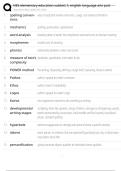
1. spelling conven- area of study that involves mechanics, usage, and sentence formation
tions
2. mechanics spelling, punctuation, capitalization
3. word analysis breaking down of words into morphemes and word units to discover meaning
4. morphemes smallest unit of meaning
5. phonics relationship between a letter and sound
6. measure of text's qualitative, quantitative, and reader & task
complexity
7. POWER method Pre-writing, Organizing, Writing a rough draft, Evaluating, Revise & rewrite
8. Pathos author's appeal to reader's emotions
9. Ethos author's level of creditability
10. Logos author's appeal to reader's logic
11. Kairos most opportune moment to do something in writing
12. developmental scribbling, letter-like symbols, strings of letters, emergence of beginning sounds,
writing stages words represented by consonants, initial middle and final sounds, transitional
phase, standard spelling
13. hyperbole extreme exaggeration to strongly state point of evoke a specific emotion
14. idioms word, phrase, or sentence that are expressed figuratively, but carry a literal mean-
ing readers must infer
15. personification giving inanimate objects qualities to intimidate human qualities
1/6
, NES elementary education subtest 1; english language arts part
Study online at https://quizlet.com/_3oaloe
16. simile comparison of 2 unlike things using connecting words
17. metaphor comparison of 2 unlike thing with no connecting words
18. onomatopoeia words that are formed by using that very sound itself (drip, drip, drip_
19. phonological ability to identify and manipulate specific units of oral language (words, syllables,
awareness onset, rimes)
20. onset initial phonological unit of a word/precedes vowel
21. rimes string of letters that follow rime
22. phoneme smallest unit in language (there are 44)
23. segmenting breaking a word into individual phonemes
24. blending connecting segmented phonemes into a word
25. active listening offering undivided attention, asking relevant questions/providing feedback, main-
taining eye contact, smiling, and using appropriate posture.
26. oral presenta- correct volume and articulation, awareness of audience
tions
27. stages of learn- pre-production, early production, speech emergence, intermediate fluency, ad-
ing acquisition vanced fluency
28. Pre-production Stage of learning acquisition where there is no verbal, only possibly nods. About
0-6 months.
29. Early production Stage of learning acquisition where child starts giving one to two word responses.
About 6-12 months.
30.
2/6
Study online at https://quizlet.com/_3oaloe
1. spelling conven- area of study that involves mechanics, usage, and sentence formation
tions
2. mechanics spelling, punctuation, capitalization
3. word analysis breaking down of words into morphemes and word units to discover meaning
4. morphemes smallest unit of meaning
5. phonics relationship between a letter and sound
6. measure of text's qualitative, quantitative, and reader & task
complexity
7. POWER method Pre-writing, Organizing, Writing a rough draft, Evaluating, Revise & rewrite
8. Pathos author's appeal to reader's emotions
9. Ethos author's level of creditability
10. Logos author's appeal to reader's logic
11. Kairos most opportune moment to do something in writing
12. developmental scribbling, letter-like symbols, strings of letters, emergence of beginning sounds,
writing stages words represented by consonants, initial middle and final sounds, transitional
phase, standard spelling
13. hyperbole extreme exaggeration to strongly state point of evoke a specific emotion
14. idioms word, phrase, or sentence that are expressed figuratively, but carry a literal mean-
ing readers must infer
15. personification giving inanimate objects qualities to intimidate human qualities
1/6
, NES elementary education subtest 1; english language arts part
Study online at https://quizlet.com/_3oaloe
16. simile comparison of 2 unlike things using connecting words
17. metaphor comparison of 2 unlike thing with no connecting words
18. onomatopoeia words that are formed by using that very sound itself (drip, drip, drip_
19. phonological ability to identify and manipulate specific units of oral language (words, syllables,
awareness onset, rimes)
20. onset initial phonological unit of a word/precedes vowel
21. rimes string of letters that follow rime
22. phoneme smallest unit in language (there are 44)
23. segmenting breaking a word into individual phonemes
24. blending connecting segmented phonemes into a word
25. active listening offering undivided attention, asking relevant questions/providing feedback, main-
taining eye contact, smiling, and using appropriate posture.
26. oral presenta- correct volume and articulation, awareness of audience
tions
27. stages of learn- pre-production, early production, speech emergence, intermediate fluency, ad-
ing acquisition vanced fluency
28. Pre-production Stage of learning acquisition where there is no verbal, only possibly nods. About
0-6 months.
29. Early production Stage of learning acquisition where child starts giving one to two word responses.
About 6-12 months.
30.
2/6