

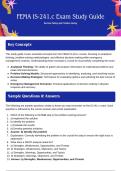
FEMA IS-241.c Exam Study Guide
Decision Making and Problem Solving
Key Concepts
This study guide covers essential concepts from the FEMA IS-241.c course, focusing on analytical
thinking, problem-solving methodologies, and effective decision-making within emergency
management contexts. Understanding these concepts is crucial for successfully completing the exam.
Analytical Thinking: The ability to gather and analyze information to understand problems and
make informed decisions.
Problem-Solving Models: Structured approaches to identifying, analyzing, and resolving issues.
Decision-Making Strategies: Techniques for evaluating options and selecting the best course of
action.
Emergency Management Scenarios: Practical applications of decision-making in disaster
response and recovery.
Sample Questions & Answers
The following are sample questions similar to those you may encounter on the IS-241.c exam. Each
question is followed by the correct answer and a brief explanation.
1. Which of the following is the first step in the problem-solving process?
2. a) Implement the solution
3. b) Identify the problem
4. c) Evaluate the results
5. d) Develop potential solutions
6. Answer: b) Identify the problem
7. Explanation: Correctly identifying the problem is the crucial first step to ensure the right issue is
addressed.*
8. What does a SWOT analysis stand for?
9. a) Strengths, Weaknesses, Opportunities, and Threats
10. b) Strategies, Weaknesses, Objectives, and Tactics
11. c) Strengths, Warnings, Opportunities, and Tactics
12. d) Strategies, Warnings, Objectives, and Threats
13. Answer: a) Strengths, Weaknesses, Opportunities, and Threats
, 14. Explanation: SWOT analysis is a strategic planning tool used to evaluate these four elements of
a project or business venture.*
15. In decision-making, what is the purpose of a 'risk assessment'?
16. a) To eliminate all potential risks
17. b) To identify and evaluate potential risks
18. c) To ignore potential risks and focus on benefits
19. d) To transfer all risks to another party
20. Answer: b) To identify and evaluate potential risks
21. Explanation: Risk assessment helps in understanding the probability and impact of potential
negative events.*
22. Which of the following is a characteristic of an effective decision-maker?
23. a) Always makes decisions quickly without considering alternatives
24. b) Considers input from others and evaluates alternatives
25. c) Relies solely on intuition
26. d) Avoids making decisions whenever possible
27. Answer: b) Considers input from others and evaluates alternatives
28. Explanation: Effective decision-makers are open to feedback and systematically evaluate
different options.*
29. What is the primary goal of 'mitigation' in emergency management?
30. a) To reduce the impact of disasters
31. b) To respond to disasters
32. c) To recover from disasters
33. d) To prepare for disasters
34. Answer: a) To reduce the impact of disasters
35. Explanation: Mitigation efforts aim to minimize the potential damage and losses from future
disasters.*
36. What does NIMS stand for?
37. a) National Incident Management System
38. b) National Information Management System
39. c) National Intelligence Management System
40. d) Natural Incident Management System
41. Answer: a) National Incident Management System
42. Explanation: NIMS provides a consistent nationwide template to enable Federal, State, tribal,
and local governments and private-sector and nongovernmental organizations to work together
effectively and efficiently to prepare for, prevent, respond to, and recover from domestic
incidents.*
43. Which problem-solving technique involves generating a large number of ideas without initial
criticism?
44. a) Root Cause Analysis
45. b) Brainstorming
46. c) Decision Matrix
47. d) Pareto Analysis
48. Answer: b) Brainstorming
49. Explanation: Brainstorming is designed to create a wide range of ideas in a non-judgmental
setting.*
50. What is a key component of 'situational awareness' in emergency response?
Decision Making and Problem Solving
Key Concepts
This study guide covers essential concepts from the FEMA IS-241.c course, focusing on analytical
thinking, problem-solving methodologies, and effective decision-making within emergency
management contexts. Understanding these concepts is crucial for successfully completing the exam.
Analytical Thinking: The ability to gather and analyze information to understand problems and
make informed decisions.
Problem-Solving Models: Structured approaches to identifying, analyzing, and resolving issues.
Decision-Making Strategies: Techniques for evaluating options and selecting the best course of
action.
Emergency Management Scenarios: Practical applications of decision-making in disaster
response and recovery.
Sample Questions & Answers
The following are sample questions similar to those you may encounter on the IS-241.c exam. Each
question is followed by the correct answer and a brief explanation.
1. Which of the following is the first step in the problem-solving process?
2. a) Implement the solution
3. b) Identify the problem
4. c) Evaluate the results
5. d) Develop potential solutions
6. Answer: b) Identify the problem
7. Explanation: Correctly identifying the problem is the crucial first step to ensure the right issue is
addressed.*
8. What does a SWOT analysis stand for?
9. a) Strengths, Weaknesses, Opportunities, and Threats
10. b) Strategies, Weaknesses, Objectives, and Tactics
11. c) Strengths, Warnings, Opportunities, and Tactics
12. d) Strategies, Warnings, Objectives, and Threats
13. Answer: a) Strengths, Weaknesses, Opportunities, and Threats
, 14. Explanation: SWOT analysis is a strategic planning tool used to evaluate these four elements of
a project or business venture.*
15. In decision-making, what is the purpose of a 'risk assessment'?
16. a) To eliminate all potential risks
17. b) To identify and evaluate potential risks
18. c) To ignore potential risks and focus on benefits
19. d) To transfer all risks to another party
20. Answer: b) To identify and evaluate potential risks
21. Explanation: Risk assessment helps in understanding the probability and impact of potential
negative events.*
22. Which of the following is a characteristic of an effective decision-maker?
23. a) Always makes decisions quickly without considering alternatives
24. b) Considers input from others and evaluates alternatives
25. c) Relies solely on intuition
26. d) Avoids making decisions whenever possible
27. Answer: b) Considers input from others and evaluates alternatives
28. Explanation: Effective decision-makers are open to feedback and systematically evaluate
different options.*
29. What is the primary goal of 'mitigation' in emergency management?
30. a) To reduce the impact of disasters
31. b) To respond to disasters
32. c) To recover from disasters
33. d) To prepare for disasters
34. Answer: a) To reduce the impact of disasters
35. Explanation: Mitigation efforts aim to minimize the potential damage and losses from future
disasters.*
36. What does NIMS stand for?
37. a) National Incident Management System
38. b) National Information Management System
39. c) National Intelligence Management System
40. d) Natural Incident Management System
41. Answer: a) National Incident Management System
42. Explanation: NIMS provides a consistent nationwide template to enable Federal, State, tribal,
and local governments and private-sector and nongovernmental organizations to work together
effectively and efficiently to prepare for, prevent, respond to, and recover from domestic
incidents.*
43. Which problem-solving technique involves generating a large number of ideas without initial
criticism?
44. a) Root Cause Analysis
45. b) Brainstorming
46. c) Decision Matrix
47. d) Pareto Analysis
48. Answer: b) Brainstorming
49. Explanation: Brainstorming is designed to create a wide range of ideas in a non-judgmental
setting.*
50. What is a key component of 'situational awareness' in emergency response?


