EJPME-US002-13
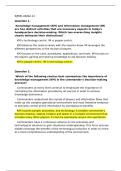
Question 1.
Knowledge management (KM) and information management (IM)
are two distinct activities that are necessary aspects in today's
headquarters decision-making. Which two overarching insights
clearly delineate their distinctions?
KM is technology-centric. IM is people-centric.
KM balances the need-to-share with the need-to-know. IM leverages the
different perspectives of the myriad of players.
KM focuses on the rules, procedures, applications, and tools. IM focuses on
the players gaining and sharing knowledge to aid decision-making.
KM is people-centric. IM is technology-centric.
Question 2.
Which of the following choices best summarizes the importance of
knowledge management (KM) in the commander's decision-making
process?
Commanders at every level continue to emphasize the importance of
controlling the information provided by all sources in order to achieve
knowledge dominance.
Commanders understand the myriad of players and information flows that
make up the complex operational environment and must therefore endeavor
to precisely control all the information by leveraging its benefits.
KM involves people, processes, and technology. It enables commander's
decision-making, making it better and faster in a complex environment that
includes many other players. It must be seamlessly woven into operations.
Commanders have a continuous reliance on the processes and
technological solutions to gain situational undersganding. This focus ensures
leaders leverage the benefits of the technological solutions in order to arrive
at a more comprehensive understanding of the environment.
, Question 3.
What action(s) can commanders take that will help them organize
and interface with the myriad of relevant players and information
flows?
delineating staff interface responsibilities and designate LNOs
all answers are correct
reducing reliance on email for sharing information
avoiding using Foreign Disclosure Officers (FDOs) as part of their staff
Question 4.
Which of the following statements about the commander's
perspectives is FALSE?
Commanders should focus their units and staff through commander's
critical information requirements (CCIR) that address both necessary
decisions and information needs.
Commanders can greatly assist their staff by sharing their unique
perspectives.
Commanders should instill a climate of seamless information sharing and
push toward "co-creation" of context.
In order to gain situational understanding, commanders are emphasizing
an increased reliance on processes and technological solutions, rather than
people interaction.
Question 5.
What action(s) should commanders consider to ensure information
sharing with partners of foreign countries?
considering both physical and virtual collaboration means to gain
information and develop knowledge
all answers are correct
Question 1.
Knowledge management (KM) and information management (IM)
are two distinct activities that are necessary aspects in today's
headquarters decision-making. Which two overarching insights
clearly delineate their distinctions?
KM is technology-centric. IM is people-centric.
KM balances the need-to-share with the need-to-know. IM leverages the
different perspectives of the myriad of players.
KM focuses on the rules, procedures, applications, and tools. IM focuses on
the players gaining and sharing knowledge to aid decision-making.
KM is people-centric. IM is technology-centric.
Question 2.
Which of the following choices best summarizes the importance of
knowledge management (KM) in the commander's decision-making
process?
Commanders at every level continue to emphasize the importance of
controlling the information provided by all sources in order to achieve
knowledge dominance.
Commanders understand the myriad of players and information flows that
make up the complex operational environment and must therefore endeavor
to precisely control all the information by leveraging its benefits.
KM involves people, processes, and technology. It enables commander's
decision-making, making it better and faster in a complex environment that
includes many other players. It must be seamlessly woven into operations.
Commanders have a continuous reliance on the processes and
technological solutions to gain situational undersganding. This focus ensures
leaders leverage the benefits of the technological solutions in order to arrive
at a more comprehensive understanding of the environment.
, Question 3.
What action(s) can commanders take that will help them organize
and interface with the myriad of relevant players and information
flows?
delineating staff interface responsibilities and designate LNOs
all answers are correct
reducing reliance on email for sharing information
avoiding using Foreign Disclosure Officers (FDOs) as part of their staff
Question 4.
Which of the following statements about the commander's
perspectives is FALSE?
Commanders should focus their units and staff through commander's
critical information requirements (CCIR) that address both necessary
decisions and information needs.
Commanders can greatly assist their staff by sharing their unique
perspectives.
Commanders should instill a climate of seamless information sharing and
push toward "co-creation" of context.
In order to gain situational understanding, commanders are emphasizing
an increased reliance on processes and technological solutions, rather than
people interaction.
Question 5.
What action(s) should commanders consider to ensure information
sharing with partners of foreign countries?
considering both physical and virtual collaboration means to gain
information and develop knowledge
all answers are correct