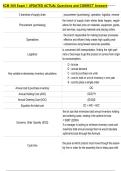
SCM 300 Exam 1 UPDATED ACTUAL Questions and CORRECT Answers
3 branches of supply chain procurement (purchasing), operation, logistics, reverse
the branch of supply chain where deals happen, negoti-
Procurement (purchasing) ations for the best price on materials, equipment, goods,
and services. acquiring materials and placing orders.
the branch responsible for making business processes
Operations effective and eflcient (help create high quality prod-
ucts/services using fewest resources possible).
is concerned with transportation, finding the right part-
Logistics ners or best ways to get the product or service from origin
to consumption.
Q - lot size
D - annual demand
Key variable in elementary inventory calculations C - cost to purchase one unite
H - cost to hold on unit of inventory in one year
S - cost to place a single order
Annual cost to purchase inventory DC
Annual Holding Cost (AHC) (Q/2)*H
Annual Ordering Cost (AOC) (D/Q)S
Equation for total cost DC + AHC + AOC
the lot size that minimizes total annual inventory holding
and ordering costs, making it the optimal lot size
= SQRT (2DS/H)
Economic Order Quantity (EOQ)
if a manager is looking to minimize inventory costs and
maximize total annual savings then he would calculate
optimal lot size through this formula.
the pace at which product must move through the assem-
Cycle time
bly line in order for the assembly line to keep pace with
, demand.
= Operating Time/D
Theoretical Minimum number of workstations calculations
total task time / cycle time
(TM)
3 Supply Chain Flows Money, material, information
the direction that points towards the end customer
Ex: delivering goods from a manufacturer to a distributor.
downstream supply chain
main suppliers s1 working to get parts prepared in time
for manufacturer.
going backwards, moving towards the supplier.
ex: finding ways to maximize eflciency coming back. see
if all the boxes that have arrived at the retailer are empty
Upstream Supply Chain
and not damaged to send them beck for reuse. develop-
ing relationships with the companies first tier supplier to
enhance and better communication.
cost, quality, speed, flexibility
Supply chain competitive priorities For example, a fast food restaurant will customize these
priorities differently from a higher up restaunt
Cost material, energy, waste, transportation
Quality design, reliability, consistency, materials or fabrics
speed delivery, on time, innovative time
flexibility customization, size of orders, design
-raw materials
-work in process
-finished goods
Types of inventory
-maintenance, repair, and operating
-market inventory
-safety stock (buffer stock)
3 branches of supply chain procurement (purchasing), operation, logistics, reverse
the branch of supply chain where deals happen, negoti-
Procurement (purchasing) ations for the best price on materials, equipment, goods,
and services. acquiring materials and placing orders.
the branch responsible for making business processes
Operations effective and eflcient (help create high quality prod-
ucts/services using fewest resources possible).
is concerned with transportation, finding the right part-
Logistics ners or best ways to get the product or service from origin
to consumption.
Q - lot size
D - annual demand
Key variable in elementary inventory calculations C - cost to purchase one unite
H - cost to hold on unit of inventory in one year
S - cost to place a single order
Annual cost to purchase inventory DC
Annual Holding Cost (AHC) (Q/2)*H
Annual Ordering Cost (AOC) (D/Q)S
Equation for total cost DC + AHC + AOC
the lot size that minimizes total annual inventory holding
and ordering costs, making it the optimal lot size
= SQRT (2DS/H)
Economic Order Quantity (EOQ)
if a manager is looking to minimize inventory costs and
maximize total annual savings then he would calculate
optimal lot size through this formula.
the pace at which product must move through the assem-
Cycle time
bly line in order for the assembly line to keep pace with
, demand.
= Operating Time/D
Theoretical Minimum number of workstations calculations
total task time / cycle time
(TM)
3 Supply Chain Flows Money, material, information
the direction that points towards the end customer
Ex: delivering goods from a manufacturer to a distributor.
downstream supply chain
main suppliers s1 working to get parts prepared in time
for manufacturer.
going backwards, moving towards the supplier.
ex: finding ways to maximize eflciency coming back. see
if all the boxes that have arrived at the retailer are empty
Upstream Supply Chain
and not damaged to send them beck for reuse. develop-
ing relationships with the companies first tier supplier to
enhance and better communication.
cost, quality, speed, flexibility
Supply chain competitive priorities For example, a fast food restaurant will customize these
priorities differently from a higher up restaunt
Cost material, energy, waste, transportation
Quality design, reliability, consistency, materials or fabrics
speed delivery, on time, innovative time
flexibility customization, size of orders, design
-raw materials
-work in process
-finished goods
Types of inventory
-maintenance, repair, and operating
-market inventory
-safety stock (buffer stock)