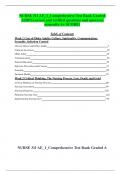
Burns’ Pediatric Primary Care (8th Ed.) — Complete Chapter-
by-Chapter Test Bank: Verified Answers & Detailed Rationales
(New Edition)
Question 1
Reference: Ch. 10, Section: Developmental Management
Question Stem:
A 4-year-old child is brought to the clinic for a well-child visit.
The parent is concerned that the child cannot yet correctly
name four colors. Using a standardized developmental
screening tool, the PNP confirms a slight delay in this specific
cognitive milestone. What is the PNP's most appropriate initial
action?
Options:
A. Refer the child immediately to a developmental pediatrician
for a comprehensive evaluation.
B. Provide anticipatory guidance with activities to practice color
identification and re-screen in 3 months.
C. Order a full neurological workup, including an EEG and MRI,
,to rule out underlying pathology.
D. Explain that this is a normal variant and requires no further
follow-up or intervention.
Correct Answer: B
Rationales:
• Correct: For an isolated, mild delay in a single milestone
identified during a well-child visit, the first step is often
parent education and focused activities, followed by re-
screening to monitor progress. This approach is consistent
with developmental surveillance and health promotion.
• Incorrect A: Immediate referral to a specialist is premature
for a single, mild concern without other red flags. The PNP
should first initiate primary care interventions.
• Incorrect C: A full neurological workup is not indicated for
an isolated developmental concern and is not a first-line
action in primary care.
• Incorrect D: Dismissing the parent's valid concern is not
appropriate. The delay was confirmed by a screening tool,
warranting some form of intervention and follow-up.
Teaching Point: Isolated mild delays warrant parent education
and re-screening before specialist referral.
Question 2
Reference: Ch. 28, Section: Asthma
,Question Stem:
A 7-year-old with persistent asthma, well-controlled on
fluticasone 110 mcg two puffs twice daily, presents for a follow-
up. The mother reports the child has been using the rescue
albuterol inhaler 2-3 times per week for the past month for
cough before soccer practice. What is the most appropriate
next step in management?
Options:
A. Increase the dose of fluticasone to 220 mcg two puffs twice
daily.
B. Add a daily leukotriene receptor antagonist (montelukast).
C. Instruct the family to pre-treat with albuterol 15 minutes
before exercise.
D. Prescribe a short course of oral prednisone to break the cycle
of inflammation.
Correct Answer: C
Rationales:
• Correct: This pattern indicates exercise-induced
bronchospasm. The first-line management is pre-treatment
with a short-acting beta-agonist (SABA) 5-15 minutes
before exercise.
• Incorrect A: Increasing the daily inhaled corticosteroid
(ICS) dose addresses overall control but is not the most
targeted intervention for predictable exercise-induced
symptoms.
, • Incorrect B: While montelukast can be used for exercise-
induced bronchospasm, the initial and most direct step is
SABA pre-treatment.
• Incorrect D: Oral steroids are reserved for moderate to
severe exacerbations, not for managing predictable
exercise-induced symptoms in an otherwise well-
controlled patient.
Teaching Point: Pre-treatment with albuterol is first-line for
exercise-induced bronchospasm in well-controlled asthma.
Question 3
Reference: Ch. 24, Section: Otitis Media
Question Stem:
An 18-month-old, otherwise healthy child presents with a
temperature of 38.5°C (101.3°F) and appears irritable.
Otoscopic examination reveals a bulging, red, immobile
tympanic membrane with purulent effusion. This is the child's
first ear infection. What is the most appropriate management?
Options:
A. Prescribe amoxicillin 80-90 mg/kg/day for a 10-day course.
B. Recommend watchful waiting and symptomatic care with
acetaminophen for 48-72 hours.
C. Prescribe amoxicillin-clavulanate 90 mg/kg/day for a 10-day
course.
by-Chapter Test Bank: Verified Answers & Detailed Rationales
(New Edition)
Question 1
Reference: Ch. 10, Section: Developmental Management
Question Stem:
A 4-year-old child is brought to the clinic for a well-child visit.
The parent is concerned that the child cannot yet correctly
name four colors. Using a standardized developmental
screening tool, the PNP confirms a slight delay in this specific
cognitive milestone. What is the PNP's most appropriate initial
action?
Options:
A. Refer the child immediately to a developmental pediatrician
for a comprehensive evaluation.
B. Provide anticipatory guidance with activities to practice color
identification and re-screen in 3 months.
C. Order a full neurological workup, including an EEG and MRI,
,to rule out underlying pathology.
D. Explain that this is a normal variant and requires no further
follow-up or intervention.
Correct Answer: B
Rationales:
• Correct: For an isolated, mild delay in a single milestone
identified during a well-child visit, the first step is often
parent education and focused activities, followed by re-
screening to monitor progress. This approach is consistent
with developmental surveillance and health promotion.
• Incorrect A: Immediate referral to a specialist is premature
for a single, mild concern without other red flags. The PNP
should first initiate primary care interventions.
• Incorrect C: A full neurological workup is not indicated for
an isolated developmental concern and is not a first-line
action in primary care.
• Incorrect D: Dismissing the parent's valid concern is not
appropriate. The delay was confirmed by a screening tool,
warranting some form of intervention and follow-up.
Teaching Point: Isolated mild delays warrant parent education
and re-screening before specialist referral.
Question 2
Reference: Ch. 28, Section: Asthma
,Question Stem:
A 7-year-old with persistent asthma, well-controlled on
fluticasone 110 mcg two puffs twice daily, presents for a follow-
up. The mother reports the child has been using the rescue
albuterol inhaler 2-3 times per week for the past month for
cough before soccer practice. What is the most appropriate
next step in management?
Options:
A. Increase the dose of fluticasone to 220 mcg two puffs twice
daily.
B. Add a daily leukotriene receptor antagonist (montelukast).
C. Instruct the family to pre-treat with albuterol 15 minutes
before exercise.
D. Prescribe a short course of oral prednisone to break the cycle
of inflammation.
Correct Answer: C
Rationales:
• Correct: This pattern indicates exercise-induced
bronchospasm. The first-line management is pre-treatment
with a short-acting beta-agonist (SABA) 5-15 minutes
before exercise.
• Incorrect A: Increasing the daily inhaled corticosteroid
(ICS) dose addresses overall control but is not the most
targeted intervention for predictable exercise-induced
symptoms.
, • Incorrect B: While montelukast can be used for exercise-
induced bronchospasm, the initial and most direct step is
SABA pre-treatment.
• Incorrect D: Oral steroids are reserved for moderate to
severe exacerbations, not for managing predictable
exercise-induced symptoms in an otherwise well-
controlled patient.
Teaching Point: Pre-treatment with albuterol is first-line for
exercise-induced bronchospasm in well-controlled asthma.
Question 3
Reference: Ch. 24, Section: Otitis Media
Question Stem:
An 18-month-old, otherwise healthy child presents with a
temperature of 38.5°C (101.3°F) and appears irritable.
Otoscopic examination reveals a bulging, red, immobile
tympanic membrane with purulent effusion. This is the child's
first ear infection. What is the most appropriate management?
Options:
A. Prescribe amoxicillin 80-90 mg/kg/day for a 10-day course.
B. Recommend watchful waiting and symptomatic care with
acetaminophen for 48-72 hours.
C. Prescribe amoxicillin-clavulanate 90 mg/kg/day for a 10-day
course.