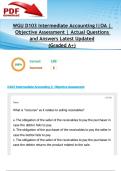
WGU D103 Intermediate Accounting I|OA |
Objective Assessment | Actual Questions
and Answers Latest Updated
(Graded A+)
Correct 100
Incorrect
D103 Intermediate Accounting I| Objective Assessment
1 of 100
Term
What is "recourse" as it relates to selling receivables?
a. The obligation of the seller of the receivables to pay the purchaser in
case the debtor fails to pay.
b. The obligation of the purchaser of the receivables to pay the seller in
case the debtor fails to pay.
c. The obligation of the seller of the receivables to pay the purchaser in
case the debtor returns the product related to the sale.
,d. The obligation of the purchaser of the receivables to pay the seller if
all of the receivables are collected.
Give this one a try later!
$1,800 = COGS: (200 x $5) + (100 x $5) + (50 x $6).
$1,725 = Ending Inventory: (200 x $6) + (75 x $7)
Accounting Rule: FIFO is the acronym for first-in, first-out, which is a cost flow
assumption. Under FIFO, the older costs of products purchased (or manufactured)
are the first costs to be removed from inventory and matched with the sales
revenues reported on the income statement. This means that the most recent costs
remain in inventory.
Debit notes receivable for $7,000; credit revenue for $5,557; credit discount on
notes receivable for $1,443.
Accounting Rule: A noninterest-bearing note is a note with no stated interest rate
on its face. The interest is implied in the face value of the note. The note is issued for
a lessor amount than its face value, and cash or sales revenue is credited for this
amount. The face value of the note at maturity includes both principal and interest.
Hence, the note receivable is always debited for is face value. Account for problems
like this as the present value of a single sum.
$4,975 = COGS: (350 x $8.50) + (250 x $8.00). Ending Inventory: $8,225 = (200 x $7) +
((500 -250) x 8) + ((600 - 350) x $8.5) + (300 x $9)
Accounting Rule: The specific identification inventory valuation method tracks every
single item in an inventory individually from the time it enters the inventory until the
time it leaves it. This inventory method is suitable for companies with expensive,
easily distinguishable low-volume merchandise such as jewelry, fur coats,
automobiles, unique furniture, special manufactured made products.
, a. The obligation of the seller of the receivables to pay the purchaser in case
the debtor fails to pay.
Accounting Rule: When accounts/notes receivable are factored (sold), the
factoring arrangement can be with recourse or without recourse. If
receivables are factored on a with recourse basis, the seller guarantees
payment to the factor in the event the debtor does not make payment. When a
factor buys receivables without recourse, the factor assumes the collection
risk and absorbs any credit losses.
Don't know?
2 of 100
Definition
17.6 times = ($110,000 - $9,000) / (($4,000 + $7,500)) / 2)
Accounting Rule: The accounts receivable turnover ratio measures the
number of times, on average, receivables are collected during the
period.
Receivables Turnover = Net Credit Sales ÷ Average Accounts
Receivable
Give this one a try later!
A company has the following balances in its accounts:
• beginning inventory: $2,000
• purchases: $3,300
• ending inventory: $1,400
, If the periodic system is used, what is the amount of goods available for sale for the
year?
A company has inventory with a sales value of $5,000 that requires $1,000 of cost to
complete. The company's normal profit margin is 10%. What are the ceiling and floor
values?
a. Ceiling $5,000, Floor $4,000
b. Ceiling $5,000, Floor $4,500
c. Ceiling $4,000, Floor $3,600
d. Ceiling $4,000, Floor $3,500
A company has the following financial information:
Year 1
Gross sales: $ 55,000
Sales return and allowances: $ 5,000
Accounts receivable: $ 4,000
Year 2:
Gross sales: $ 110,000
Sales return and allowances: $ 9,000
Accounts receivable: $ 7,500
What is the accounts receivable turnover for Year 2, rounded to the nearest
one decimal place?
A company has net sales of $1,340,000, beginning accounts receivable of $500,000,
and ending accounts receivable of $650,000.
How many days does it take the company to collect its accounts receivable,
rounded to the nearest one decimal place?
Don't know?
Objective Assessment | Actual Questions
and Answers Latest Updated
(Graded A+)
Correct 100
Incorrect
D103 Intermediate Accounting I| Objective Assessment
1 of 100
Term
What is "recourse" as it relates to selling receivables?
a. The obligation of the seller of the receivables to pay the purchaser in
case the debtor fails to pay.
b. The obligation of the purchaser of the receivables to pay the seller in
case the debtor fails to pay.
c. The obligation of the seller of the receivables to pay the purchaser in
case the debtor returns the product related to the sale.
,d. The obligation of the purchaser of the receivables to pay the seller if
all of the receivables are collected.
Give this one a try later!
$1,800 = COGS: (200 x $5) + (100 x $5) + (50 x $6).
$1,725 = Ending Inventory: (200 x $6) + (75 x $7)
Accounting Rule: FIFO is the acronym for first-in, first-out, which is a cost flow
assumption. Under FIFO, the older costs of products purchased (or manufactured)
are the first costs to be removed from inventory and matched with the sales
revenues reported on the income statement. This means that the most recent costs
remain in inventory.
Debit notes receivable for $7,000; credit revenue for $5,557; credit discount on
notes receivable for $1,443.
Accounting Rule: A noninterest-bearing note is a note with no stated interest rate
on its face. The interest is implied in the face value of the note. The note is issued for
a lessor amount than its face value, and cash or sales revenue is credited for this
amount. The face value of the note at maturity includes both principal and interest.
Hence, the note receivable is always debited for is face value. Account for problems
like this as the present value of a single sum.
$4,975 = COGS: (350 x $8.50) + (250 x $8.00). Ending Inventory: $8,225 = (200 x $7) +
((500 -250) x 8) + ((600 - 350) x $8.5) + (300 x $9)
Accounting Rule: The specific identification inventory valuation method tracks every
single item in an inventory individually from the time it enters the inventory until the
time it leaves it. This inventory method is suitable for companies with expensive,
easily distinguishable low-volume merchandise such as jewelry, fur coats,
automobiles, unique furniture, special manufactured made products.
, a. The obligation of the seller of the receivables to pay the purchaser in case
the debtor fails to pay.
Accounting Rule: When accounts/notes receivable are factored (sold), the
factoring arrangement can be with recourse or without recourse. If
receivables are factored on a with recourse basis, the seller guarantees
payment to the factor in the event the debtor does not make payment. When a
factor buys receivables without recourse, the factor assumes the collection
risk and absorbs any credit losses.
Don't know?
2 of 100
Definition
17.6 times = ($110,000 - $9,000) / (($4,000 + $7,500)) / 2)
Accounting Rule: The accounts receivable turnover ratio measures the
number of times, on average, receivables are collected during the
period.
Receivables Turnover = Net Credit Sales ÷ Average Accounts
Receivable
Give this one a try later!
A company has the following balances in its accounts:
• beginning inventory: $2,000
• purchases: $3,300
• ending inventory: $1,400
, If the periodic system is used, what is the amount of goods available for sale for the
year?
A company has inventory with a sales value of $5,000 that requires $1,000 of cost to
complete. The company's normal profit margin is 10%. What are the ceiling and floor
values?
a. Ceiling $5,000, Floor $4,000
b. Ceiling $5,000, Floor $4,500
c. Ceiling $4,000, Floor $3,600
d. Ceiling $4,000, Floor $3,500
A company has the following financial information:
Year 1
Gross sales: $ 55,000
Sales return and allowances: $ 5,000
Accounts receivable: $ 4,000
Year 2:
Gross sales: $ 110,000
Sales return and allowances: $ 9,000
Accounts receivable: $ 7,500
What is the accounts receivable turnover for Year 2, rounded to the nearest
one decimal place?
A company has net sales of $1,340,000, beginning accounts receivable of $500,000,
and ending accounts receivable of $650,000.
How many days does it take the company to collect its accounts receivable,
rounded to the nearest one decimal place?
Don't know?