

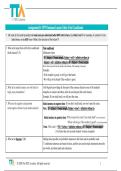
Assignment B - PPP Grammar Lesson Table: First Conditional
NB: Look at the model provided and make sure you understand what MFP refer to here. See Units 2 and 7. For example, in number 4 in the
table below, we do NOT mean 'What is the function of the lesson'!!!
1. What is the target form of the first conditional First conditional
(both clauses)? (F) Affirmative form:
- If + Subject + Present simple, Subject + will + infinitive without to
- Subject + will + infinitive without to If + Subject + Present simple
(the if clause can come first of second in the sentence. The meaning is the same.)
Example:
- If the weather is good, we will go to the beach.
- We will go to the beach if the weather is good.
2. What is the model sentence you will elicit to I will begin by providing the first part of the sentence (based on one of the students'
begin your presentation? examples in warmer) and then, elicit the second part (the result clause).
Example: If you study hard, you will pass the exam.
3. What are the negative and question Model sentence in negative form: If you don’t study hard, you won’t pass the exam.
(interrogative) forms of your model sentence? Form: If + Subject + Present simple, Subject + won’t + infinitive without to
Model sentence in question form: Will you pass the exam if you study hard? (yes/no question)
Where will we go if the weather is good? (wh-word question)
Form: (Wh-word) + Will + Subject + infinitive without to If + Subject + Present simple?
(I will also take into account students’ warmer examples)
4. What is the function? (M) Talking about possible (or probable) situations in the future and its probable result.
1st conditional sentences are based on facts, and they are used to make statements about the
real world, and about particular situations.
© 2020 The TEFL Academy. All rights reserved. 1
,5. What do students need to know about the WEAK FORMS
pronunciation, including sentence stress and In affirmative form the subject and will are usually contracted:
intonation? (P) I’ll, you’ll, we’ll, they’ll, etc.
(Think only about how the model sentence
would normally be said.) In negative form (in the result clause) the verb will and not are usually contracted: won’t
Reminder (Present Simple): In negative form (in the condition clause) the auxiliary verbs
do/does and not are usually contracted: don’t, doesn’t.
STRESS
Affirmative:
The stress is on the main verb of the sentence and any content words following the verb: If
you study hard, you will pass the exam.
If the weather is good, we will go to the beach.
Note: Although “will” is a weak form, sometimes, when we are sure that the result is likely
or not likely to happen, we can stress it.
If the weather is good, I will go to the beach.
Negative: Auxiliary will + not carries stress and any content words following the verb.
If you don’t study hard, you won’t pass the exam.
Question form: in Wh-word questions the stress is on the question word.
Where will we go if the weather is good.
INTONATION
Question form:
For yes/no questions the voice rises at the end:
© 2020 The TEFL Academy. All rights reserved. 2
, Will you pass the exam if you study hard?
Affirmative and negative forms: voice normally falls at the end: If
you study hard, you will pass the exam.
6. What is the context I will use to introduce the Making prediction about the future.
form? (M)
7. How will I try to elicit the first conditional from I will use a student example about the future events or situations, when they feel like given a
the students? certain condition something is going to happen (predicting the future).
8. How will I encourage students to analyse the I will put example sentences generated from students on the board, and then analyse them as
form (S+V, etc.) themselves rather than just a class.
telling them what it is? (F)
9. What concept questions will I ask to check - Are we talking about present or future? (Future)
students understand how the form is being - Is it possible that this will happen in the future? (Yes)
used/what it means? - Is the situation real or unreal? (Real)
- Do we use it to express possible condition and its probable result or improbable result?
(probable)
- Can I say if it will rain? (No)
- Which part of the sentence is the condition and which the consequence?
© 2020 The TEFL Academy. All rights reserved. 3
, 10. What timeline can I use to help students
understand sentences such as 'If it's sunny
tomorrow, we'll go to the beach.'?
(See bibliography for source)
11. How will I get students to practise the Drilling and practice activities.
pronunciation?
12. What controlled practice activities will the 1. Students will choose the correct form of the verb.
students do? E.g. If he comes/will come I am/will be surprised.
2. Students will complete the sentences using the correct verb form. (if short of time leave out
this activity)
E.g.
If the teacher (see) him cheating, he (have) big problems.
3. Students will play a game where they make first conditional sentences by matching pairs
of picture cards together ('If' and 'result' picture cards).
13. What freer practice activities will the students Students will play the Conditional chain game.
do? E.g. If I the weather is good, I’ll go to the beach. If I go to the beach, I’ll swim in the sea.
© 2020 The TEFL Academy. All rights reserved. 4
NB: Look at the model provided and make sure you understand what MFP refer to here. See Units 2 and 7. For example, in number 4 in the
table below, we do NOT mean 'What is the function of the lesson'!!!
1. What is the target form of the first conditional First conditional
(both clauses)? (F) Affirmative form:
- If + Subject + Present simple, Subject + will + infinitive without to
- Subject + will + infinitive without to If + Subject + Present simple
(the if clause can come first of second in the sentence. The meaning is the same.)
Example:
- If the weather is good, we will go to the beach.
- We will go to the beach if the weather is good.
2. What is the model sentence you will elicit to I will begin by providing the first part of the sentence (based on one of the students'
begin your presentation? examples in warmer) and then, elicit the second part (the result clause).
Example: If you study hard, you will pass the exam.
3. What are the negative and question Model sentence in negative form: If you don’t study hard, you won’t pass the exam.
(interrogative) forms of your model sentence? Form: If + Subject + Present simple, Subject + won’t + infinitive without to
Model sentence in question form: Will you pass the exam if you study hard? (yes/no question)
Where will we go if the weather is good? (wh-word question)
Form: (Wh-word) + Will + Subject + infinitive without to If + Subject + Present simple?
(I will also take into account students’ warmer examples)
4. What is the function? (M) Talking about possible (or probable) situations in the future and its probable result.
1st conditional sentences are based on facts, and they are used to make statements about the
real world, and about particular situations.
© 2020 The TEFL Academy. All rights reserved. 1
,5. What do students need to know about the WEAK FORMS
pronunciation, including sentence stress and In affirmative form the subject and will are usually contracted:
intonation? (P) I’ll, you’ll, we’ll, they’ll, etc.
(Think only about how the model sentence
would normally be said.) In negative form (in the result clause) the verb will and not are usually contracted: won’t
Reminder (Present Simple): In negative form (in the condition clause) the auxiliary verbs
do/does and not are usually contracted: don’t, doesn’t.
STRESS
Affirmative:
The stress is on the main verb of the sentence and any content words following the verb: If
you study hard, you will pass the exam.
If the weather is good, we will go to the beach.
Note: Although “will” is a weak form, sometimes, when we are sure that the result is likely
or not likely to happen, we can stress it.
If the weather is good, I will go to the beach.
Negative: Auxiliary will + not carries stress and any content words following the verb.
If you don’t study hard, you won’t pass the exam.
Question form: in Wh-word questions the stress is on the question word.
Where will we go if the weather is good.
INTONATION
Question form:
For yes/no questions the voice rises at the end:
© 2020 The TEFL Academy. All rights reserved. 2
, Will you pass the exam if you study hard?
Affirmative and negative forms: voice normally falls at the end: If
you study hard, you will pass the exam.
6. What is the context I will use to introduce the Making prediction about the future.
form? (M)
7. How will I try to elicit the first conditional from I will use a student example about the future events or situations, when they feel like given a
the students? certain condition something is going to happen (predicting the future).
8. How will I encourage students to analyse the I will put example sentences generated from students on the board, and then analyse them as
form (S+V, etc.) themselves rather than just a class.
telling them what it is? (F)
9. What concept questions will I ask to check - Are we talking about present or future? (Future)
students understand how the form is being - Is it possible that this will happen in the future? (Yes)
used/what it means? - Is the situation real or unreal? (Real)
- Do we use it to express possible condition and its probable result or improbable result?
(probable)
- Can I say if it will rain? (No)
- Which part of the sentence is the condition and which the consequence?
© 2020 The TEFL Academy. All rights reserved. 3
, 10. What timeline can I use to help students
understand sentences such as 'If it's sunny
tomorrow, we'll go to the beach.'?
(See bibliography for source)
11. How will I get students to practise the Drilling and practice activities.
pronunciation?
12. What controlled practice activities will the 1. Students will choose the correct form of the verb.
students do? E.g. If he comes/will come I am/will be surprised.
2. Students will complete the sentences using the correct verb form. (if short of time leave out
this activity)
E.g.
If the teacher (see) him cheating, he (have) big problems.
3. Students will play a game where they make first conditional sentences by matching pairs
of picture cards together ('If' and 'result' picture cards).
13. What freer practice activities will the students Students will play the Conditional chain game.
do? E.g. If I the weather is good, I’ll go to the beach. If I go to the beach, I’ll swim in the sea.
© 2020 The TEFL Academy. All rights reserved. 4


