The TEFL Academy Level 5 TEFL Course
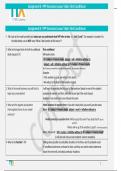
Assignment B - PPP Grammar Lesson Table: First Conditional 1. What is the target form of the first conditional (both clauses)? (F) First conditional Affirmative form: - If + Subject + Present simple, Subject + will + infinitive without to - Subject + will + infinitive without to If + Subject + Present simple (the if clause can come first of second in the sentence. The meaning is the same.) Example: - If the weather is good, we will go to the beach. - We will go to the beach if the weather is good. 2. What is the model sentence you will elicit to begin your presentation? I will begin by providing the first part of the sentence (based on one of the students' examples in warmer) and then, elicit the second part (the result clause). Example: If you study hard, you will pass the exam. 3. What are the negative and question (interrogative) forms of your model sentence? Model sentence in negative form: If you don’t study hard, you won’t pass the exam. Form: If + Subject + Present simple, Subject + won’t + infinitive without to Model sentence in question form: Will you pass the exam if you study hard? (yes/no question) Where will we go if the weather is good? (wh-word question) Form: (Wh-word) + Will + Subject + infinitive without to If + Subject + Present simple? (I will also take into account students’ warmer examples) 4. What is the function? (M) Talking about possible (or probable) situations in the future and its probable result. 1st conditional sentences are based on facts, and they are used to make statements about the real world, and about particular situations. 5. What do students need to know about the pronunciation, including sentence stress and intonation? (P) (Think only about how the model sentence would normally be said.) WEAK FORMS In affirmative form the subject and will are usually contracted: I’ll, you’ll, we’ll, they’ll, etc. In negative form (in the result clause) the verb will and not are usually contracted: won’t Reminder (Present Simple): In negative form (in the condition clause) the auxiliary verbs do/does and not are usually contracted: don’t, doesn’t. STRESS Affirmative: The stress is on the main verb of the sentence and any content words following the verb: If you study hard, you will pass the exam. If the weather is good, we will go to the beach. Note: Although “will” is a weak form, sometimes, when we are sure that the result is likely or not likely to happen, we can stress it. If the weather is good, I will go to the beach. Negative: Auxiliary will + not carries stress and any content words following the verb. If you don’t study hard, you won’t pass the exam. Question form: in Wh-word questions the stress is on the question word. Where will we go if the weather is good. INTONATION Question form: For yes/no questions the voice rises at the end: Will you pass the exam if you study hard? Affirmative and negative forms: voice normally falls at the end: If you study hard, you will pass the exam. 6. What is the context I will use to introduce the form? (M) Making prediction about the future. 7. How will I try to elicit the first conditional from the students? I will use a student example about the future events or situations, when they feel like given a certain condition something is going to happen (predicting the future). 8. How will I encourage students to analyse the form (S+V, etc.) themselves rather than just telling them what it is? (F) I will put example sentences generated from students on the board, and then analyse them as a class. 9. What concept questions will I ask to check students understand how the form is being used/what it means? - Are we talking about present or future? (Future) - Is it possible that this will happen in the future? (Yes) - Is the situation real or unreal? (Real) - Do we use it to express possible condition and its probable result or improbable result? (probable) - Can I say if it will rain? (No) - Which part of the sentence is the condition and which the consequence? 10. What timeline can I use to help students understand sentences such as 'If it's sunny tomorrow, we'll go to the beach.'? (See bibliography for source) 11. How will I get students to practise the pronunciation? Drilling and practice activities. 12. What controlled practice activities will the students do? 1. Students will choose the correct form of the verb. E.g. If he comes/will come I am/will be surprised. 2. Students will complete the sentences using the correct verb form. (if short of time leave out this activity) E.g. If the teacher (see) him cheating, he (have) big problems. 3. Students will play a game where they make first conditional sentences by matching pairs of picture cards together ('If' and 'result' picture cards). 13. What freer practice activities will the students do? Students will play the Conditional chain game. E.g. If I the weather is good, I’ll go to the beach. If I go to the beach, I’ll swim in the sea. Assignment B - Lesson Plan Form and Paragraph Lesson Type: Grammar Lesson Aims: To introduce the first conditional for the function of talking about events that are likely to happen. To contrast the use of future simple and present simple tenses. To provide controlled and freer practice of the first conditional in this function. Level of Class: A2 (Late elementary/ pre-intermediate) Teenagers (14-16 years old) Lesson Objectives: Students will understand form and function through presentation in a clear context generated in the warmer. Students will practise producing form accurately through controlled practice and writing (freer) activities. Students will practise producing the form communicatively through creating the chain story by working in groups. Number of Students: 12 Assumed Knowledge: Students would already know present simple, present continuous, past simple for common verbs, and would be familiar with will for future events. They would be familiar with grammatical terminology, such as the names of the tenses they already know, subject, auxiliary verb, negative form, etc. They have not been taught the first conditional before; however, a few students might have heard about the first conditional. Nationality/First Language: Spanish students - Spanish language Length of Lesson: 60 mins 1- Students may use will in the if-clause or in both parts of the sentence. Since the 1st conditional is used to talk about things that might happen in the future many students tend to use will in both clauses. The overall meaning is in the future, so naturally learners want to use “will” to talk about the future. 2- Solution: I will keep reminding the students that in the first conditional, we use the present simple in the if-clause and ‘will’ in the main clause. I will point out that Conditional sentences have two parts: the if–clause and the main clause (will- clause). To help my students remember this rule, as well as highlight that these two words must be placed in different parts of the sentence, I will ask them to remember the following rhyming phrase ‘if’ and ‘will’ never have a deal. I will also ask students to give their own examples to ensure they understood. 3- Forgetting about a comma. Anticipated Problems: Solution: To remind students that if “will” clause comes first in the sentence, we do not write a comma. We will practice it through the written activities in the semi-controlled practice. 4- Students might not understand how to connect two separate (but related) events and can feel ashamed or embarrassed for not understanding the teacher. Solution: I will keep it simple, by grading my language and providing simple examples, as well as making concept questions to check understanding and using controlled practice activities for further clarification. This might allow the students to understand the concept of the first conditional without feeling overwhelmed. 5- Forgetting about “– s” ending (3d singular), confusing do/does auxiliaries. Solution: I will revise the form of the Present Simple tense if this mistake is repeatedly made throughout the controlled practice stage and do some additional activities on this tense if it is needed. 6- The grammar lesson may be boring for the students, and it might be difficult to keep students’ attention during the whole lesson. Solution: I will use technology to catch students’ attention and make the lesson more entertaining and memorable. I will also prepare communicative and engaging activities to make students involved in the lesson. 7- Students don’t grasp the meaning and function of the target language. Solution: I will use the concept questions which are designed to check students understanding of meaning and structure before any intensive practice is carried out. I will also use the timeline to establish tenses and to show how particular events or situations are related to other events. 8- The contracted form of the verb will can be difficult to hear/perceive Solution: I will drill the pronunciation of this verb and encourage students to use it in their examples, so they are aware of this form and its pronunciation. Materials: 2 Handouts for each student: controlled practice worksheets Material a. Controlled practice (in case the internet connection fails), controlled practice worksheets (Materials b. Controlled practice). 3 sets of 'If' cards and 'Result' cards. (Material c. Game. Controlled practice) Pdf. document for controlled practice to project on the whiteboard for giving instructions. (Material c. Instructions. Controlled practice) Pdf. document for the warmer stage. Material. Warmer. worksheet to project on the whiteboard. Pdf. document for final stage, worksheet Material. Plenary (in case the internet connection fails). Copy of board plan for teacher to use during presentation Overhead projector Whiteboard Laptop Assignment B - Lesson Plan Template The presentation stage must be of your own design. Stage Aim Timing Inter- action Teacher Activity Student Activity Warmer Get students talking and introduce a context for target language Before students come into class, in the middle of the board write “Planning my holiday “, and a couple of model sentences below it (about my personal plans). (see the board plan) - I will travel to Italy by car this summer. - I will have a lot of fun with my friends. Students make up sentences about their holiday plans 6 m Whole class Ask students to make prediction about their future holiday, using the example sentences on the board (using will). Help students by asking: Where do you go on holiday? What do you do on holiday? Write down the students’ examples, but don't correct language when learners are volunteering. To avoid stronger students dominating, nominate who will answer questions (if it needed). Acknowledge each contribution with gestures or Comments. Students think of different ways to finish the sentences on the board 4 m (10 mins for stage) Whole class When the sentences have been written on the board encourage students to make any correction if necessary. Point out where mistakes are. Students correct the sentences on the board Presentation Introduce students to form, function and pronunciation. Check understanding. 4 m T-class Elicit target language: Introduce an appropriate context for the target language. Elicit target language from students; if they can't produce it, teacher gives it. Write the model sentence exemplifying the target language on the board. Elicit form from students and put it on board (including negative and interrogative forms, if appropriate). Get everyone to repeat in chorus a couple of times for pronunciation. Students make examples trying to produce the target language Students tell teacher what to write Students repeat in chorus 3 m T-class Check form Looking at examples we now have on the board, elicit the form (see teacher language). Ask students about how to form Present Simple and revise the use of auxiliaries do/does. Pay attention to the use of comma to separate the part of the condition from the part of the result Students analyse the form. Students copy the form and examples into their notebooks.
Document information
- Uploaded on
- July 11, 2024
- Number of pages
- 36
- Written in
- 2023/2024
- Type
- Exam (elaborations)
- Contains
- Questions & answers