

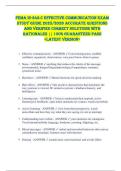
FEMA IS-242.c Effective Communication EXAM
STUDY GUIDE 2025/2026 ACCURATE QUESTIONS
AND VERIFIED CORRECT SOLUTIONS WITH
RATIONALES || 100% GUARANTEED PASS
<LATEST VERSION>
1. Effective communicators - ANSWER ✓ Conviction/passion, credible,
confident, organized, clear/concise, vary pace/ know when to pause.
2. Noise - ANSWER ✓ anything that reduces the clarity of the message.
environmental, hunger/fatigue(physiological-impairment, semantic,
syntactical noise.
3. Heuristics - ANSWER ✓ Mental shortcuts for quick decision-making.
4. Halo effect - ANSWER ✓ One positive characteristic that dominates the
way a person is viewed. IE: attractive person = kindness honesty, and
intelligence.
5. Listening tips - ANSWER ✓ listen to understand then respond, active
listener(give feedback), open mind, maintain eye contact, watch nonverbals
6. Active listening - ANSWER ✓ view from their perspective, watch
nonverbals and how they say what they are saying, try not to interrupt,
7. Understanding non verbals - ANSWER ✓ your emotions are contagious,
Vocal intonation/body language, bordeom: yawning, fidgeting, etc,
8. Mixed messages - ANSWER ✓ verbal and nonverbal behaviors that convey
contradictory meanings. listeners react with mistrust.
9. Pausing - ANSWER ✓ sounds more conversational, and avoids fillers
, 10.Do (when speaking) - ANSWER ✓ Clear concise language, speak loud
enough to be heard, vary the pace of your presentation, use the pause.
11.Donts (when speaking) - ANSWER ✓ montone voice, be afraid of pauses.
12.Asking questions - ANSWER ✓ Open ended: to stimulate thinking and
decision making/encourage discussion and direct: to confirm facts/stop a
discussion
13.Handling responses - ANSWER ✓ acknowledge all responses and try not to
judge, avoid answering your own question/ wait a few seconds then
rephrase, ask clarifying questions if needed.
14.Action #1 (comms w/ community) - ANSWER ✓ Message is clear and
understanable clear; use plain language and avoid acronyms, apply basic
communications skills when speaking, ID your audience and tailer the
speech to their level, use pictures to help digestion.
15.Action #2 (comms w/ community) - ANSWER ✓ Tailor message delivery to
specific needs.
16.Action #3 (comms w/ comuntiy) - ANSWER ✓ ID alternative avenues for
communication:
17.Action #4 (comms w/ comunity) - ANSWER ✓ Communicate with respect.
18.How can you determine if you are going to need to build a motivational
presentation? A. You ask yourself if you are relaying facts or shaping
opinions. B. You ask yourself if the information is important. C. You ask the
end user what type they prefer. D. You ask the end user to fill out a
questionnaire. - ANSWER ✓ YOU ASK YOURSELF IF YOU ARE
RELYING
19.Which of the following messages is best suited to an informational
presentation? A. Sell the board of supervisors on the importance of investing
in mitigation. B. Persuade homeowners to have a personal evacuation plan.
C. Convince residents to become involved in volunteer agencies. D. Lead
STUDY GUIDE 2025/2026 ACCURATE QUESTIONS
AND VERIFIED CORRECT SOLUTIONS WITH
RATIONALES || 100% GUARANTEED PASS
<LATEST VERSION>
1. Effective communicators - ANSWER ✓ Conviction/passion, credible,
confident, organized, clear/concise, vary pace/ know when to pause.
2. Noise - ANSWER ✓ anything that reduces the clarity of the message.
environmental, hunger/fatigue(physiological-impairment, semantic,
syntactical noise.
3. Heuristics - ANSWER ✓ Mental shortcuts for quick decision-making.
4. Halo effect - ANSWER ✓ One positive characteristic that dominates the
way a person is viewed. IE: attractive person = kindness honesty, and
intelligence.
5. Listening tips - ANSWER ✓ listen to understand then respond, active
listener(give feedback), open mind, maintain eye contact, watch nonverbals
6. Active listening - ANSWER ✓ view from their perspective, watch
nonverbals and how they say what they are saying, try not to interrupt,
7. Understanding non verbals - ANSWER ✓ your emotions are contagious,
Vocal intonation/body language, bordeom: yawning, fidgeting, etc,
8. Mixed messages - ANSWER ✓ verbal and nonverbal behaviors that convey
contradictory meanings. listeners react with mistrust.
9. Pausing - ANSWER ✓ sounds more conversational, and avoids fillers
, 10.Do (when speaking) - ANSWER ✓ Clear concise language, speak loud
enough to be heard, vary the pace of your presentation, use the pause.
11.Donts (when speaking) - ANSWER ✓ montone voice, be afraid of pauses.
12.Asking questions - ANSWER ✓ Open ended: to stimulate thinking and
decision making/encourage discussion and direct: to confirm facts/stop a
discussion
13.Handling responses - ANSWER ✓ acknowledge all responses and try not to
judge, avoid answering your own question/ wait a few seconds then
rephrase, ask clarifying questions if needed.
14.Action #1 (comms w/ community) - ANSWER ✓ Message is clear and
understanable clear; use plain language and avoid acronyms, apply basic
communications skills when speaking, ID your audience and tailer the
speech to their level, use pictures to help digestion.
15.Action #2 (comms w/ community) - ANSWER ✓ Tailor message delivery to
specific needs.
16.Action #3 (comms w/ comuntiy) - ANSWER ✓ ID alternative avenues for
communication:
17.Action #4 (comms w/ comunity) - ANSWER ✓ Communicate with respect.
18.How can you determine if you are going to need to build a motivational
presentation? A. You ask yourself if you are relaying facts or shaping
opinions. B. You ask yourself if the information is important. C. You ask the
end user what type they prefer. D. You ask the end user to fill out a
questionnaire. - ANSWER ✓ YOU ASK YOURSELF IF YOU ARE
RELYING
19.Which of the following messages is best suited to an informational
presentation? A. Sell the board of supervisors on the importance of investing
in mitigation. B. Persuade homeowners to have a personal evacuation plan.
C. Convince residents to become involved in volunteer agencies. D. Lead


