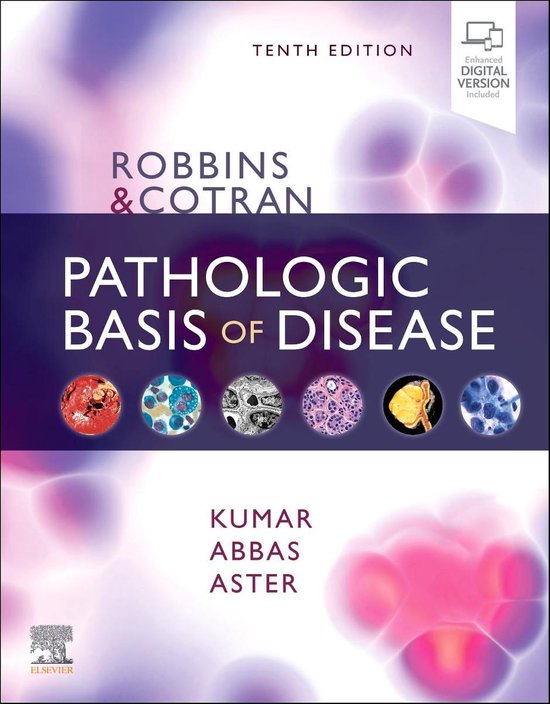
Robbins & Cotran 10th Ed. Pathology Test Bank | Chapter-
by-Chapter Questions & Verified Solutions
Robbins & Cotran Pathologic Basis of Disease
10th Edition
• Author(s)Vinay Kumar; Abul K. Abbas; Jon C. Aster
The Genome & Cellular Housekeeping
1. Chapter 1 Section: The Genome
A genetic counselor explains a disorder caused by a
mutation in a non-coding region of DNA that alters
chromatin structure, thereby affecting the expression of
several genes rather than the structure of a single protein.
This mechanism is best described as a disruption in:
A. Protein synthesis by ribosomes.
B. Genomic imprinting.
C. Epigenetic regulation of gene expression.
D. Post-translational modification.
Correct Answer: C
Rationale: Epigenetic modifications, such as DNA
methylation and histone modification, regulate gene
,expression without changing the DNA sequence itself.
They influence how chromatin is packaged, determining
which genes are accessible for transcription. Disruption of
this process can lead to aberrant expression of multiple
genes, contributing to disease . Mutations affecting
protein synthesis (A) would directly impact the amino acid
sequence. Genomic imprinting (B) is a specific subtype of
epigenetic regulation involving parent-of-origin specific
gene expression, which is too narrow for this scenario.
Post-translational modifications (D) affect proteins after
they are synthesized.
Teaching Point: Epigenetics controls gene accessibility,
linking chromatin structure to gene expression patterns.
2. Chapter 1 Section: Cellular Housekeeping
A patient with a neurodegenerative disease has an
accumulation of damaged proteins within neurons. A
defect in which primary intracellular degradation system is
most likely responsible?
A. The ubiquitin-proteasome system
B. Autophagic vacuoles (autophagosomes)
C. Lysosomal degradation
D. Mitochondrial permeability transition pores
Correct Answer: A
Rationale: The ubiquitin-proteasome system is primarily
responsible for the targeted degradation of short-lived
,and misfolded proteins. A defect in this system leads to
the intracellular accumulation of damaged proteins, a
hallmark of several neurodegenerative diseases like
Alzheimer's and Parkinson's . Autophagic vacuoles (B)
degrade long-lived proteins and entire organelles.
Lysosomal degradation (C) primarily breaks down
extracellular material brought in by endocytosis or
obsolete intracellular components via autophagy.
Mitochondrial pores (D) are involved in cell death, not
routine protein degradation.
Teaching Point: The ubiquitin-proteasome system is
crucial for clearing misfolded proteins to maintain cellular
health.
Cellular Metabolism & Mitochondrial Function
3. Chapter 1 Section: Cellular Metabolism and
Mitochondrial Function
A researcher is studying a toxin that inhibits the final
enzyme in the mitochondrial electron transport chain.
Which process is directly blocked?
A. Conversion of pyruvate to acetyl-CoA
B. Oxidation of NADH and FADH2
C. Reduction of oxygen to water
D. Phosphorylation of ADP to ATP
Correct Answer: C
Rationale: The final enzyme in the electron transport
, chain is cytochrome c oxidase (Complex IV). Its specific
function is to catalyze the reduction of molecular oxygen
(O₂) to water (H₂O) . While inhibition of this step halts the
entire chain, the direct action blocked is oxygen reduction.
The conversion of pyruvate to acetyl-CoA (A) occurs
before the citric acid cycle. The oxidation of NADH and
FADH2 (B) begins at Complex I and II, respectively. The
phosphorylation of ADP to ATP (D) is carried out by ATP
synthase (Complex V), which is driven by the proton
gradient generated by the electron transport chain but is a
separate complex.
Teaching Point: Cytochrome c oxidase is the terminal
complex of the electron transport chain, responsible for
water formation.
4. Chapter 1 Section: Cellular Metabolism and
Mitochondrial Function
In a patient with a mitochondrial myopathy, a biopsy
reveals defective mitochondria and a resulting over-
reliance on anaerobic glycolysis for ATP production. Which
serum finding is most likely elevated due to this
compensatory mechanism?
A. Free fatty acids
B. Lactic acid
C. Uric acid
D. Creatine kinase
by-Chapter Questions & Verified Solutions
Robbins & Cotran Pathologic Basis of Disease
10th Edition
• Author(s)Vinay Kumar; Abul K. Abbas; Jon C. Aster
The Genome & Cellular Housekeeping
1. Chapter 1 Section: The Genome
A genetic counselor explains a disorder caused by a
mutation in a non-coding region of DNA that alters
chromatin structure, thereby affecting the expression of
several genes rather than the structure of a single protein.
This mechanism is best described as a disruption in:
A. Protein synthesis by ribosomes.
B. Genomic imprinting.
C. Epigenetic regulation of gene expression.
D. Post-translational modification.
Correct Answer: C
Rationale: Epigenetic modifications, such as DNA
methylation and histone modification, regulate gene
,expression without changing the DNA sequence itself.
They influence how chromatin is packaged, determining
which genes are accessible for transcription. Disruption of
this process can lead to aberrant expression of multiple
genes, contributing to disease . Mutations affecting
protein synthesis (A) would directly impact the amino acid
sequence. Genomic imprinting (B) is a specific subtype of
epigenetic regulation involving parent-of-origin specific
gene expression, which is too narrow for this scenario.
Post-translational modifications (D) affect proteins after
they are synthesized.
Teaching Point: Epigenetics controls gene accessibility,
linking chromatin structure to gene expression patterns.
2. Chapter 1 Section: Cellular Housekeeping
A patient with a neurodegenerative disease has an
accumulation of damaged proteins within neurons. A
defect in which primary intracellular degradation system is
most likely responsible?
A. The ubiquitin-proteasome system
B. Autophagic vacuoles (autophagosomes)
C. Lysosomal degradation
D. Mitochondrial permeability transition pores
Correct Answer: A
Rationale: The ubiquitin-proteasome system is primarily
responsible for the targeted degradation of short-lived
,and misfolded proteins. A defect in this system leads to
the intracellular accumulation of damaged proteins, a
hallmark of several neurodegenerative diseases like
Alzheimer's and Parkinson's . Autophagic vacuoles (B)
degrade long-lived proteins and entire organelles.
Lysosomal degradation (C) primarily breaks down
extracellular material brought in by endocytosis or
obsolete intracellular components via autophagy.
Mitochondrial pores (D) are involved in cell death, not
routine protein degradation.
Teaching Point: The ubiquitin-proteasome system is
crucial for clearing misfolded proteins to maintain cellular
health.
Cellular Metabolism & Mitochondrial Function
3. Chapter 1 Section: Cellular Metabolism and
Mitochondrial Function
A researcher is studying a toxin that inhibits the final
enzyme in the mitochondrial electron transport chain.
Which process is directly blocked?
A. Conversion of pyruvate to acetyl-CoA
B. Oxidation of NADH and FADH2
C. Reduction of oxygen to water
D. Phosphorylation of ADP to ATP
Correct Answer: C
Rationale: The final enzyme in the electron transport
, chain is cytochrome c oxidase (Complex IV). Its specific
function is to catalyze the reduction of molecular oxygen
(O₂) to water (H₂O) . While inhibition of this step halts the
entire chain, the direct action blocked is oxygen reduction.
The conversion of pyruvate to acetyl-CoA (A) occurs
before the citric acid cycle. The oxidation of NADH and
FADH2 (B) begins at Complex I and II, respectively. The
phosphorylation of ADP to ATP (D) is carried out by ATP
synthase (Complex V), which is driven by the proton
gradient generated by the electron transport chain but is a
separate complex.
Teaching Point: Cytochrome c oxidase is the terminal
complex of the electron transport chain, responsible for
water formation.
4. Chapter 1 Section: Cellular Metabolism and
Mitochondrial Function
In a patient with a mitochondrial myopathy, a biopsy
reveals defective mitochondria and a resulting over-
reliance on anaerobic glycolysis for ATP production. Which
serum finding is most likely elevated due to this
compensatory mechanism?
A. Free fatty acids
B. Lactic acid
C. Uric acid
D. Creatine kinase