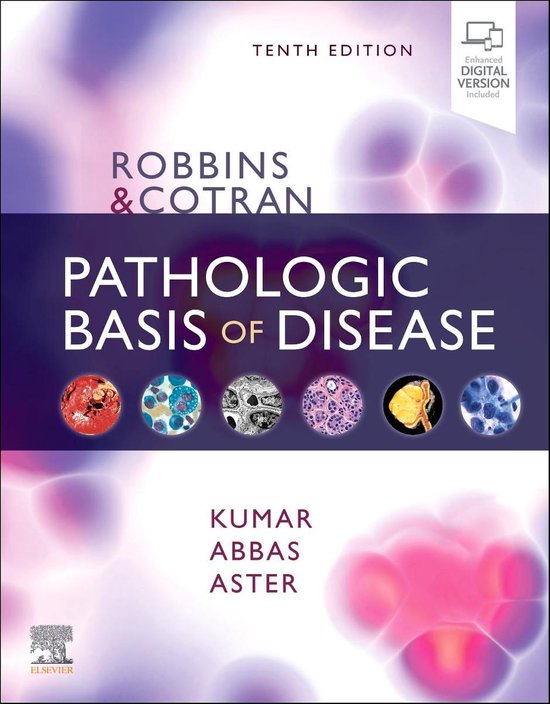
Robbins & Cotran 10th Ed. Pathology Test Bank | Chapter-
by-Chapter Questions & Verified Solutions
Robbins & Cotran Pathologic Basis of Disease
10th Edition
• Author(s)Vinay Kumar; Abul K. Abbas; Jon C. Aster
Multiple-Choice Questions: Robbins & Cotran Chapter 1
1. Chapter & Section: The Genome / Noncoding DNA
Question: A patient is diagnosed with a disease linked to a
malfunction in X-chromosome inactivation. A genetic analysis
would most likely reveal a mutation in a gene encoding which of
the following?
A. A microRNA (miRNA) that degrades messenger RNA in the
cytosol
B. A transcription factor that binds to promoter regions
C. A long noncoding RNA (lncRNA) such as XIST
D. A protein involved in DNA methylation of centromeres
Correct Answer: C
• Rationale for C: The lncRNA XIST is transcribed from
the X chromosome and plays an essential role in coating
, and inactivating one X chromosome in female cells. A
mutation disrupting this process would directly lead to
problems with X-chromosome inactivation .
• Rationale for A: While miRNAs are involved in post-
transcriptional gene silencing, they are not primarily
responsible for the large-scale chromatin silencing involved
in X-inactivation.
• Rationale for B: Transcription factors bind promoters to
regulate protein-coding genes but are not the primary
molecule responsible for initiating X-chromosome
inactivation.
• Rationale for D: DNA methylation is involved in
maintaining the inactivated state of the X chromosome, but
the initial triggering event is mediated by XIST.
Teaching Point: X-inactivation is initiated by the long
noncoding RNA XIST, which silences genes on one X
chromosome.
2. Chapter & Section: The Genome / Epigenetics
Question: A pathology lecture discusses how histone
modification can influence gene accessibility without changing
the DNA sequence. Which of the following modifications is
most directly associated with creating an open, transcriptionally
active chromatin structure?
A. Methylation of histone lysine residues
B. Deacetylation of histone lysine residues
C. Phosphorylation of histone serine residues
,D. Acetylation of histone lysine residues
Correct Answer: D
• Rationale for D: Acetylation of lysine residues by histone
acetyltransferases (HATs) neutralizes the positive charge of
histones, reducing their affinity for negatively charged
DNA. This leads to a more open chromatin structure
(euchromatin) that is accessible for transcription .
• Rationale for A: Methylation can lead to either activation
or repression, depending on the specific lysine residue that
is methylated.
• Rationale for B: Deacetylation, performed by HDACs,
leads to chromatin condensation and transcriptional
inactivation.
• Rationale for C: Phosphorylation can be involved in
activation or inactivation, but it is not the primary
modification for opening chromatin.
Teaching Point: Histone acetylation opens chromatin for
transcription, while deacetylation closes it.
3. Chapter & Section: Cellular Housekeeping
Question: A research scientist needs to normalize gene
expression data from a variety of human tissues. They select
genes involved in basic cellular functions that are expressed in
all cells. These are best known as:
A. Constitutive genes
B. Transcription factors
C. Housekeeping genes
, D. Ribosomal RNA genes
Correct Answer: C
• Rationale for C: Housekeeping genes are those required
for the maintenance of basic cellular function and are
expressed in all cells of an organism under normal and
patho-physiological conditions, making them ideal
reference points for gene expression studies .
• Rationale for A: While housekeeping genes are a type of
constitutive gene (always expressed), the term
"housekeeping" specifically denotes their essential role in
basic cellular maintenance.
• Rationale for B: Transcription factors are often regulated
and cell-type specific, not universally stable.
• Rationale for D: While ribosomal genes are often used, the
broader category of housekeeping genes includes these and
other essential pathways.
Teaching Point: Housekeeping genes are constitutively
expressed and essential for basic cell survival across all
tissue types.
4. Chapter & Section: Cellular Housekeeping
Question: Which of the following cellular components is
primarily responsible for the degradation of denatured or
ubiquitin-tagged cytosolic proteins?
A. Lysosomes
B. Peroxisomes
C. Proteasomes
by-Chapter Questions & Verified Solutions
Robbins & Cotran Pathologic Basis of Disease
10th Edition
• Author(s)Vinay Kumar; Abul K. Abbas; Jon C. Aster
Multiple-Choice Questions: Robbins & Cotran Chapter 1
1. Chapter & Section: The Genome / Noncoding DNA
Question: A patient is diagnosed with a disease linked to a
malfunction in X-chromosome inactivation. A genetic analysis
would most likely reveal a mutation in a gene encoding which of
the following?
A. A microRNA (miRNA) that degrades messenger RNA in the
cytosol
B. A transcription factor that binds to promoter regions
C. A long noncoding RNA (lncRNA) such as XIST
D. A protein involved in DNA methylation of centromeres
Correct Answer: C
• Rationale for C: The lncRNA XIST is transcribed from
the X chromosome and plays an essential role in coating
, and inactivating one X chromosome in female cells. A
mutation disrupting this process would directly lead to
problems with X-chromosome inactivation .
• Rationale for A: While miRNAs are involved in post-
transcriptional gene silencing, they are not primarily
responsible for the large-scale chromatin silencing involved
in X-inactivation.
• Rationale for B: Transcription factors bind promoters to
regulate protein-coding genes but are not the primary
molecule responsible for initiating X-chromosome
inactivation.
• Rationale for D: DNA methylation is involved in
maintaining the inactivated state of the X chromosome, but
the initial triggering event is mediated by XIST.
Teaching Point: X-inactivation is initiated by the long
noncoding RNA XIST, which silences genes on one X
chromosome.
2. Chapter & Section: The Genome / Epigenetics
Question: A pathology lecture discusses how histone
modification can influence gene accessibility without changing
the DNA sequence. Which of the following modifications is
most directly associated with creating an open, transcriptionally
active chromatin structure?
A. Methylation of histone lysine residues
B. Deacetylation of histone lysine residues
C. Phosphorylation of histone serine residues
,D. Acetylation of histone lysine residues
Correct Answer: D
• Rationale for D: Acetylation of lysine residues by histone
acetyltransferases (HATs) neutralizes the positive charge of
histones, reducing their affinity for negatively charged
DNA. This leads to a more open chromatin structure
(euchromatin) that is accessible for transcription .
• Rationale for A: Methylation can lead to either activation
or repression, depending on the specific lysine residue that
is methylated.
• Rationale for B: Deacetylation, performed by HDACs,
leads to chromatin condensation and transcriptional
inactivation.
• Rationale for C: Phosphorylation can be involved in
activation or inactivation, but it is not the primary
modification for opening chromatin.
Teaching Point: Histone acetylation opens chromatin for
transcription, while deacetylation closes it.
3. Chapter & Section: Cellular Housekeeping
Question: A research scientist needs to normalize gene
expression data from a variety of human tissues. They select
genes involved in basic cellular functions that are expressed in
all cells. These are best known as:
A. Constitutive genes
B. Transcription factors
C. Housekeeping genes
, D. Ribosomal RNA genes
Correct Answer: C
• Rationale for C: Housekeeping genes are those required
for the maintenance of basic cellular function and are
expressed in all cells of an organism under normal and
patho-physiological conditions, making them ideal
reference points for gene expression studies .
• Rationale for A: While housekeeping genes are a type of
constitutive gene (always expressed), the term
"housekeeping" specifically denotes their essential role in
basic cellular maintenance.
• Rationale for B: Transcription factors are often regulated
and cell-type specific, not universally stable.
• Rationale for D: While ribosomal genes are often used, the
broader category of housekeeping genes includes these and
other essential pathways.
Teaching Point: Housekeeping genes are constitutively
expressed and essential for basic cell survival across all
tissue types.
4. Chapter & Section: Cellular Housekeeping
Question: Which of the following cellular components is
primarily responsible for the degradation of denatured or
ubiquitin-tagged cytosolic proteins?
A. Lysosomes
B. Peroxisomes
C. Proteasomes