Robbins & Cotran 10th Ed. Pathology Test Bank | Chapter-
by-Chapter Questions & Verified Solutions
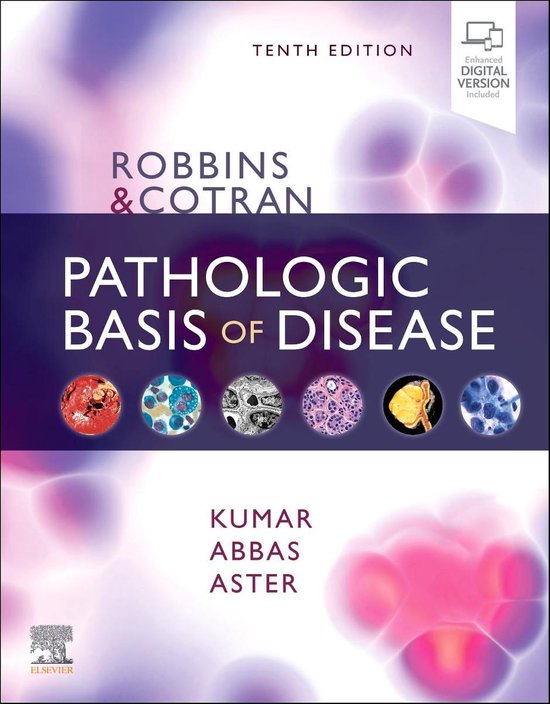
Robbins & Cotran Pathologic Basis of Disease
10th Edition
• Author(s)Vinay Kumar; Abul K. Abbas; Jon C. Aster
• Chapter 1 — The Genome
Stem: A 45-year-old man’s tumor shows loss of heterozygosity
at a locus encoding a DNA repair protein. Which cellular
consequence best explains how this genetic change promotes
cancer?
A. Increased telomerase activation permitting limitless
replication
B. Failure to repair DNA damage leading to mutation
accumulation
C. Upregulation of antioxidant enzymes preventing apoptosis
D. Enhanced mismatch repair that increases cell cycle arrest
Correct Answer: B
Rationale (correct): Loss of DNA repair function reduces
correction of DNA lesions, allowing accumulation of mutations
,in oncogenes and tumor suppressors that drive neoplastic
transformation. Robbins explains defective repair pathways as a
source of genomic instability.
Rationale (A): Telomerase activation provides replicative
immortality but is a downstream mechanism, not the direct
consequence of losing a DNA repair locus.
Rationale (C): Upregulating antioxidants would reduce
oxidative damage; loss of a repair protein does not cause
increased antioxidant activity.
Rationale (D): Enhanced mismatch repair would decrease
mutation rates; loss of heterozygosity indicates reduced, not
increased, repair.
Teaching Point: DNA repair defects cause genomic instability
and mutation accumulation.
Citation: Robbins & Cotran, 10th Ed., Chapter 1 — The
Genome / Genomic Instability
2. Chapter 1 — The Genome
Stem: A newborn is found to have a mitochondrial DNA
mutation affecting oxidative phosphorylation. Which feature of
mitochondrial genetics best explains variable disease severity
among maternal siblings?
A. Mendelian autosomal dominant inheritance
B. Heteroplasmy — variable proportion of mutant mtDNA in
cells
C. X-linked inheritance with male predominance
D. Mitochondrial genome recombination during fertilization
,Correct Answer: B
Rationale (correct): Heteroplasmy — differing ratios of mutant
to wild-type mtDNA among oocytes and tissues — produces
variable phenotypes even within a family. Robbins discusses
heteroplasmy as central to mitochondrial disease variability.
Rationale (A): Mitochondrial disorders are not Mendelian
autosomal dominant; they follow maternal inheritance.
Rationale (C): X-linked inheritance does not apply to
mitochondrial DNA mutations.
Rationale (D): Mitochondrial genomes are maternally inherited
and do not recombine during fertilization.
Teaching Point: Heteroplasmy causes variable expression of
mitochondrial diseases.
Citation: Robbins & Cotran, 10th Ed., Chapter 1 — The
Genome / Mitochondrial Genetics
3. Chapter 1 — Cellular Housekeeping (Autophagy &
Proteasome)
Stem: A patient on a proteasome inhibitor for multiple myeloma
develops peripheral neuropathy. Which mechanism explains
how proteasome inhibition leads to cellular dysfunction?
A. Increased lysosomal degradation of misfolded proteins
B. Accumulation of ubiquitinated proteins causing ER stress and
apoptosis
C. Enhanced autophagic flux that clears damaged organelles
D. Rapid degradation of chaperone proteins improving folding
, Correct Answer: B
Rationale (correct): Proteasome inhibition prevents
degradation of ubiquitinated proteins, causing their
accumulation, ER stress, and cell death; Robbins describes
ubiquitin–proteasome system importance for protein quality
control.
Rationale (A): Lysosomal degradation (autophagy) is a separate
pathway and is not directly increased by proteasome blockade.
Rationale (C): Proteasome inhibition often triggers autophagy
as compensation, but it does not enhance flux sufficiently to
prevent proteotoxic stress universally.
Rationale (D): Proteasome inhibition does not selectively
degrade chaperones to improve folding; it reduces degradation
overall.
Teaching Point: Proteasome dysfunction causes proteotoxic
stress via accumulation of ubiquitinated proteins.
Citation: Robbins & Cotran, 10th Ed., Chapter 1 — Cellular
Housekeeping / Ubiquitin–Proteasome System
4. Chapter 1 — Cellular Metabolism & Mitochondrial
Function
Stem: A hypotensive patient develops lactic acidosis after
prolonged tissue hypoperfusion. Which mitochondrial event
most directly causes increased lactate production?
A. Increased mitochondrial ATP synthesis via oxidative
phosphorylation
B. Inhibition of pyruvate dehydrogenase and reduced aerobic
by-Chapter Questions & Verified Solutions
Robbins & Cotran Pathologic Basis of Disease
10th Edition
• Author(s)Vinay Kumar; Abul K. Abbas; Jon C. Aster
• Chapter 1 — The Genome
Stem: A 45-year-old man’s tumor shows loss of heterozygosity
at a locus encoding a DNA repair protein. Which cellular
consequence best explains how this genetic change promotes
cancer?
A. Increased telomerase activation permitting limitless
replication
B. Failure to repair DNA damage leading to mutation
accumulation
C. Upregulation of antioxidant enzymes preventing apoptosis
D. Enhanced mismatch repair that increases cell cycle arrest
Correct Answer: B
Rationale (correct): Loss of DNA repair function reduces
correction of DNA lesions, allowing accumulation of mutations
,in oncogenes and tumor suppressors that drive neoplastic
transformation. Robbins explains defective repair pathways as a
source of genomic instability.
Rationale (A): Telomerase activation provides replicative
immortality but is a downstream mechanism, not the direct
consequence of losing a DNA repair locus.
Rationale (C): Upregulating antioxidants would reduce
oxidative damage; loss of a repair protein does not cause
increased antioxidant activity.
Rationale (D): Enhanced mismatch repair would decrease
mutation rates; loss of heterozygosity indicates reduced, not
increased, repair.
Teaching Point: DNA repair defects cause genomic instability
and mutation accumulation.
Citation: Robbins & Cotran, 10th Ed., Chapter 1 — The
Genome / Genomic Instability
2. Chapter 1 — The Genome
Stem: A newborn is found to have a mitochondrial DNA
mutation affecting oxidative phosphorylation. Which feature of
mitochondrial genetics best explains variable disease severity
among maternal siblings?
A. Mendelian autosomal dominant inheritance
B. Heteroplasmy — variable proportion of mutant mtDNA in
cells
C. X-linked inheritance with male predominance
D. Mitochondrial genome recombination during fertilization
,Correct Answer: B
Rationale (correct): Heteroplasmy — differing ratios of mutant
to wild-type mtDNA among oocytes and tissues — produces
variable phenotypes even within a family. Robbins discusses
heteroplasmy as central to mitochondrial disease variability.
Rationale (A): Mitochondrial disorders are not Mendelian
autosomal dominant; they follow maternal inheritance.
Rationale (C): X-linked inheritance does not apply to
mitochondrial DNA mutations.
Rationale (D): Mitochondrial genomes are maternally inherited
and do not recombine during fertilization.
Teaching Point: Heteroplasmy causes variable expression of
mitochondrial diseases.
Citation: Robbins & Cotran, 10th Ed., Chapter 1 — The
Genome / Mitochondrial Genetics
3. Chapter 1 — Cellular Housekeeping (Autophagy &
Proteasome)
Stem: A patient on a proteasome inhibitor for multiple myeloma
develops peripheral neuropathy. Which mechanism explains
how proteasome inhibition leads to cellular dysfunction?
A. Increased lysosomal degradation of misfolded proteins
B. Accumulation of ubiquitinated proteins causing ER stress and
apoptosis
C. Enhanced autophagic flux that clears damaged organelles
D. Rapid degradation of chaperone proteins improving folding
, Correct Answer: B
Rationale (correct): Proteasome inhibition prevents
degradation of ubiquitinated proteins, causing their
accumulation, ER stress, and cell death; Robbins describes
ubiquitin–proteasome system importance for protein quality
control.
Rationale (A): Lysosomal degradation (autophagy) is a separate
pathway and is not directly increased by proteasome blockade.
Rationale (C): Proteasome inhibition often triggers autophagy
as compensation, but it does not enhance flux sufficiently to
prevent proteotoxic stress universally.
Rationale (D): Proteasome inhibition does not selectively
degrade chaperones to improve folding; it reduces degradation
overall.
Teaching Point: Proteasome dysfunction causes proteotoxic
stress via accumulation of ubiquitinated proteins.
Citation: Robbins & Cotran, 10th Ed., Chapter 1 — Cellular
Housekeeping / Ubiquitin–Proteasome System
4. Chapter 1 — Cellular Metabolism & Mitochondrial
Function
Stem: A hypotensive patient develops lactic acidosis after
prolonged tissue hypoperfusion. Which mitochondrial event
most directly causes increased lactate production?
A. Increased mitochondrial ATP synthesis via oxidative
phosphorylation
B. Inhibition of pyruvate dehydrogenase and reduced aerobic