Robbins & Cotran 10th Ed. Pathology Test Bank | Chapter-
by-Chapter Questions & Verified Solutions
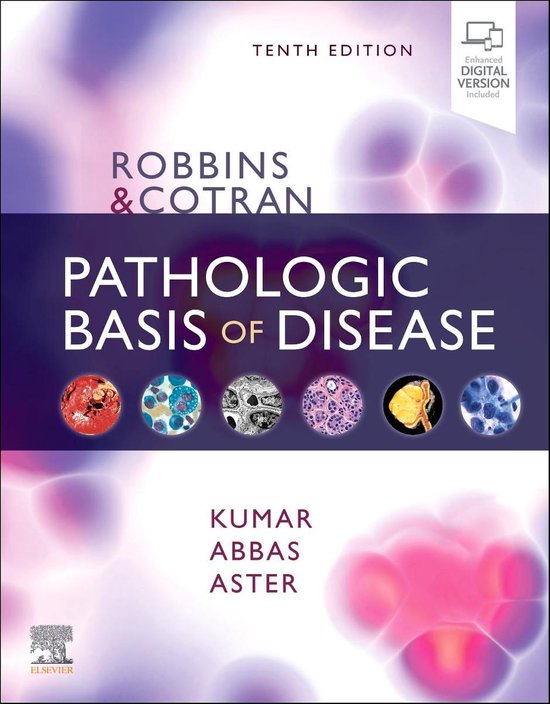
Robbins & Cotran Pathologic Basis of Disease
10th Edition
• Author(s)Vinay Kumar; Abul K. Abbas; Jon C. Aster
Chapter 1 — The Genome
Stem: A 45-year-old man’s tumor shows a high burden of
single-base substitutions concentrated at CpG dinucleotides.
Which molecular mechanism most likely produced these
changes?
A. Errors of base excision repair of oxidative damage
B. Spontaneous deamination of 5-methylcytosine
C. Defective nucleotide excision repair of bulky adducts
D. Mismatch repair failure during replication
Correct Answer: B
Rationales:
• B (Correct): Spontaneous deamination of 5-methylcytosine
converts it to thymine, producing C→T transitions at CpG
, sites — a common mutational signature described in
Robbins.
• A: Base excision repair fixes small oxidized bases (e.g., 8-
oxoguanine); it does not specifically account for CpG C→T
transitions.
• C: Nucleotide excision repair removes bulky helix-
distorting adducts (e.g., UV dimers, chemical adducts), not
spontaneous deamination products.
• D: Mismatch repair defects produce replication-associated
insertion/deletion loops and microsatellite instability
rather than CpG C→T predominance.
Teaching Point: 5-methylcytosine deamination causes frequent
C→T transitions at CpG dinucleotides.
Citation: Robbins & Cotran, 10th ed., Ch. 1 — The Genome
(mutations and DNA repair).
2 — The Genome
Stem: A neonate presents with failure to grow and recurrent
infections; genetic testing shows a nonsense mutation in a gene
for a DNA repair protein that normally functions in
nonhomologous end joining (NHEJ). Which cellular process is
most directly impaired?
A. Removal of thymine dimers caused by UV radiation
B. Repair of double-strand breaks in G1 phase
,C. Excision of single-base oxidative lesions
D. Correction of replication errors in microsatellites
Correct Answer: B
Rationales:
• B (Correct): NHEJ repairs DNA double-strand breaks
throughout the cell cycle and is especially important in G1;
Robbins details NHEJ’s role in DSB repair.
• A: UV thymine dimer removal is handled by nucleotide
excision repair, not NHEJ.
• C: Oxidative single-base lesions are repaired by base
excision repair.
• D: Microsatellite replication errors are corrected by
mismatch repair, not NHEJ.
Teaching Point: NHEJ is the primary pathway for repairing
double-strand breaks, especially in G1.
Citation: Robbins & Cotran, 10th ed., Ch. 1 — The Genome
(DNA repair pathways).
3 — Cellular Housekeeping
Stem: A patient’s biopsy shows accumulation of ubiquitin-
tagged misfolded proteins in hepatocytes. Which intracellular
system is most likely overwhelmed?
A. Lysosomal hydrolases and autophagy
B. Endoplasmic reticulum-associated degradation (ERAD) and
, proteasome
C. Mitochondrial mitophagy pathway
D. Clathrin-mediated endocytosis
Correct Answer: B
Rationales:
• B (Correct): The ubiquitin–proteasome system (ERAD)
targets misfolded proteins for proteasomal degradation;
Robbins explains ubiquitin tagging and proteasome
overload in protein-folding disorders.
• A: Autophagy/lysosomes handle larger structures and
organelles; ubiquitin-tagged soluble misfolded proteins are
primarily proteasomal substrates.
• C: Mitophagy selectively removes damaged mitochondria,
not generalized misfolded cytosolic proteins.
• D: Clathrin endocytosis mediates membrane trafficking,
unrelated to cytosolic misfolded protein degradation.
Teaching Point: Ubiquitin–proteasome (ERAD) removes
misfolded proteins; overload leads to intracellular aggregates.
Citation: Robbins & Cotran, 10th ed., Ch. 1 — Cellular
Housekeeping (ubiquitin–proteasome and autophagy).
4 — Cellular Metabolism and Mitochondrial Function
Stem: After a coronary occlusion, myocardial cells in the
ischemic zone show early ATP depletion and failure of ionic
by-Chapter Questions & Verified Solutions
Robbins & Cotran Pathologic Basis of Disease
10th Edition
• Author(s)Vinay Kumar; Abul K. Abbas; Jon C. Aster
Chapter 1 — The Genome
Stem: A 45-year-old man’s tumor shows a high burden of
single-base substitutions concentrated at CpG dinucleotides.
Which molecular mechanism most likely produced these
changes?
A. Errors of base excision repair of oxidative damage
B. Spontaneous deamination of 5-methylcytosine
C. Defective nucleotide excision repair of bulky adducts
D. Mismatch repair failure during replication
Correct Answer: B
Rationales:
• B (Correct): Spontaneous deamination of 5-methylcytosine
converts it to thymine, producing C→T transitions at CpG
, sites — a common mutational signature described in
Robbins.
• A: Base excision repair fixes small oxidized bases (e.g., 8-
oxoguanine); it does not specifically account for CpG C→T
transitions.
• C: Nucleotide excision repair removes bulky helix-
distorting adducts (e.g., UV dimers, chemical adducts), not
spontaneous deamination products.
• D: Mismatch repair defects produce replication-associated
insertion/deletion loops and microsatellite instability
rather than CpG C→T predominance.
Teaching Point: 5-methylcytosine deamination causes frequent
C→T transitions at CpG dinucleotides.
Citation: Robbins & Cotran, 10th ed., Ch. 1 — The Genome
(mutations and DNA repair).
2 — The Genome
Stem: A neonate presents with failure to grow and recurrent
infections; genetic testing shows a nonsense mutation in a gene
for a DNA repair protein that normally functions in
nonhomologous end joining (NHEJ). Which cellular process is
most directly impaired?
A. Removal of thymine dimers caused by UV radiation
B. Repair of double-strand breaks in G1 phase
,C. Excision of single-base oxidative lesions
D. Correction of replication errors in microsatellites
Correct Answer: B
Rationales:
• B (Correct): NHEJ repairs DNA double-strand breaks
throughout the cell cycle and is especially important in G1;
Robbins details NHEJ’s role in DSB repair.
• A: UV thymine dimer removal is handled by nucleotide
excision repair, not NHEJ.
• C: Oxidative single-base lesions are repaired by base
excision repair.
• D: Microsatellite replication errors are corrected by
mismatch repair, not NHEJ.
Teaching Point: NHEJ is the primary pathway for repairing
double-strand breaks, especially in G1.
Citation: Robbins & Cotran, 10th ed., Ch. 1 — The Genome
(DNA repair pathways).
3 — Cellular Housekeeping
Stem: A patient’s biopsy shows accumulation of ubiquitin-
tagged misfolded proteins in hepatocytes. Which intracellular
system is most likely overwhelmed?
A. Lysosomal hydrolases and autophagy
B. Endoplasmic reticulum-associated degradation (ERAD) and
, proteasome
C. Mitochondrial mitophagy pathway
D. Clathrin-mediated endocytosis
Correct Answer: B
Rationales:
• B (Correct): The ubiquitin–proteasome system (ERAD)
targets misfolded proteins for proteasomal degradation;
Robbins explains ubiquitin tagging and proteasome
overload in protein-folding disorders.
• A: Autophagy/lysosomes handle larger structures and
organelles; ubiquitin-tagged soluble misfolded proteins are
primarily proteasomal substrates.
• C: Mitophagy selectively removes damaged mitochondria,
not generalized misfolded cytosolic proteins.
• D: Clathrin endocytosis mediates membrane trafficking,
unrelated to cytosolic misfolded protein degradation.
Teaching Point: Ubiquitin–proteasome (ERAD) removes
misfolded proteins; overload leads to intracellular aggregates.
Citation: Robbins & Cotran, 10th ed., Ch. 1 — Cellular
Housekeeping (ubiquitin–proteasome and autophagy).
4 — Cellular Metabolism and Mitochondrial Function
Stem: After a coronary occlusion, myocardial cells in the
ischemic zone show early ATP depletion and failure of ionic