

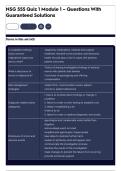
NSG 555 Quiz 1 Module 1 – Questions With
Guaranteed Solutions
Save
Terms in this set (45)
In outpatient settings •diagnosis, medications, medical and surgical
most common treatment. Handoff communication and electronic
malpractice claims are health records play a role in cases with adverse
due to what? patient outcomes.
•Policy of sharing investigative findings of adverse
What is disclosure of events with patients and families
errors in malpractice? •A process of apologizing and offering
compensation
Risk management •Patient first, communication issues, patient
strategies concerns, patient adherence
1. failure to id observation findings or change in
condition
Diagnosis related claims 2. failure to order correct testing to establish a dx
categories 3. delay in establishing a dx
4.failure to dx
5. failure to order or address diagnostic test results
appologize and compensate works better than
litigation.
acknowldege event occured
empathis and appologize if appropriate
Disclosure of errors and take steps to minimize further harm
adverse events explain to pt/family what will happen next
communicate the investigation process
disclose the results of the investigation
make changes to prevent the failure from recurring
provide emotional support
, polypharmacy
cognitive impairment
Common geriatric dehydrayion
syndromes falls
FTT
elder abuse
What is palliative care-
tenets, definition and
epidemiology
living will: describes in detail the patient's wishes
Advanced directives
Health care proxy/DPOA--alternate decision maker
pathophysiology: use of >5 medications or any not
medically indicated, includes rX and OTC. Drug
distribution/clearance affected by dec. lean body
mass and kidney/liver blood flow, inc in body fat.
alters pharmacokinetics.
Polypharmacy consequences--adverse drug rx-->GI, delirium,
dizziness, depression, derm effects
management--BEERS list, improved rx in elderly
tool, screening tool to alert doctors to the right
treatment, screening tool of older persons and
potentially inappropriate prescriptions
most common is AD
short term memory loss is primary symptom
+disorientation; exec. functioning problems, ADLs,
neuro (aphasia, apraxia, agnosia), sleep cycles
reversed, psychomotor changes, irritability or
Cognitive impairment
apathy in early stages
delirium: transient waxing/waning of LOC. acute
onset. more common in hospitalized patients, may
actually be unmasking an undiagnosed dementia
Guaranteed Solutions
Save
Terms in this set (45)
In outpatient settings •diagnosis, medications, medical and surgical
most common treatment. Handoff communication and electronic
malpractice claims are health records play a role in cases with adverse
due to what? patient outcomes.
•Policy of sharing investigative findings of adverse
What is disclosure of events with patients and families
errors in malpractice? •A process of apologizing and offering
compensation
Risk management •Patient first, communication issues, patient
strategies concerns, patient adherence
1. failure to id observation findings or change in
condition
Diagnosis related claims 2. failure to order correct testing to establish a dx
categories 3. delay in establishing a dx
4.failure to dx
5. failure to order or address diagnostic test results
appologize and compensate works better than
litigation.
acknowldege event occured
empathis and appologize if appropriate
Disclosure of errors and take steps to minimize further harm
adverse events explain to pt/family what will happen next
communicate the investigation process
disclose the results of the investigation
make changes to prevent the failure from recurring
provide emotional support
, polypharmacy
cognitive impairment
Common geriatric dehydrayion
syndromes falls
FTT
elder abuse
What is palliative care-
tenets, definition and
epidemiology
living will: describes in detail the patient's wishes
Advanced directives
Health care proxy/DPOA--alternate decision maker
pathophysiology: use of >5 medications or any not
medically indicated, includes rX and OTC. Drug
distribution/clearance affected by dec. lean body
mass and kidney/liver blood flow, inc in body fat.
alters pharmacokinetics.
Polypharmacy consequences--adverse drug rx-->GI, delirium,
dizziness, depression, derm effects
management--BEERS list, improved rx in elderly
tool, screening tool to alert doctors to the right
treatment, screening tool of older persons and
potentially inappropriate prescriptions
most common is AD
short term memory loss is primary symptom
+disorientation; exec. functioning problems, ADLs,
neuro (aphasia, apraxia, agnosia), sleep cycles
reversed, psychomotor changes, irritability or
Cognitive impairment
apathy in early stages
delirium: transient waxing/waning of LOC. acute
onset. more common in hospitalized patients, may
actually be unmasking an undiagnosed dementia


