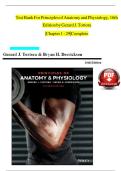
Test Bank For Principles of Anatomy and Physiology, 16th
k k k k k k k k
k Edition by Gerard J. Tortora
k k k k
|Chapter 1 - 29|Complete
k k k
,
,Chapter 01 An Introduction to the Human Body
k k k k k k k
Question type: Multiple Choice :
k k k k
1) Which describes the study of the functions of body structures?
k k k k k k k k k
a) Anatomy
b) Physiology
c) Endocrinology
d) Histology
e) Immunology
ANSWER: b k
k Difficulty:
Easy
k
Bloomcode: Knowledge k
Learning Objective 1: LO 1.1 Define anatomy and physiology, and name several branches of
k k k k k k k k k k k k k
these sciences.
k k
Section Reference 1: Sec 1.1 Anatomy and Physiology Defined
k k k k k k k k
k Question type: Multiple Choice
k k k
2) A group of cells that work together to perform a particular function is a(n)
k k k k k k k k k k k k k
a) tissue.
b) organ.
c) molecules.
d) compounds.
e) organism.
ANSWER: a k
Difficulty: Easy
k k
Bloomcode: Knowledge k
Learning Objective 1: LO1.2 Identify the locations and functions of each of the organ systems
k k k k k k k k k k k k k k
and major organs of the human body.
k k k k k k k
Section Reference 1: Sec 1.2 Levels of Structural Organization and Body Systems.
k k k k k k k k k k k
, Question type: Multiple Selection
k k k
3) What process occurs when amino acids build new proteins? Select all that apply.
k k k k k k k k k k k k
a) Metabolism
b) Anabolism
c) Catabolism
d) Responsiveness
e) Differentiation
Answer 1: ak k
Answer 2: bk k
Difficulty: Medium k
Bloomcode: Application
k k
Learning Objective 1: LO1.3 Define the important life processes of the human body.
k k k k k k k k k k k k
Section Reference 1: Sec 1.3 Characteristics of the Living Human Organism
k k k k k k k k k k k
Question type: Essay
k k
4) How are reproduction, differentiation and growth related?
k k k k k k
ANSWER:
Difficulty: Hard k
Bloomcode: Synthesis
k k
Learning Objective 1: LO1.3 Define the important life processes of the human body.
k k k k k k k k k k k k
Section Reference 1: Sec 1.3 Characteristics of the Living Human Organism
k k k k k k k k k k k
Solution: Reproduction occurs through the fertilization of an ovum by a sperm cell to form a
k k k k k k k k k k k k k k k
zygote, followed by repeated cell divisions and the differentiation of these cells. Growth is an
k k k k k k k k k k k k k k k
increase in body size that results from an increase in the size of existing cells, an increase in the
k k k k k k k k k k k k k k k k k k k
number of cells, or both.
k k k k k
Question type: Multiple Choice
k k k
5) The two organ systems that predominantly regulate and maintain homeostasis are the
k k k k k k k k k k k
a) cardiovascular and integumentary systems. k k k
b) nervous and endocrine systems.
k k k
c) cardiovascular and respiratory systems. k k k
k k k k k k k k
k Edition by Gerard J. Tortora
k k k k
|Chapter 1 - 29|Complete
k k k
,
,Chapter 01 An Introduction to the Human Body
k k k k k k k
Question type: Multiple Choice :
k k k k
1) Which describes the study of the functions of body structures?
k k k k k k k k k
a) Anatomy
b) Physiology
c) Endocrinology
d) Histology
e) Immunology
ANSWER: b k
k Difficulty:
Easy
k
Bloomcode: Knowledge k
Learning Objective 1: LO 1.1 Define anatomy and physiology, and name several branches of
k k k k k k k k k k k k k
these sciences.
k k
Section Reference 1: Sec 1.1 Anatomy and Physiology Defined
k k k k k k k k
k Question type: Multiple Choice
k k k
2) A group of cells that work together to perform a particular function is a(n)
k k k k k k k k k k k k k
a) tissue.
b) organ.
c) molecules.
d) compounds.
e) organism.
ANSWER: a k
Difficulty: Easy
k k
Bloomcode: Knowledge k
Learning Objective 1: LO1.2 Identify the locations and functions of each of the organ systems
k k k k k k k k k k k k k k
and major organs of the human body.
k k k k k k k
Section Reference 1: Sec 1.2 Levels of Structural Organization and Body Systems.
k k k k k k k k k k k
, Question type: Multiple Selection
k k k
3) What process occurs when amino acids build new proteins? Select all that apply.
k k k k k k k k k k k k
a) Metabolism
b) Anabolism
c) Catabolism
d) Responsiveness
e) Differentiation
Answer 1: ak k
Answer 2: bk k
Difficulty: Medium k
Bloomcode: Application
k k
Learning Objective 1: LO1.3 Define the important life processes of the human body.
k k k k k k k k k k k k
Section Reference 1: Sec 1.3 Characteristics of the Living Human Organism
k k k k k k k k k k k
Question type: Essay
k k
4) How are reproduction, differentiation and growth related?
k k k k k k
ANSWER:
Difficulty: Hard k
Bloomcode: Synthesis
k k
Learning Objective 1: LO1.3 Define the important life processes of the human body.
k k k k k k k k k k k k
Section Reference 1: Sec 1.3 Characteristics of the Living Human Organism
k k k k k k k k k k k
Solution: Reproduction occurs through the fertilization of an ovum by a sperm cell to form a
k k k k k k k k k k k k k k k
zygote, followed by repeated cell divisions and the differentiation of these cells. Growth is an
k k k k k k k k k k k k k k k
increase in body size that results from an increase in the size of existing cells, an increase in the
k k k k k k k k k k k k k k k k k k k
number of cells, or both.
k k k k k
Question type: Multiple Choice
k k k
5) The two organ systems that predominantly regulate and maintain homeostasis are the
k k k k k k k k k k k
a) cardiovascular and integumentary systems. k k k
b) nervous and endocrine systems.
k k k
c) cardiovascular and respiratory systems. k k k